ALMA Maps the Stacked Gas Layers of a Giant Planet-Forming Disk
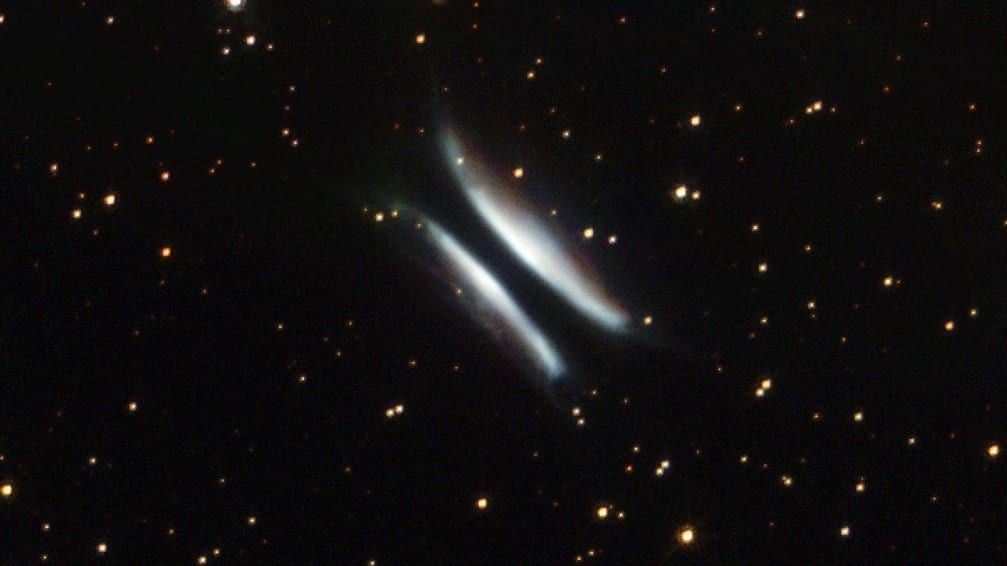
Astronomers using the Atacama Large Millimeter/submillimeter Array have found a narrow, one-sided arc of sulfur monoxide in the outer part of a huge planet-forming disk seen almost exactly edge-on from Earth, and read it as heat from a giant planet in its earliest stages.
Charles J. Law of the University of Minnesota, Ke Zhang of the University of Wisconsin-Madison, and colleagues published the observations Oct. 19, 2026, in The Astrophysical Journal. The disk, cataloged as IRAS 18059-3211 and nicknamed Gomez's Hamburger, or GoHam, sits so nearly side-on that the observations place carbon monoxide, two sulfur-bearing molecules and dust at their own heights within it, a separation far harder to achieve in a face-on disk.
"This makes it a benchmark system for testing detailed models of how planets form and evolve in disks," Law said in a release from the NSF National Radio Astronomy Observatory.
The authors report that the arc peaks near a dense clump found in the disk earlier, and that the heating it implies could come from an early-stage giant planet or from a fragment of the disk itself. On their reading, it could be one of the earliest observable stages of a giant planet forming far from its star. Sulfur-bearing molecules are predicted to build up where gas is shock-heated, where ice turns to vapor, or where gravity pulls a disk together.
The dust is brighter and more extended on the disk's north side than the south, and some of the carbon monoxide moves in ways the disk's rotation does not account for, which the authors read as a wind blowing gas off the disk. They derive a mass of about 2.2 times the Sun's for the central star, and a revised distance of about 139 parsecs places GoHam at the edge of the Scorpius-Centaurus association of young stars.
The observatory's release calls GoHam one of the largest known planet-forming disks, and puts the span of its carbon monoxide gas at nearly 1,000 times the Earth-Sun distance in radius. The release attributes that lopsidedness to a vortex or a large-scale disturbance that could trap solids where planets form.
Sources
- The Astrophysical JournalPeer-reviewed
- public.nrao.edu