Astronomers Catch a Young Planet Stirring the Gas That Is Still Feeding It

The scenario is decades old and mostly drawn from simulations. A young gas giant plows through the disk of gas and dust it was born in, and the gas closest to it stops moving the way the rest of the disk moves. Models produce that disturbance readily. Telescopes have had a much harder time.
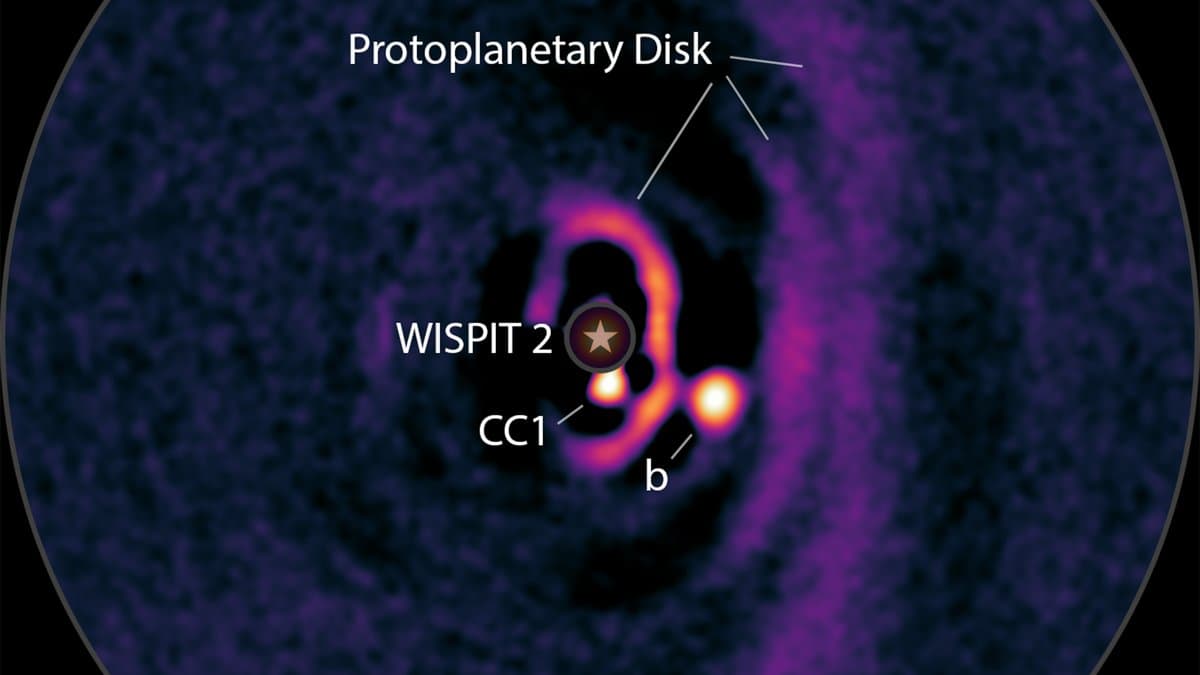
On Sept. 24, 2026, a team led by Myriam Benisty of the Max Planck Institute for Astronomy published a map of that gas around a planet astronomers can actually see. The planet is WISPIT 2b, a gas giant of about 4.9 times Jupiter's mass in a young system roughly 430 light-years from Earth. In carbon monoxide emission observed with ALMA, the array of radio dishes on the Chajnantor plateau in Chile, a pronounced thunderbolt-shaped feature sits at the planet's location. Writing in The Astrophysical Journal Letters, Benisty and colleagues identify it as a kinematic planetary signature, a kink in the disk's otherwise orderly rotation, and call it "the first system with a confirmed kinematic signature associated with a directly imaged planet."
Kinks like this are not new. Astronomers have been finding them since 2018, starting with the disk around HD 163296: features in velocity maps where the gas departs from the smooth pattern expected from a rotating disk. Such kinematic disturbances have been interpreted as signatures of embedded planets, but in those cases the planets themselves could not be directly identified at the location of the disturbance.
The obvious counter-case looks different. PDS 70, the first system where a forming planet was clearly imaged, has two directly imaged planets inside a large disk cavity. Their gravitational interaction with the disk is well established, but the system does not provide the same combination of a directly imaged planet and a localized kinematic signature at the planet's position.
WISPIT 2b is the first place both halves arrive together: a planet already imaged with ESO's Very Large Telescope and the Magellan Clay telescope, and gas around it moving in the way predicted by planet-disk interaction models. Planets caught in the act of forming are still scarce, and WISPIT 2 is only the second known system in which young planets have been directly imaged within a protoplanetary disk.
That first feature is not the only thing in the new maps. Benisty and colleagues report a clear gas gap carved by WISPIT 2b and an empty cavity inside the orbit of a second planet, WISPIT 2c, which was announced in March 2026. Between the two orbits sits a thin ring of dust and gas. The surface of the disk changes shape across planet b's orbit as well: flat inside the cavity, then steeply flared beyond it, producing clear breaks in the velocity channels.
"We clearly see both planets shaping their environment," Benisty said in the institute's announcement. "WISPIT 2c has carved a cavity, and WISPIT 2b a gap. Around WISPIT 2b, we find swirls of gas that had been predicted by simulations of disk-planet interactions, but never actually seen before. Now there is an image of them!"
Reaching that detail took ALMA in one of its most extended configurations, over three observing sessions between September 2025 and March 2026. The institute offers a scale: at WISPIT 2's distance, resolving something as wide as the gap between Earth and the Sun is about as hard as reading an ordinary book from five kilometers away.
By mirroring the velocity maps against each other around the system's own velocity, the team isolated extra emission around WISPIT 2b. That emission extends across the planet's Hill sphere, the region where its gravity dominates over the star's. A circumplanetary disk would be much smaller.
So the authors do not report that a circumplanetary disk has been imaged. They attribute the excess to a combination of processes: spiral wakes driven by the planet, gas heated locally by it and possibly a circumplanetary disk. They write that distinguishing those contributions will require higher spectral resolution. Which process dominates is the question this observation leaves open, and it is a sharper question than the field had before.
The practical payoff is a reference point. Disturbances of this kind have shown up in disks where no planet is visible, and researchers have debated whether they mark something hidden or can instead be produced by turbulence. "Hopefully, observations like this will teach astronomers to distinguish between disk features that indicate the presence of a protoplanet and features that don't," said Stefano Facchini of the University of Milan, who led the ALMA proposal behind the observations.
The paper is open access under a CC-BY license, so its images can be reused by anyone who credits them. A second group, led from Leiden, reports kinematic signatures in this same disk at the same two planet positions; that work is a preprint submitted to Nature Astronomy, and it reaches conclusions consistent with the new observations.
Two details about the system itself are worth keeping straight. WISPIT 2b's orbit is about 57 au, nearly twice Neptune's distance from the Sun. That figure comes from the institute's announcement rather than from the paper. And the thing at the middle of the disk is probably not a single star: a separate analysis by Cade Bürgy of the same institute and colleagues, published as a letter in Astronomy & Astrophysics, finds two stars in a very close orbit.
None of this is where a planetary system's architecture usually gets settled; that orbit is a long way out, and most known exoplanets sit far closer to their stars. The institute's own view is that the method matters more than the target: with ESO's Extremely Large Telescope and a sensitivity upgrade for ALMA, a picture like this one could in a bit over a decade show a gas giant at the distance of Jupiter or Saturn from the Sun.