The Habitable Zone's Boundaries Pass Their First Independent Test
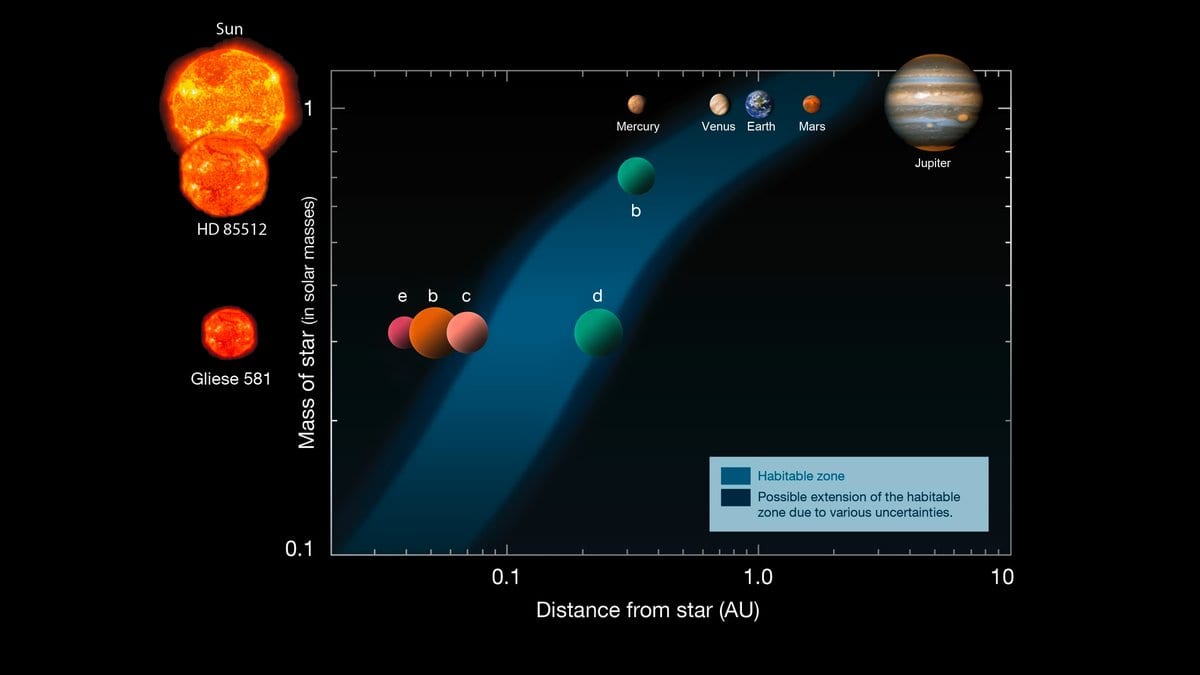
A newly built climate model has reproduced the habitable-zone limits that astronomers have used to pick exoplanet targets for three decades. Those limits had never been checked against an independently built model of comparable detail, according to a paper published Nov. 6, 2026, in The Astrophysical Journal.
The habitable zone is the range of orbits around a star where a planet could hold liquid water at its surface, and it narrows the list of worlds worth pointing a telescope at. The boundaries in standard use were calculated with a one-dimensional climate model called Clima. Jacob Haqq-Misra of Blue Marble Space, Ravi K. Kopparapu of NASA Goddard Space Flight Center and a co-author built a second model of the same kind, ExoColumn, and ran the calculation again with it. They also published updated boundary coefficients for other groups to use.
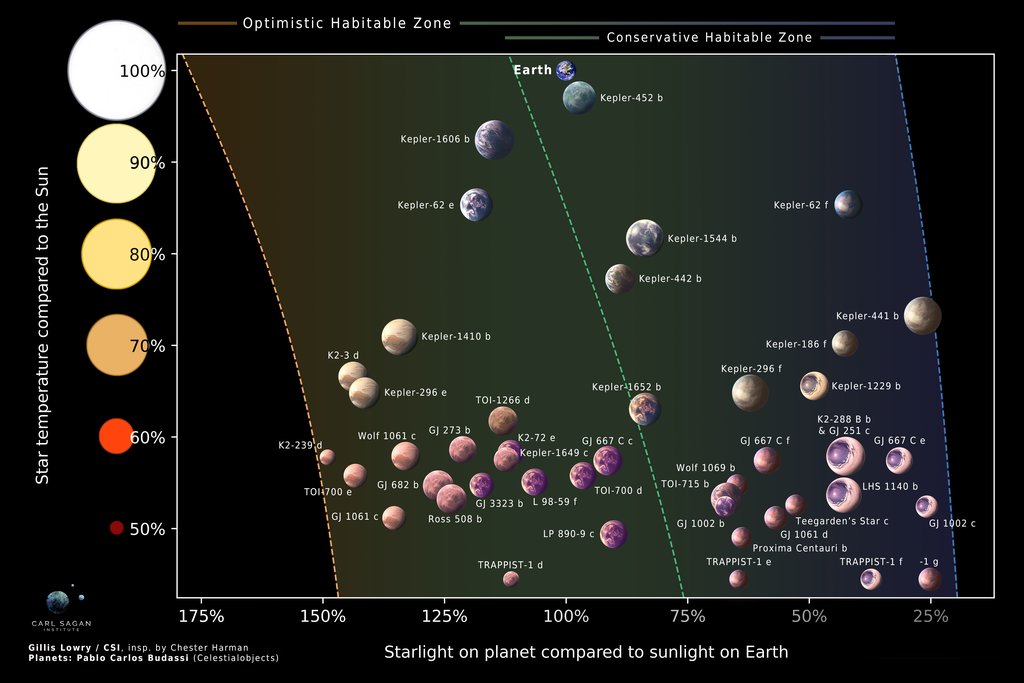
The paper puts the inner edge at 0.970 times the Earth-sun distance for a moist greenhouse, where a planet begins losing water to space, and at 0.966 for a runaway greenhouse. It puts the outer edge at 1.611 times that distance, at a carbon dioxide pressure of 8.7 bar. The authors report that the ExoColumn limits sit systematically closer to the host star than Clima's but agree with them to within a few percent in orbital distance. They describe that agreement as validating the robustness of the published Clima boundaries.
ExoColumn joins a newly written atmospheric physics package to ExoRT, the radiation code also used in the three-dimensional ExoCAM model. Calibrated to present-day conditions, it matches other models of its type to within a few kelvin through the lower atmosphere. The paper reports that in line-by-line tests the ExoRT and Clima radiation codes each reproduced the heat a planet sheds to space to within a few percent, with the difference coming from the spectral line databases each one uses.
The calculations were extended to 12 host stars spanning 2000 to 7200 K and to planets both lighter and heavier than Earth. NASA funded the work, and the paper is open access.
Sources
- The Astrophysical JournalPeer-reviewed