The Smallest Planet-Forming Disks Are Not as Smooth as They Looked
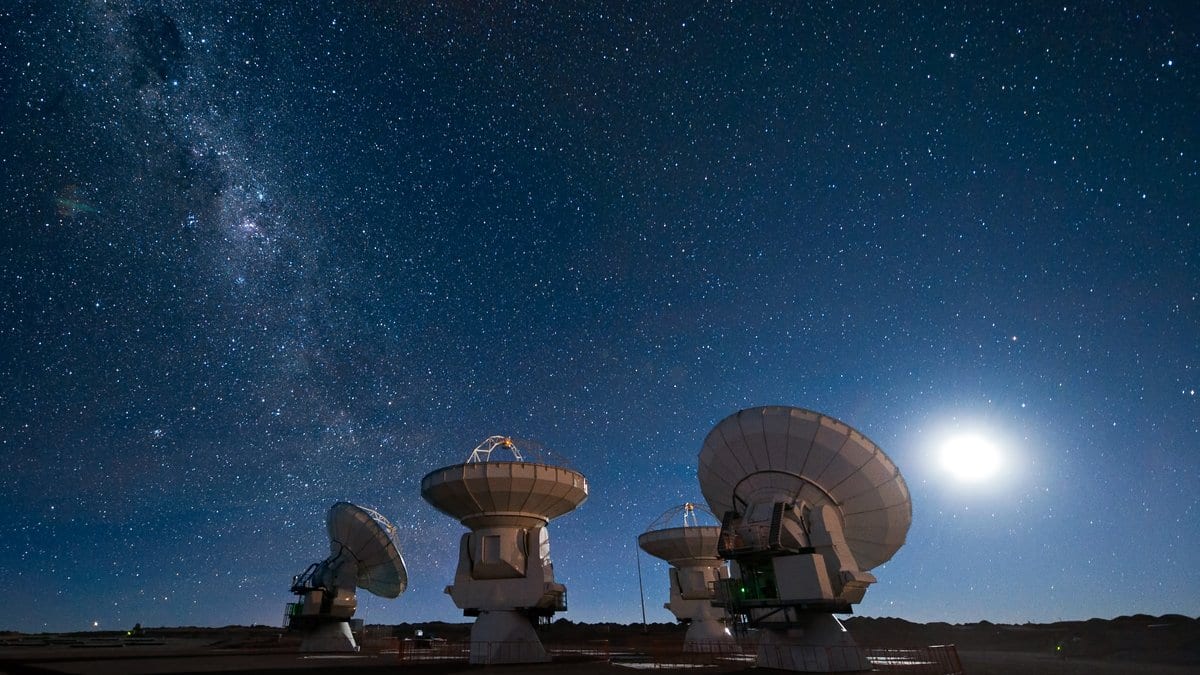
Astronomers using the Atacama Large Millimeter/submillimeter Array (ALMA) have found rings, gaps and cavities inside four of 11 very small planet-forming disks, a class of disk that had looked smooth and featureless. The features lie within 10 astronomical units of the young star, one astronomical unit being the average distance between Earth and the Sun, and the team reports indications of similar structure in three more.
Earlier high-resolution ALMA surveys could not resolve structure this close to a star. Many known exoplanets orbit that close, and the Joint ALMA Observatory says compact disks therefore offer a way to study planet formation in the regions where many planets end up.

Pietro Curone and Laura Pérez, both of the Universidad de Chile, and colleagues observed the disks in the Lupus star-forming region with ALMA's antennas at their widest spacing. That gave a resolution of about 0.02 arcseconds, roughly two astronomical units at Lupus's distance, which the observatory says is the sharpest ALMA can currently reach at this wavelength. In one system, Sz 112, the data resolved a central cavity extending to only 1.6 astronomical units from the star. The work appeared Oct. 14, 2026, in The Astrophysical Journal Letters.
Curone said in the observatory's release: "When we zoom in far enough, rings, gaps and cavities begin to appear, even in these tiny systems."
The team cautions that rings, gaps and cavities are not direct detections of planets. Several mechanisms can carve structure into a disk, and the release says the observations do not completely rule out explanations that involve no planet at all. The researchers worked out what kind of planet could produce each feature if a single planet were responsible, and for the structures within five astronomical units the masses required fall in the range of super-Earths and mini-Neptunes.
The observations also turned up faint rings well outside the bright central disks of two of the systems. The release says this raises the possibility that some disks classed as very small hold more material that has stayed hidden because it is faint.