Time Under Suspicion: From a Thought Experiment to an Optical Clock

In everyday life, time has an impeccable reputation. When asked, “What time is it?” we usually answer confidently after glancing at our watches. It’s harder to understand what “now” means when we’re talking about an event that took place long ago. In 1963, Robert Shankland published transcripts of conversations with Albert Einstein that took place between 1950 and 1954. According to Shankland, Einstein, recalling his work on the special theory of relativity, described the decisive turning point as follows: “until at last it came to me that time was suspect!” Our familiar intuition came under suspicion: the idea that there is a single common time for all events, and that any clock (no matter where it is or how it moves) must measure that time in the same way. But the very concept of simultaneity is relative.
In his book The Nature of the Physical World (1928), astrophysicist Arthur Eddington proposes a thought experiment. Imagine that you are in love with a woman on Neptune, and she shares your feelings. You want to comfort yourself with the thought that, at a predetermined moment, you are both thinking of each other. But in a relativistic universe, there is no single “now” that would encompass both Earth and Neptune at the same time. Observers who are moving at a constant speed and in a straight line relative to one another may give different answers to the question: what event on a distant planet is taking place at the same time as the selected moment on Earth? Eddington takes this difficulty to a touching, almost comical extreme: for the statement “she is thinking of me right now” to remain consistent with different inertial reference frames, the lady would have to think of you continuously for about eight hours. According to Eddington’s estimate, this is the duration of the interval between events on Neptune that different moving observers might consider simultaneous with a chosen event on Earth. To some, this sounds like a death knell for interplanetary romance; to others, it sounds like a university physics problem.
But this same peculiarity of time becomes much more evident in another classic example from the theory of relativity, the muon.
A muon is an unstable elementary particle, a heavier relative of the electron.
Most muons are produced in the upper layers of the atmosphere at altitudes of about 15 kilometers. The average intrinsic lifetime of a muon is about 2.2 microseconds. Without relativistic time dilation, even at a speed nearly equal to the speed of light, its average path before decay would be only about 660 meters, which is much less than 15 kilometers. However, ground-based instruments detect a large number of atmospheric muons.
The special theory of relativity explains this from two perspectives:
From the perspective of an observer on Earth, the average lifetime of a muon increases, while the distance from its point of origin to the Earth’s surface remains the same.
From the muon’s own perspective, its average lifetime remains the same, while the distance from its point of origin to the Earth’s surface decreases.
In the case of the muon, we measure the number of surviving particles, but in order to directly test how motion affects the passage of time, scientists decided to compare clocks on a flying aircraft with those on the ground.
The atomic clocks' flight around the Earth
In October 1971, physicist Joseph Hafele and astronomer Richard Keating took some unusual luggage on regular commercial flights: four cesium atomic clocks. The clocks traveled in the cabin alongside the researchers, and upon their return, their time was compared to the atomic time scale at the U.S. Naval Observatory. They circled the Earth twice: first eastward, then westward. During the eastbound flight, the clocks lagged behind the reference clocks on Earth by 59 10 nanoseconds; during the westbound flight, they ran ahead by 273 7 nanoseconds.
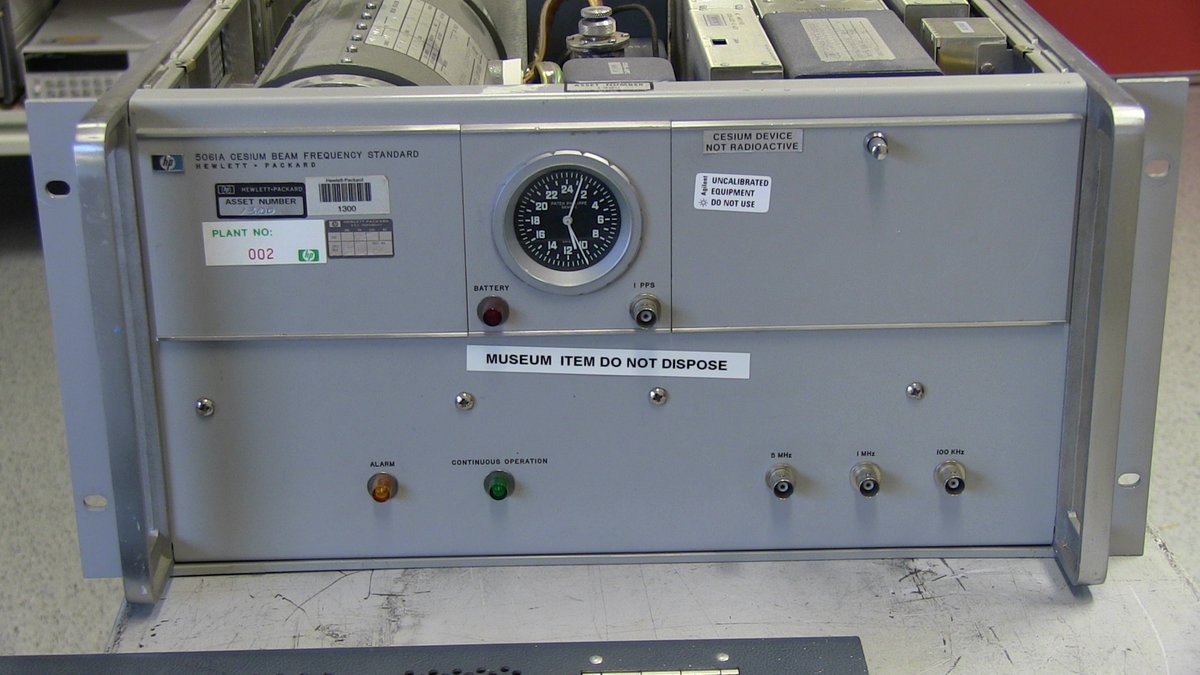
The theory of relativity made it possible to calculate this difference, but to do so, two factors had to be taken into account: motion and gravity. The Earth rotates from west to east, and clocks on the ground move along with it around the Earth’s axis. Flying eastward increased the speed of the onboard clocks around this axis, while flying westward decreased it. This explains the different signs of the results, which are related to motion. Flight altitude contributed another factor: at higher altitudes, where the gravitational potential is greater, clocks run slightly faster than at the Earth’s surface. The results were consistent with the predictions of Einstein’s theory of relativity within the margins of error.
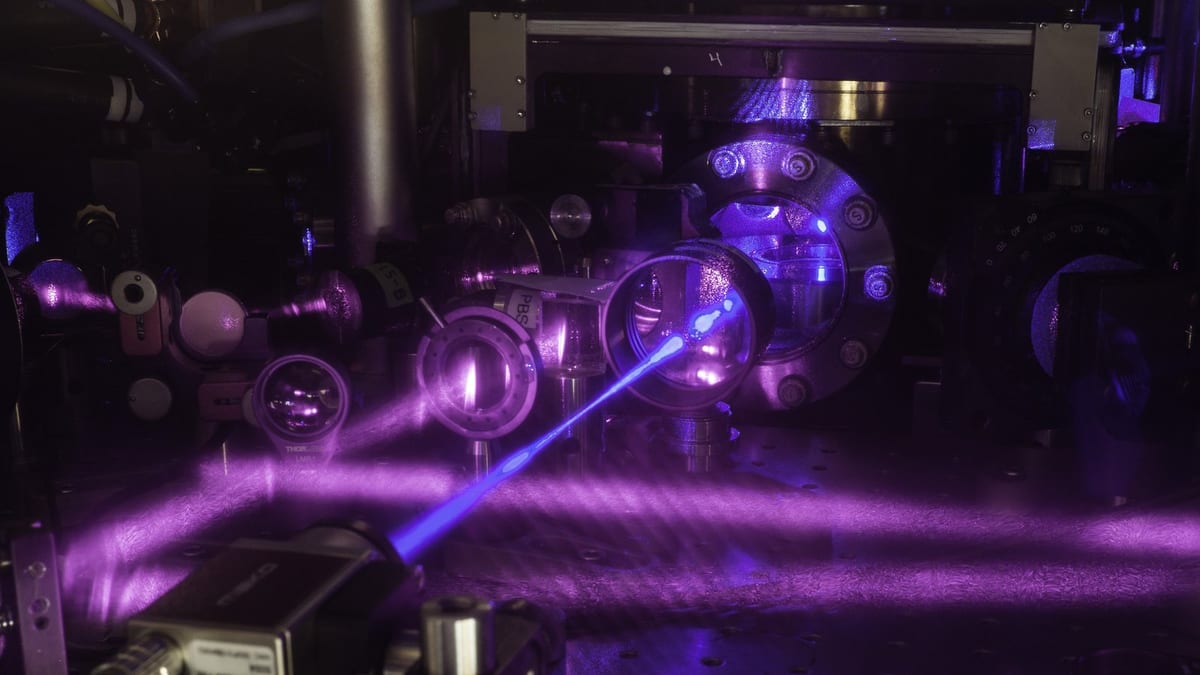
Over the course of several decades, the level of experimental precision has changed. Physics no longer merely asserts that the passage of time depends on motion and gravity: it measures these differences on scales beyond human perception, on the order of a millimeter. In a paper published in Nature in February 2022, researchers used an ultracold strontium optical clock and tracked how the frequency changed with height within a cloud of atoms about a millimeter in size. By comparing the frequencies of the atomic transition in different parts of the cloud, the physicists discovered a difference: the upper part of the cloud ticked slightly faster than the lower part (a relative frequency shift of (9.8 2.3) per millimeter of height).
Two optical standards and new possibilities for precise measurements
When the effect of gravity on the passage of time must be taken into account even on the millimeter scale, verifying the accuracy and reproducibility of optical standards becomes particularly important. Do independent experiments yield consistent results? On Sept. 23, 2026, Nature published an article titled “Lu+ optical frequency references with accuracy verified at the 19th digit” by Murray Barrett’s group at the Centre for Quantum Technologies at the National University of Singapore. The authors, Kyle Arnold and Michael Lee, along with their colleagues, compared the frequencies of two independent optical standards (to verify whether they were keeping time at the same rate).
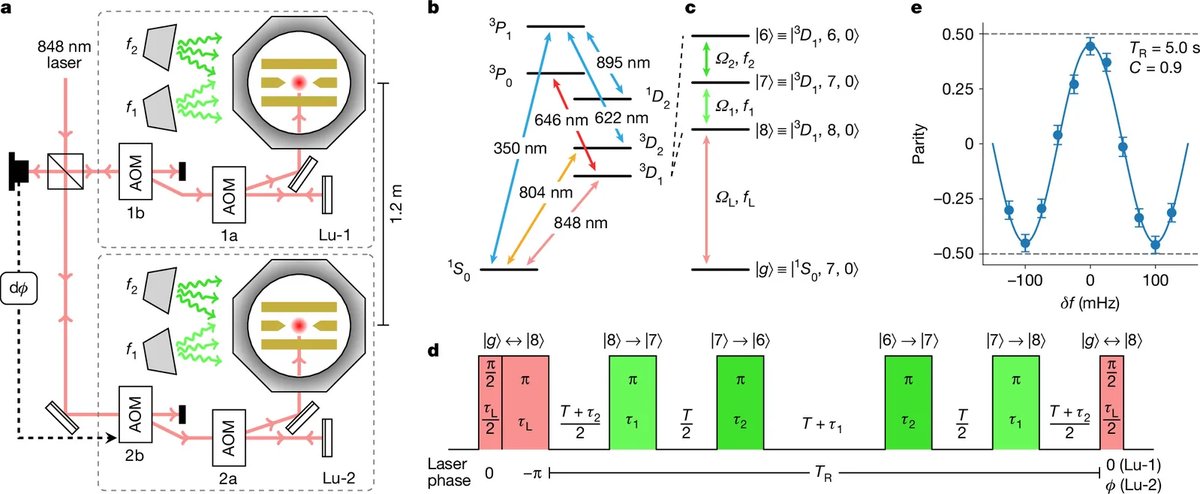
Each of the standards used a single trapped lutetium-176 ion. The vertical distance between the ions was about four millimeters; even such a small difference causes a slight shift in frequency: the lower the position, the slower time passes.
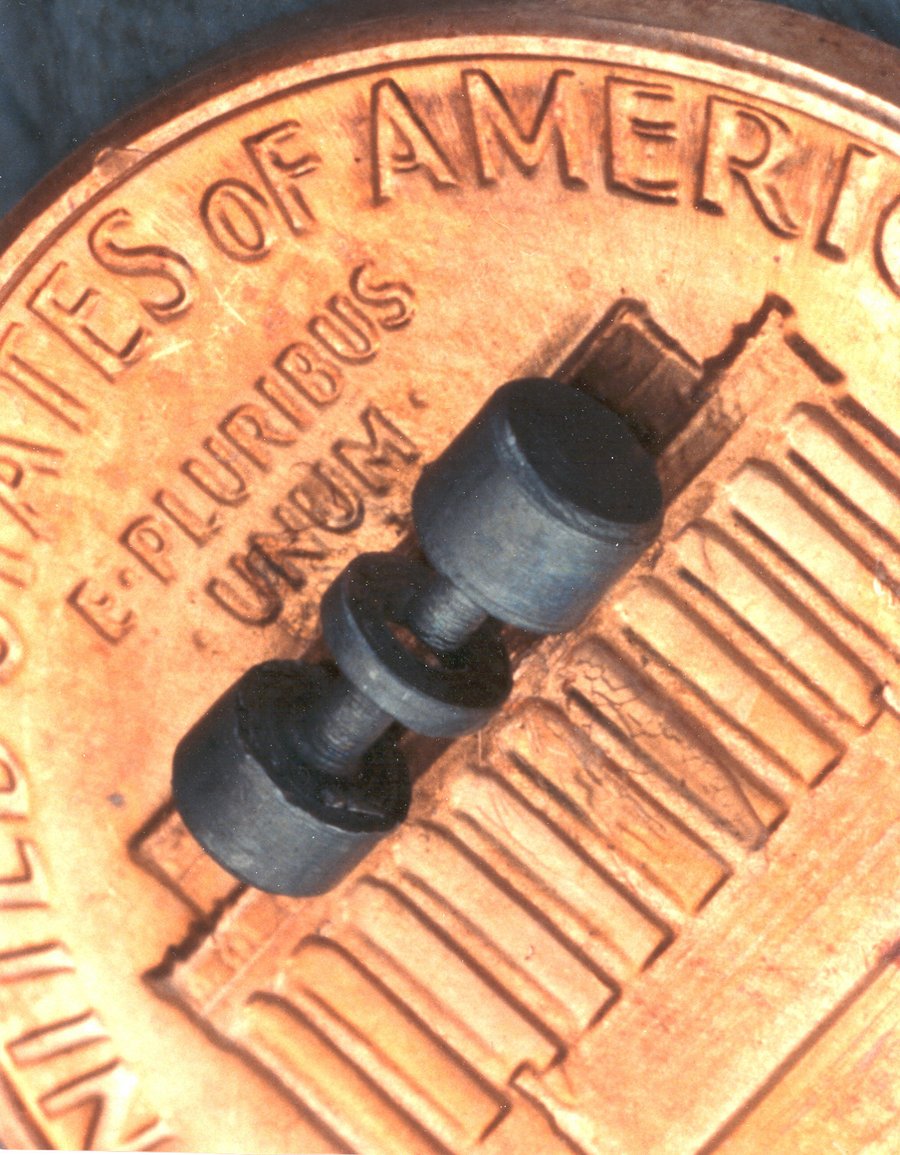
The scientists accounted for the effect of altitude so as not to mistake it for a discrepancy in the performance of the standards themselves. In total, the comparison lasted about 200 hours: after accounting for the altitude correction, the frequencies matched within the margin of error (5.7 of the measured frequency).
High accuracy turned out not to be the only advantage of the lutetium standards. The researchers achieved this accuracy at room temperature, without magnetic shielding. They used Paul traps to confine the ions and generated the necessary laser radiation using commercially available devices.
According to the authors, this relative simplicity of installation makes it possible to create a portable version of the device, and they view the lutetium-176 ion standards themselves as one of the possible foundations for a new definition of the SI second. In geodesy, their use will make it possible to determine the difference in gravitational potentials between distant points with a sensitivity equivalent to millimeter-scale elevation differences. The significance of such high precision extends beyond the realm of time measurement. The authors of the study view these standards as a promising tool for testing fundamental laws of physics and searching for signs of dark matter.
What is surprising about this whole story is not only that time can pass at different rates, but also just how accurately physicists have learned to measure this difference.
British physicist William Thomson, Lord Kelvin, once explained the importance of measurements to science as follows:
“I often say that when you can measure what you are speaking about, and express it in numbers, you know something about it…”
(Lecture “Electrical Units of Measurement,” 1883.)
Time once came under suspicion. And that suspicion changed the very nature of the question: what became important was not only what the clock showed, but also where, how and relative to what it was moving.
Sources
- Shankland, R. S. (1963). Conversations with Albert Einstein. American Journal of Physics 31, 47-57
- Eddington, A. S. (1928). The Nature of the Physical World. Cambridge University Press
- U.S. Naval Observatory (2021). USNO Marks 50 Year Anniversary of Breakthrough Relativity Experiment
- Hafele, J. C., Keating, R. E. (1972). Around-the-World Atomic Clocks: Observed Relativistic Time Gains. Science 177, 168-170
- Bothwell, T., Kennedy, C. J., Aeppli, A., Kedar, D., Robinson, J. M., Oelker, E., Staron, A., Ye, J. (2022). Resolving the gravitational redshift across a millimetre-scale atomic sample. Nature 602, 420-424
- Arnold, K. J., Lee, M. D. K., Zhao, Q., Qin, Q., Zhang, Z., Jayjong, N., Barrett, M. D. (2026). Lu+ optical frequency references with accuracy verified at the 19th digit. Nature 658, 60-64
- Thomson, W., Lord Kelvin (1889). Electrical Units of Measurement, a lecture of 1883. In Popular Lectures and Addresses, Vol. 1. Macmillan