Ancient DNA Narrows Down Where the Celtic Languages Came From
Hugh McColl of the University of Copenhagen, Guus Kroonen of Leiden University and colleagues have tested four competing accounts of where the Celtic languages came from against genome-wide data from 4,587 ancient individuals. They report that one of them fits the genetic record with the fewest extra assumptions: a westward movement of people out of eastern central Europe in the late Bronze Age.
Celtic survives today only on Europe's Atlantic fringe, in languages such as Irish, Welsh and Breton. In the Iron Age it was spoken across much of the continent, and how it reached that range is contested. The authors write that their results do not settle where Celtic began, but narrow which population movements could plausibly have carried it, so that any new model of its spread has to account for the patterns they report.
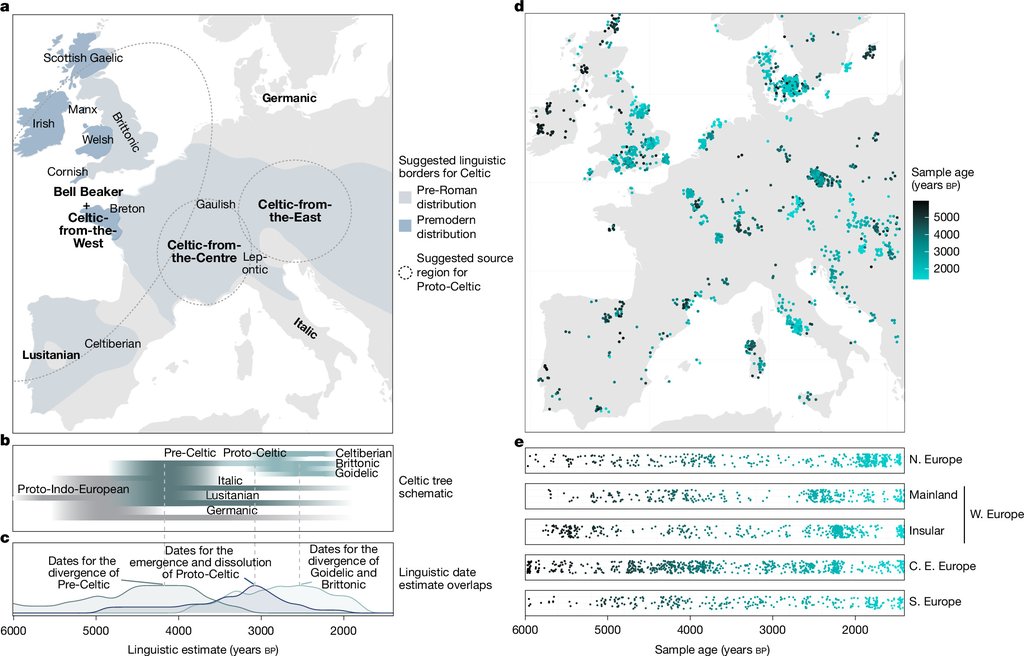
The paper, published in Nature on Nov. 4, 2026, sets out three population processes relevant to the spread. The first is the arrival of ancestry from the steppe north of the Black Sea with the Bell Beaker culture, after about 4400 bp, counted in calibrated years before 1950. The second is a movement from southwestern Europe into Britain between 3800 and 3200 bp. The third is a westward spread of ancestry tied to the Urnfield culture of eastern central Europe between 3200 and 2800 bp, reaching France, the British Isles, northeastern Iberia and Italy.
The team writes that all three movements have parallels in one or more of the models, but that only the last falls inside the window most linguistic estimates allow for Proto-Celtic, the undocumented language from which all Celtic languages descend. On that reading, the Celtic-from-the-East model is the most parsimonious of the four, the one requiring the fewest separate migrations, date mismatches and extra assumptions. They add that human history need not follow the most parsimonious path, and that language shifts need not track genetic change.
The genomes are a filtered set from the dataset assembled for an accompanying Nature study of the Germanic languages, and both papers are open access.
Sources
- NaturePeer-reviewed