A Patagonian Icefield Would Keep Shrinking Even Without More Warming

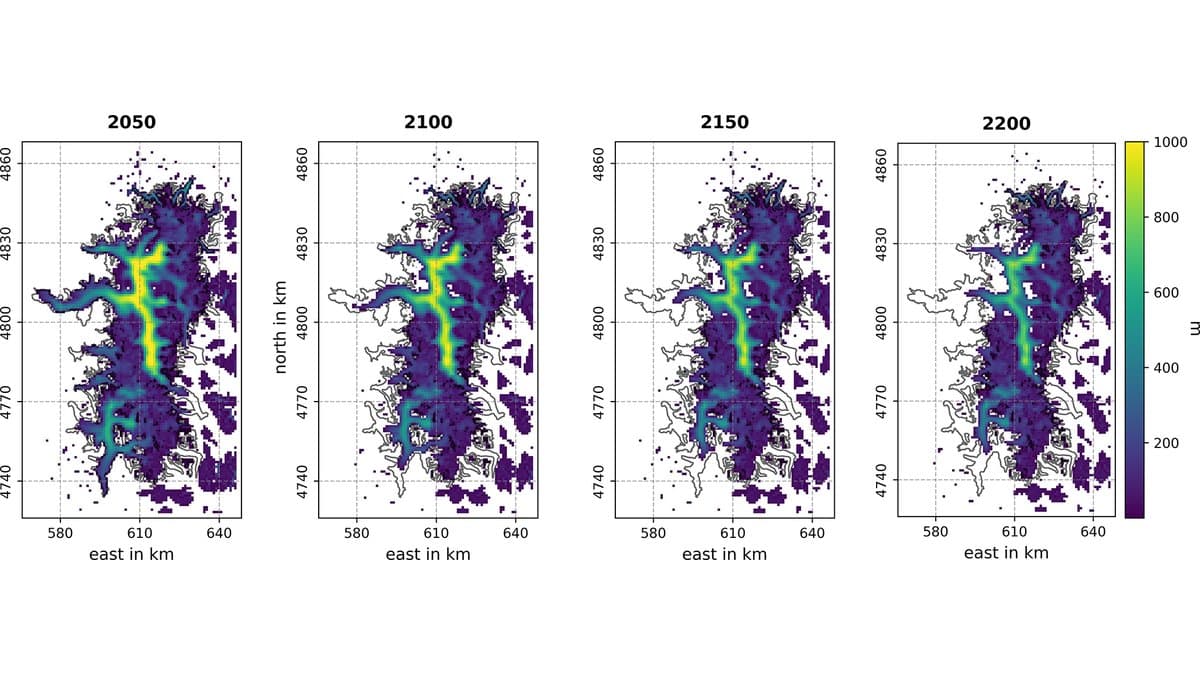
Ice does not keep up with the weather. When the air around a glacier warms, the glacier does not shrink that year, or that decade, to fit the climate it now lives in. It keeps flowing, thinning and drawing back its front for as long as it takes to reach a size the new climate can hold. For the Northern Patagonian Icefield, a high plateau of ice in southern Chile lying at about the latitude of the Alps, that adjustment takes roughly a century.
How much of the lag is still to run is the question behind a modeling study in The Cryosphere. Marius Schaefer of the Austral University of Chile in Valdivia and colleagues put the whole icefield into an ice-flow model called SICOPOLIS and ran it to the year 2200. They wanted to separate two things that measurements alone cannot: how much of the ice loss recorded in Patagonia today is a response to warming that has already happened, and how much is still to come.
The cleanest of their experiments has no further climate change in it at all. The team pinned the icefield's balance of snowfall against melt, its surface mass balance, to the average modeled for 1975–2011 and let the ice adjust. It never settles. Two centuries later the icefield has lost about 36% of the mass it had in 2000, the state the model was built to reproduce. That average is a late-20th-century one rather than a present-day one, so the run describes an icefield with no further warming rather than one sealed inside today's weather.
Melting does not stay fixed along with the climate. As the ice surface sinks to lower and warmer elevations, the model melts it faster, which is part of why the loss keeps going.
From its own results and from a standard textbook formula, the team puts the icefield's response time at "approximately 100 years." Mass changes measured today may be responding to climate shifts spread over nearly a century, so a retreat rate measured over the past two decades is not a clean readout of the past two decades' climate. Other work on the Southern Andes has found a similar response time for the region as a whole.
Add warming and the two futures pull far apart. Under a low-emissions pathway, the model leaves between 25% and 62% of the year-2000 ice standing in 2200. Under a high-emissions one, it leaves between 6% and 19%, and the icefield breaks into two separate bodies. The long glacier tongues that reach down the valleys today are gone in both.
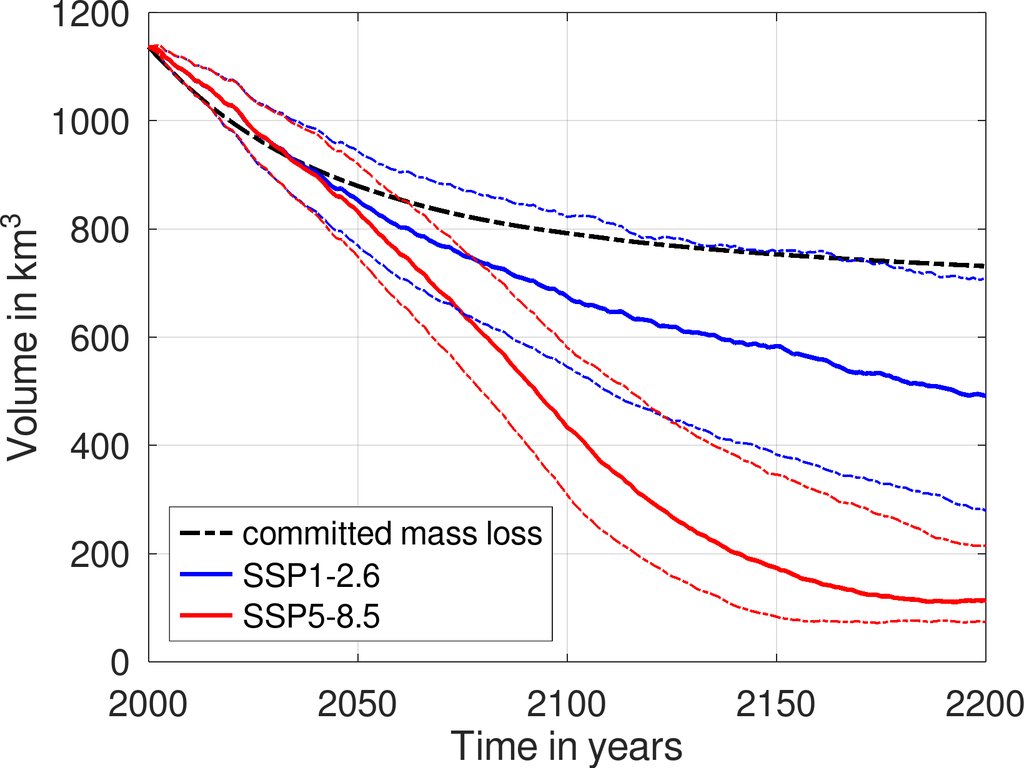
Those numbers carry a detail that is easy to miss. After 2100 there is no emissions scenario to follow, because none is defined that far ahead. The researchers held the climate flat for the final century by picking one year at random from the 2090s and repeating its conditions. Everything the model does after that point, in every run, is ice catching up with a climate that has stopped changing.
The width of those bands is not a measure of how well the ice is understood. It comes from the climate side: 33 climate models disagree about how much Patagonia will warm, and the bands are the spread of that disagreement pushed through the ice model. The ice model's own uncertainty is not in them. Nine combinations of two settings that cannot be measured directly (how readily the ice deforms and how fast it slides on its bed) were tested against observations, and one was carried into every projection. The real uncertainty is wider than the published range, not narrower.
This is a projection from a single model rather than a measurement, and the study names the places where it simplifies. Ice breaking off into the sea happens at two cells of the model grid, at the front of San Rafael Glacier, the only part of the icefield that reaches the ocean, and the tidewater glacier closest to the equator. The rate there is set to match what has been measured rather than worked out from physics, and the team notes they did not test more elaborate calving laws. Ice breaking into the lakes below the other glaciers is left out altogether.
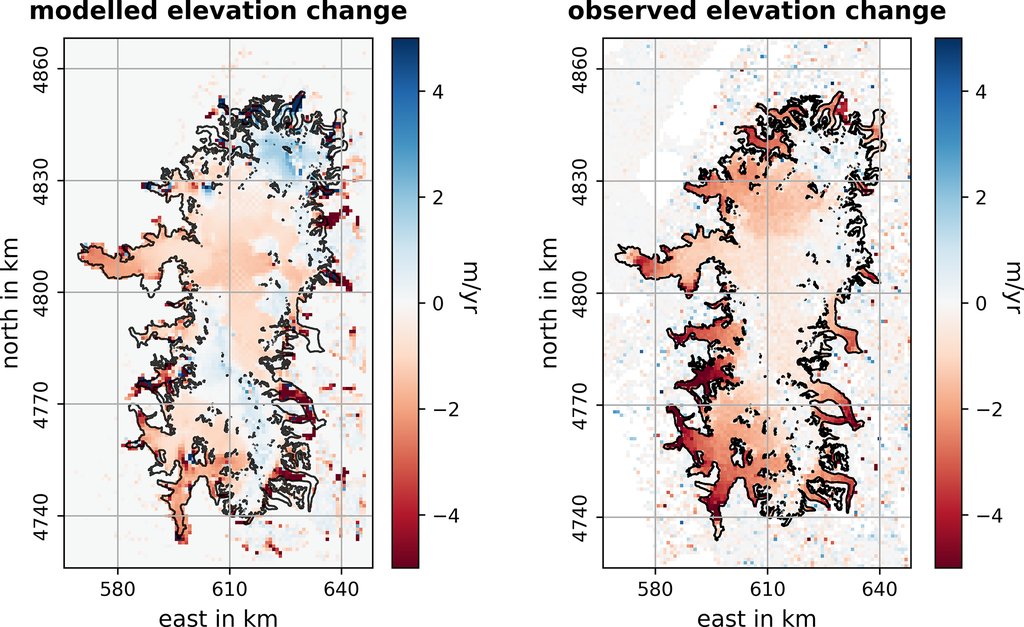
Their own main caveat is the sharpest sentence in the paper: "The validation period is shorter than the expected response time." The model was tuned against about two decades of satellite observations and then asked to run for two centuries. What would help are simulations that begin much earlier, built on longer records of where the ice once stood, back to the Little Ice Age.
According to the researchers, the projections fall between those of similar models rather than outside them. The only earlier projection of the whole icefield used a global glacier model with no calving in it, and lost ice faster. A widely used comparison of global glacier models loses it more slowly, though that comparison covers the whole Southern Andes, which the much larger icefield to the south dominates.
The model itself is free and open source, and the simulation results are publicly available, so another group can take the same icefield and try it a different way. More than the far-off total, what matters in the meantime is the century of lag behind it: the ice being surveyed in Patagonia now is still answering warming that arrived decades ago.
Sources
- Peer-reviewedThe Cryosphere