Four Models, One Antarctic Future, and Four Different Snow Budgets by 2100

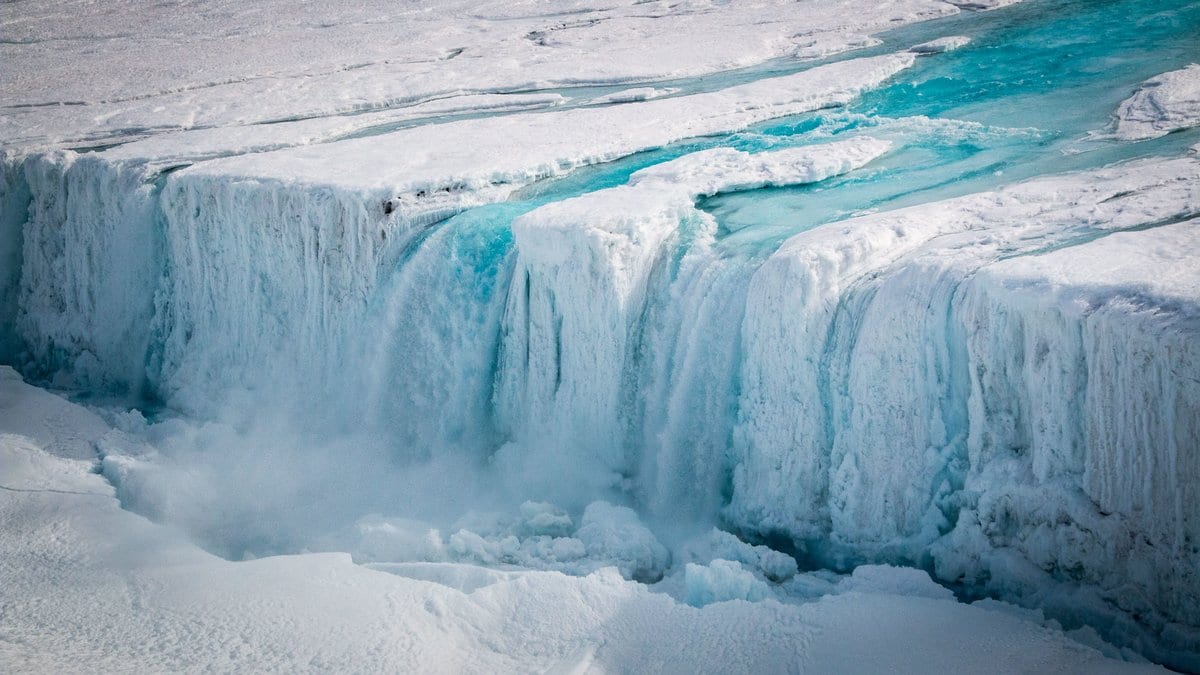
Three polar climate models have spent years being measured against the Antarctica we can observe, and all three pass. Give them the same century and they stop agreeing. That is what Benjamin Heurgue, Charles Amory and colleagues report in The Cryosphere, in a paper published Nov. 9, 2026: one emissions pathway, one global model feeding all three at their edges, and four accounts of the floating ice shelves that cannot all be right.
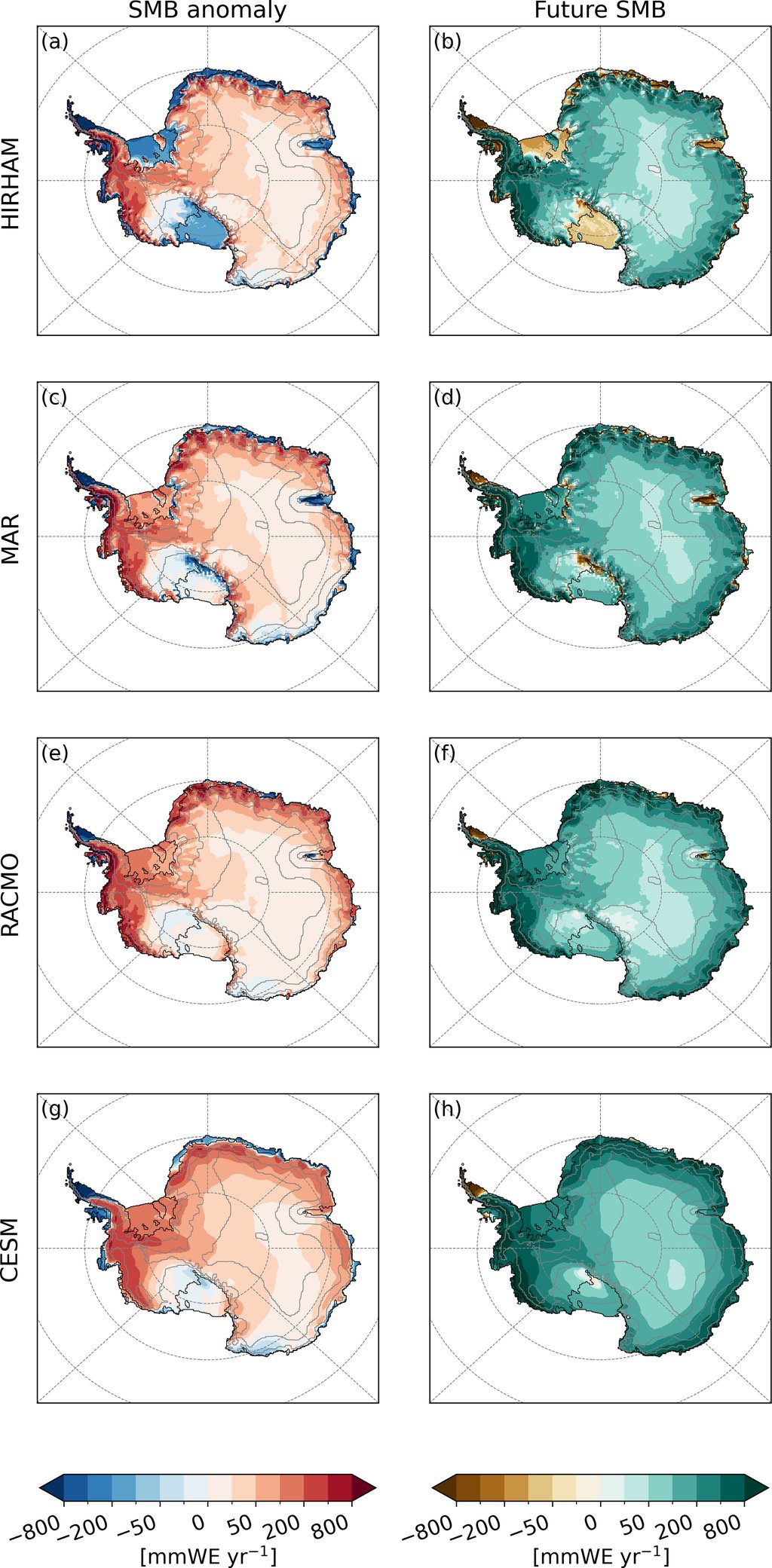
The design is the new part. Each of the three regional models, MAR, RACMO and HIRHAM, had been run to the end of the century before, but each on different inputs, so nobody could separate what a regional model contributes from what its driving model handed it. These runs close that gap. All three work at fine resolution over Antarctica inside boundaries set by a single global model, CESM2, under the high-emission SSP5-8.5 scenario. Over the present day the four look alike: their Antarctic surface mass balance, everything the snow surface gains minus what it loses, differs between them by only 2–7%.
Then the century turns. Against a 1995–2014 baseline, the four part company over the floating ice shelves. HIRHAM has the surface there losing 529 billion metric tons a year by the end of the century. MAR gives 209 billion, CESM2 118 billion, and RACMO comes out the other way, with a small gain of 25 billion tons a year that the paper's own test places outside the ordinary year-to-year scatter. The spread is the result, and so is its timing: HIRHAM's ice-shelf budget turns negative two decades before MAR's.
Three models, and one their own authors doubt
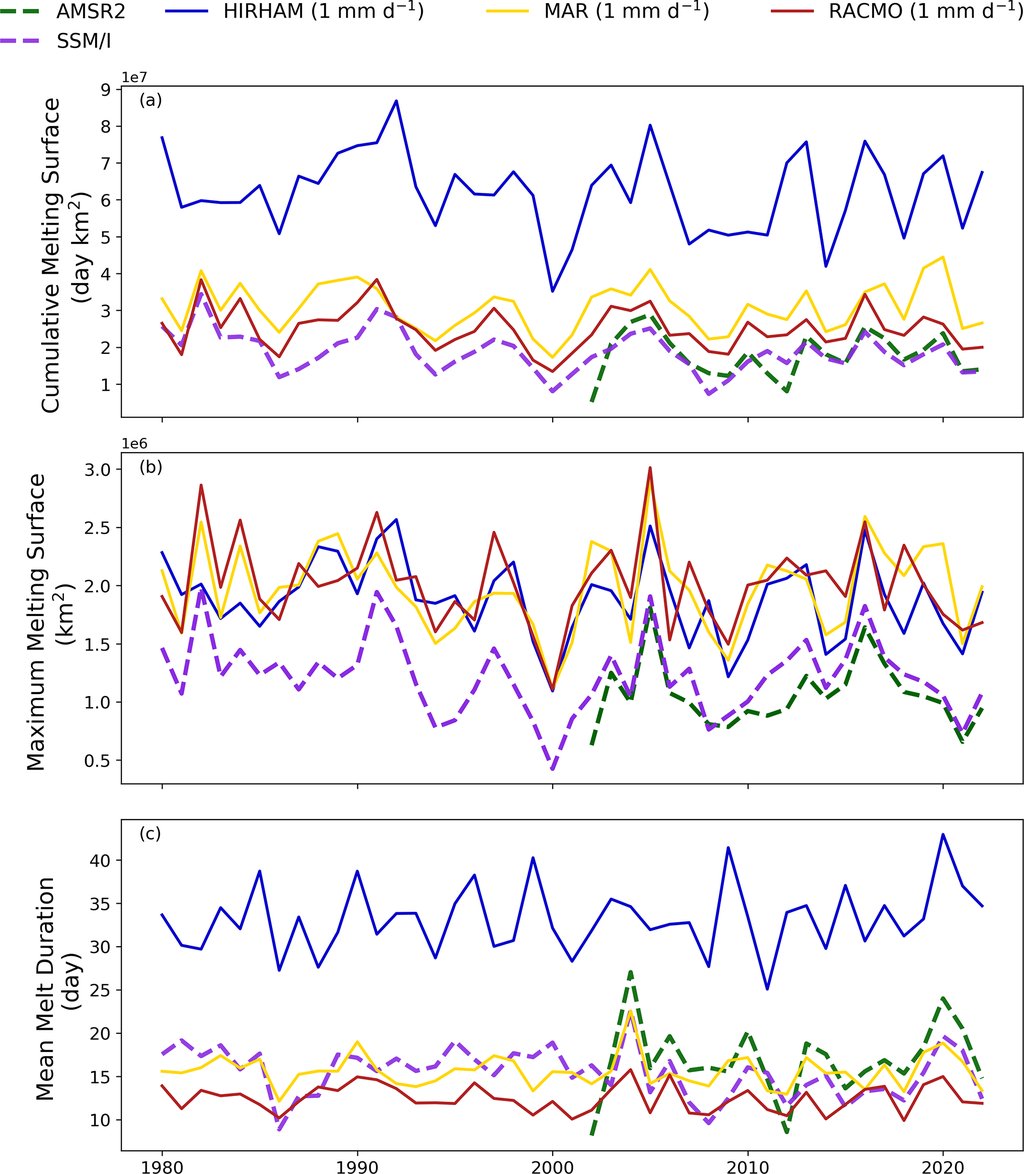
The paper does not offer four equally live futures. It names the model at the extreme end and argues that it melts far too much already. Measured against satellite records of surface melting, HIRHAM produces 3.5 times as much melt as the SSM/I instrument detects. It also keeps melt running 33.7 days a year on average, against 14.5 days in the SSM/I record and 16.8 in AMSR2. MAR and RACMO, the authors write, "faithfully represent the observations."
The checking is not done by another model: SSM/I and AMSR2 read liquid water at or near the snow surface from orbit. HIRHAM's melt and refreezing rates today run about five and four times those of both MAR and RACMO, which puts its present day at levels the other two reach only at the century's end. The findings, the authors write, "raise serious questions about the plausibility of HIRHAM's simulated melt and refreezing rates" under current conditions. It is not an outsider's verdict either: the author list carries the groups that run all four models, HIRHAM's among them. The paper discloses that a co-author sits on the journal's editorial board and that an independent editor guided the review; the referee reports are public.
Where the meltwater goes decides the century
The split is not about snowfall. Precipitation rises in all four models, roughly as a warmer atmosphere requires. What divides them is runoff, and runoff is settled inside the snowpack. Meltwater that percolates into firn (the compacted old snow below the surface) and refreezes there is not a loss. It becomes one only when the firn has no pore space left and the water leaves instead. HIRHAM refreezes heavily from the start, which fills that space early, and once it is full, each further melt season sends more water off the shelf. Melt does not rise in step with temperature either: melting darkens snow, darker snow takes up more sunlight, and more melting follows. The extra sunlight absorbed over HIRHAM's shelves by the century's end is several times any other model's.
The paper also marks the line where a shelf's snowpack gives out. Once liquid water at the surface reaches 70% of the snow the surface gains in a year, the snowpack can no longer renew the pore space it needs. Runoff and meltwater ponds follow, and with them the risk of water prying a shelf apart. MAR, RACMO and CESM2 cross that line several degrees of warming above where they begin. HIRHAM crosses it at a temperature indistinguishable from its own present-day average, so most of its ice shelves are already past it in the reference period. That, the authors write, suggests "an unrealistically early onset of runaway runoff in HIRHAM."
The gentler half of the spread is just as instructive. MAR and RACMO melt almost identically today, and by the century's end MAR sheds more than twice the ice-shelf runoff RACMO does. The obvious explanation does not hold. "Firn thickness and retention capacity alone therefore cannot explain the higher runoff in MAR," the paper states. What is left is a persistent 1–2 °C temperature offset between those two models, and a difference in accounting. MAR lets a share of the water working down through the snow run off as soon as it meets a buried layer of solid ice; RACMO waits for the whole firn column to saturate.
What these numbers are not
None of this is a figure for how much ice Antarctica will lose. Over the grounded ice sheet, where the air stays cold, all four models project the surface gaining more rather than less: between 610 and 870 billion tons a year by the century's end, carried by snowfall. In every one of the four, that gain is larger in magnitude than the ice-shelf decline. The models also stop at the snow surface. They are not coupled to ice flow and they hold the ice sheet's shape and extent fixed, so the glacier losses that compete with the surface budget sit outside them, and shelf ice is afloat already. Even the sign of Antarctica's net contribution to sea level by 2100 is unsettled, a point the authors take from the IPCC's sixth assessment and the ice-sheet model intercomparisons, not from their own runs.
What the work hands modelers is a reason to stop treating one model's answer as interchangeable with another's. If agreement on the present-day total can hide a disagreement of several times over about how much is melting, then the spread between models is not by itself an uncertainty range. The authors argue that uncertainty estimates should account for model skill, weighting models by how well they match observations. CESM2, a global model on a roughly 110-kilometer grid and not built for polar work, tracked the regional models closely, which the authors credit to work on how it represents an ice-sheet surface. And HIRHAM5 was retired shortly after these runs finished, in favor of a successor system: "These will therefore be the last results published from HIRHAM." The analysis scripts and the data behind them are posted openly.
Sources
- The CryospherePeer-reviewed
- tc.copernicus.org
- zenodo.org