Antarctica's Coldest Ice Shelves May Be the Most Sensitive to Warming

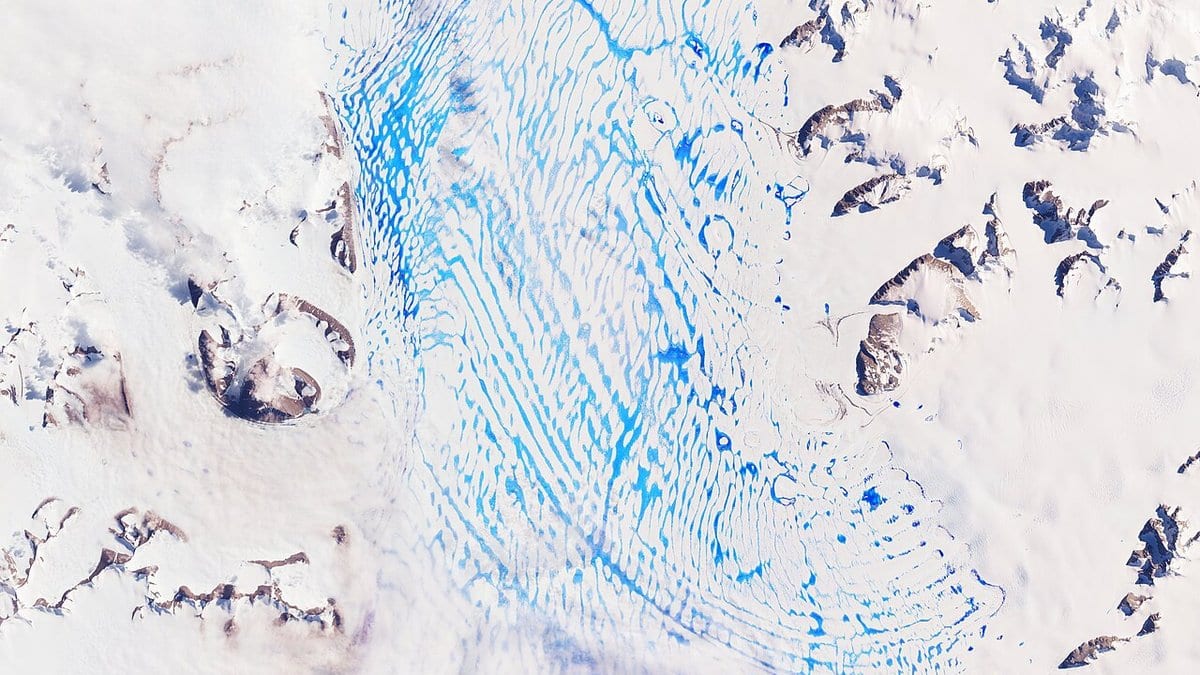
The Ross and Filchner-Ronne ice shelves are the two largest floating slabs of ice on the planet, and by the usual reading they are the least troubled. Their summers are cold, their surfaces stay white, and almost nothing melts. A paper published August 26, 2026, in The Cryosphere argues that this is precisely what makes them worth watching. It is the work of Marte Gé Hofsteenge, Michiel van den Broeke and colleagues at Utrecht University's Institute for Marine and Atmospheric Research, who ran a polar climate model out to 2100 and then pulled the snow surface's energy budget apart, one temperature bin at a time. In that model, the coldest and driest shelves hold the most unspent sensitivity to warming.
Surface melt on a floating shelf adds nothing to sea level by itself; the ice is already in the water. What it can do is open the shelf. Meltwater that cannot drain into the snowpack collects in ponds, and a pond sitting over a crevasse can drive it open: hydrofracture, the mechanism behind the sudden shelf collapses of the past few decades. Remove a shelf and the grounded ice it was buttressing flows faster into the ocean, and that does raise sea level.
The model is RACMO2.4p1, a regional climate model adapted for polar surfaces, run over Antarctica on an 11-kilometer grid with a multilayer snow scheme beneath it. For the present day it was driven by ERA5, the reanalysis that stitches observed weather into a continuous record. For the future it was driven by two global Earth system models, CESM2 and MPI-ESM, under SSP3-7.0, one high-emissions pathway, with no low-emissions run alongside it for contrast. The paper contains no new field measurements. Every threshold in it is a property of the simulation, and the question the study asks is what the model's energy balance does, not what the continent has done.
What the simulations show first is a surface that resists warming. Over the dry shelves (the paper divides Antarctica at an annual snowfall of about 500 millimeters), a warmer summer in the model is also a cloudier, snowier one, and both cloud and fresh snow make the surface brighter. Less sunlight is absorbed, and part of the warming cancels itself. That holds until summer averages reach about −12 °C. Beyond it, melting and the coarsening of snow grains darken the surface faster than new snow can brighten it, absorbed sunlight begins to rise with temperature instead of falling, and the feedback that was damping melt starts driving it.
That switch is a dry-shelf phenomenon. Where snowfall is heavy, the surface keeps being reset to bright, and the model's melt sensitivity runs through longwave radiation instead: a warmer, damper, cloudier atmosphere radiates more heat down onto the ice. The −12 °C figure matches an earlier estimate of where the snowmelt-albedo feedback starts to strengthen, but that earlier work shares a senior author and an institute with this one, so it is better read as an internal consistency check than as a second group landing on the same number.
The second switch sits at 0 °C, and its leading cause is the quieter of the two things that happen there. A melting snow surface cannot get warmer than the melting point; the air above it can. So once summer mean temperatures reach freezing, every further degree of warming widens that gap, and more sensible heat and more downward longwave radiation arrive at a surface whose only remaining response is to melt. Additionally, some of the snow starts falling as rain, which takes away the brightening effect of fresh snowfall and darkens the surface further as it refreezes.
The rain is mechanically important and quantitatively small. Averaged over the shelves, simulated annual rainfall rises by 4 to 7 millimeters across the century, with more of it on the Antarctic Peninsula. The authors also flag that projected Antarctic rainfall varies widely among CMIP6 models, which makes it the least settled quantity in the paper. Summers averaging near 0 °C are also still rare over Antarctic ice shelves, so the second switch describes a regime that mostly lies ahead rather than one running now.
Put the two switches together and the ranking of risk turns over. In the model a dry shelf reaches any given melt rate at a summer temperature several degrees lower than a wet one, because there is less fresh snow to keep it bright. It also has less pore space in which to hide the meltwater. Ponding and hydrofracture become possible once melt reaches roughly 0.7 of a year's accumulation, and a shelf that accumulates little gets there on little melt. The authors keep the conclusion conditional: currently colder, drier and stable shelves could see rapid increases in melt, not will.
One line of support comes from outside the modeling. Satellite mapping of Antarctic surface meltwater by a separate British group, published last year, finds the drier East Antarctic shelves more favorable to ponding than West Antarctic ones. It puts the largest observed pool of East Antarctic surface meltwater on the Amery, a dry shelf that already melts hard. That observation agrees with the corollary. It is not a test of the mechanism, which remains something only the model has been asked about.
The target of all this is a shortcut. Ice-sheet models that cannot afford to carry a full surface energy balance convert temperature into melt with a degree-day factor, and that factor is routinely applied at one value across the whole continent. The paper's finding is that no single value exists: melt sensitivity depends on how much it snows, how cloudy it gets and how bright the surface already is, and a factor tuned where melt is easy to observe will understate it on a dry East Antarctic shelf. The monthly output of all three simulations is posted openly on Zenodo, which is what a group would need to fit factors of its own.