One Extra Quantum Dot Gives a Qubit's Speed a Dial

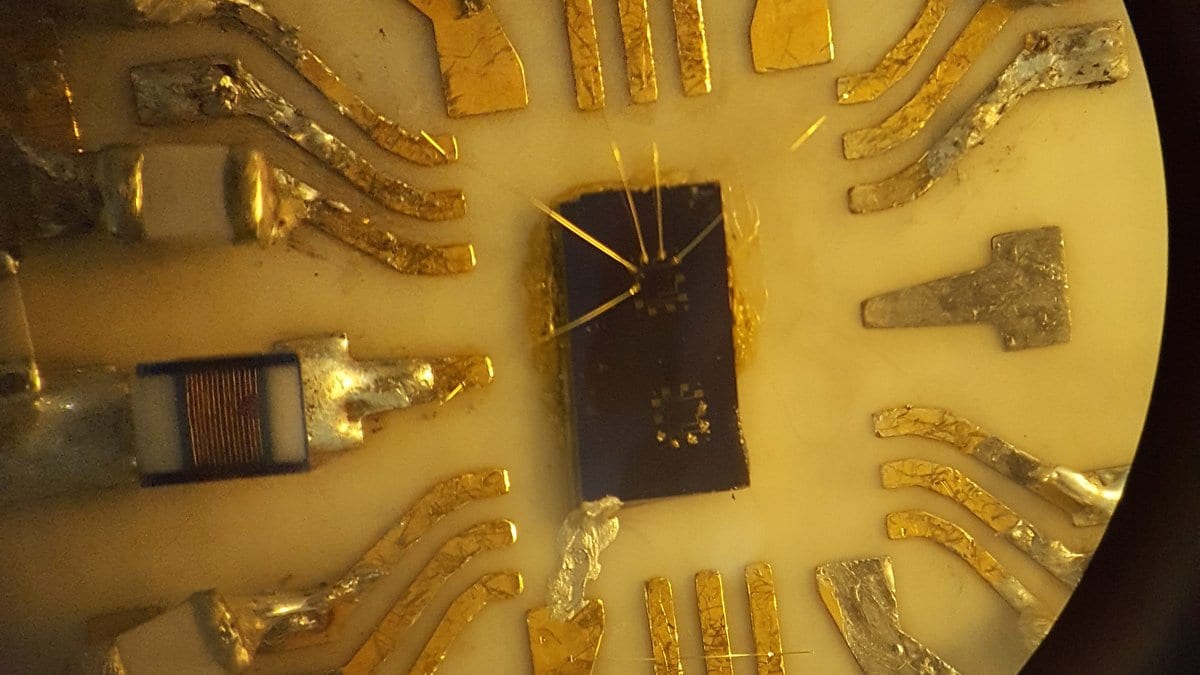
Every setting that makes a spin qubit faster is the same setting that makes it jumpier. To steer a single electron's spin with a voltage instead of a magnetic field, physicists let the electron slosh back and forth between two neighboring quantum dots. The dots are tiny electrical traps in a semiconductor, and the sloshing makes the spin and the electron's position partly the same thing. That mixing is where the speed comes from. It is also an open door: every stray voltage wobble on the chip now has a route into the qubit.
That package deal has been the constraint. In a two-dot device, run in what the field calls flopping mode, the width of the quiet operating window and the boost to the rotation rate are governed by the same quantity: the energy gap between the electron's orbital states. Make the gap small and the qubit turns quickly and hears every rattle. Make it wide and the qubit is calm and slow. Once the chip is fabricated, there is nothing left to negotiate with.
A team at the University of Osaka and Ruhr University Bochum has added a knob. The work was published Oct. 24, 2026, in npj Quantum Information. Y. Matsumoto, A. Oiwa and colleagues built the qubit out of three quantum dots in gallium arsenide rather than two, using the third one purely as a control. Tilting that third dot against its neighbor flattens the way the qubit's frequency responds to voltage on the working pair, while leaving spin and charge strongly mixed. Flat response means the qubit stops caring so much about small electrical drifts. Strong mixing means it still turns fast. In that configuration the group drove spin rotations electrically at rates above 100 megahertz.
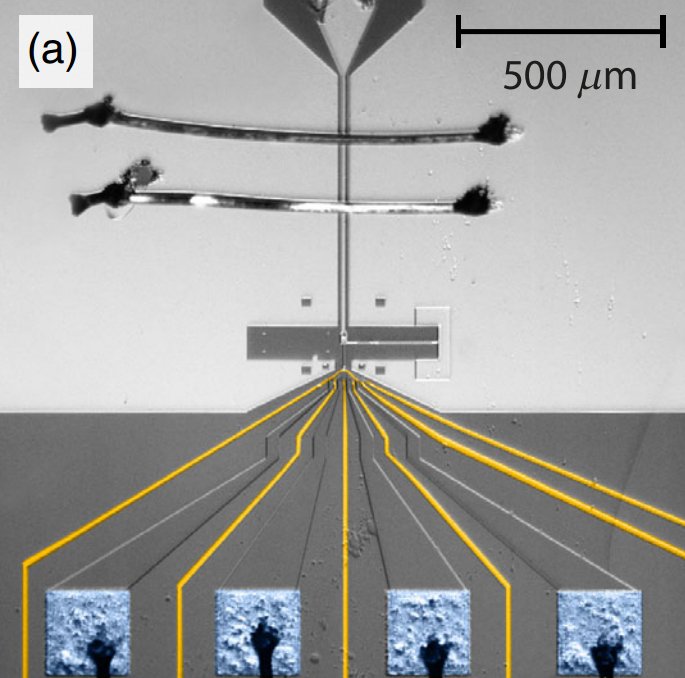
Speed alone was never the hard part. A qubit's frequency wanders over seconds and minutes as charges shift in the material around it, so a rotation calibrated a minute ago is slightly wrong now. The standard remedy is a feedback loop that estimates the current frequency from recent measurements and retunes the microwave drive. Here the estimator is a feedforward neural network, in place of the statistical estimators usually used for this job. It is instrumentation, not a discovery. The network is not learning physics; it tracks one wandering number and corrects for it, cycle after cycle. With the loop running, the spread in those slow wanderings fell to 388 kilohertz.
Then the gate itself. At that stabilized operating point the group measured a quarter turn of the spin, a 90-degree flip and the basic step of single-qubit control, at 99.56% fidelity with a gate time of 4.05 nanoseconds. Those two numbers sit side by side rather than in sequence. A quarter turn taking 4.05 nanoseconds implies a rotation rate well short of 100 megahertz, and the paper does not say at which rate the benchmarked gate was driven, so the fastest setting and the benchmarked one are not the same point. This is one device, one qubit and single-qubit gates only. It is not a two-qubit gate, not a processor and not an error-correction result.
What the result puts in an experimenter's hands is a setting that was not there before. In a two-dot device, the balance between speed and steadiness is largely fixed when the chip is grown and patterned. Here it can be shifted with a voltage, on a cold device already wired into its control electronics. The trade-off itself does not disappear. Strong mixing still buys speed at the price of sensitivity to electrical noise, and a third dot does not repeal that. What changes is that the exchange rate has become adjustable: the paper presents the third dot as an electrical route for tuning the trade-off, not for removing it.
The authors place the method alongside the two established routes to fast electrical spin control rather than above them. One route is choosing a material whose own physics couples spin to motion; the other is patterning small magnets onto the chip to build in a magnetic field gradient. That is complementary, not better, and the paper attaches no claim about scaling the scheme up. It is open access and peer-reviewed, published early as an accepted manuscript that the publisher says may still be edited before the final version. Gallium arsenide, meanwhile, is not where most of the field's effort now goes; silicon spin qubits built on industrial chip lines have drawn that. Whether a third dot does the same job in silicon is a separate experiment.
Sources
- npj Quantum InformationPeer-reviewed