A Burst That Looks Like Both Kinds of Star Death

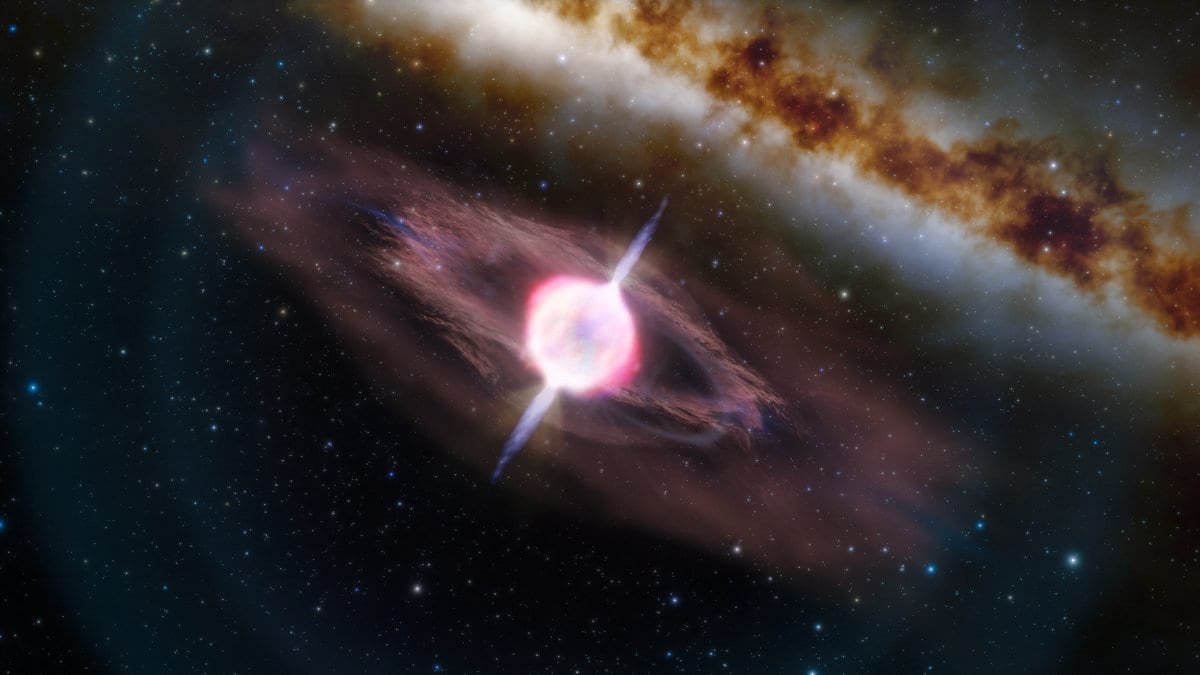
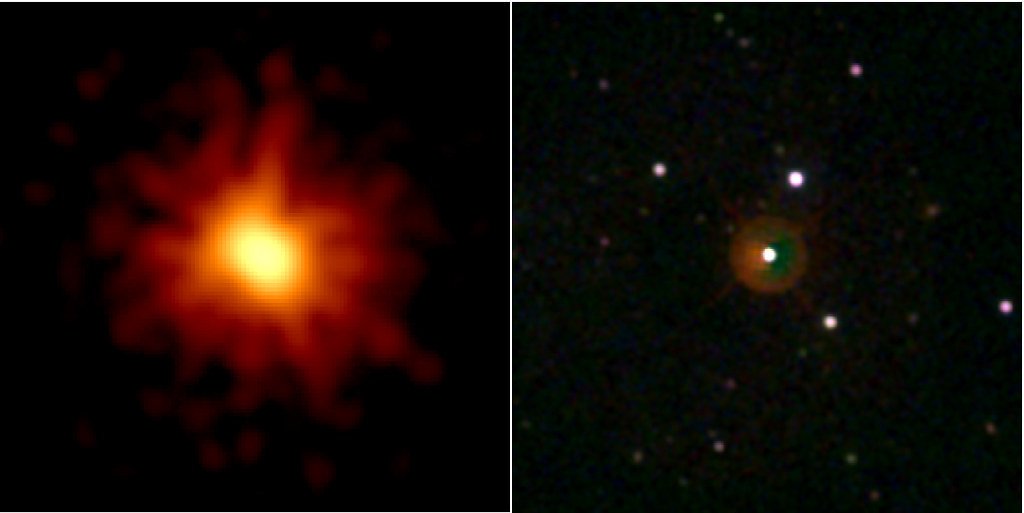
Astronomers have a stopwatch rule for gamma-ray bursts, the brief flashes of high-energy light that reach us from across the universe. If the flash lasts less than two seconds, it is usually associated with two compact stellar remnants merging. If it lasts longer, it is usually associated with the collapse of a massive star. The rule is crude, and a whole classification scheme rests on it. Then there is the burst that NASA's Swift satellite caught on April 25, 2016, which seems to fit both categories within the same event.
On Oct. 23, a team led by Liang Li of Ningbo University published an analysis of that burst, GRB 160425A, in Nature Astronomy. Yu Wang of Sapienza University of Rome and Bing Zhang of The University of Hong Kong are among the 22 authors. They describe a single event made of two sub-bursts four minutes apart: a short one they label G1 and a long one they label G2. The authors report that nearly all the standard tests applied to the observed emission classify G1 as belonging to the short, merger-associated family and G2 to the long, collapse-associated family.
Those tests are the trade's working tools: the shape of the pulse, its duration, how hard its spectrum is, the shortest timescale on which the brightness flickers and a set of measured relations between a burst's energy and its spectral peak. The paper's qualifier, "nearly all," matters. These are sorting criteria, not direct observations of the progenitors. They place each episode in a family whose members are thought to arise from mergers or collapsing stars, but neither progenitor was observed directly. The authors do not report an associated kilonova, the glow powered by the radioactive decay of freshly synthesized heavy elements, or a supernova.
The oddity was flagged at the time. The Swift team's circular on the burst, filed within hours, describes a light curve showing "a single-peaked structure with a duration of about 2 sec, followed by a 50 second-long peak at T+250s", and then states the problem plainly: "It is extremely unusual for a short GRB to have a long pulse a few minutes later with much more fluence. It is more common for a long GRB to have a short precursor pulse." Fluence is the energy received per unit area over the burst's duration, so the later, longer pulse was by far the bigger of the two. The circular also noted a possible precursor peak minutes before the trigger, which is not part of the new paper's analysis of G1 and G2.
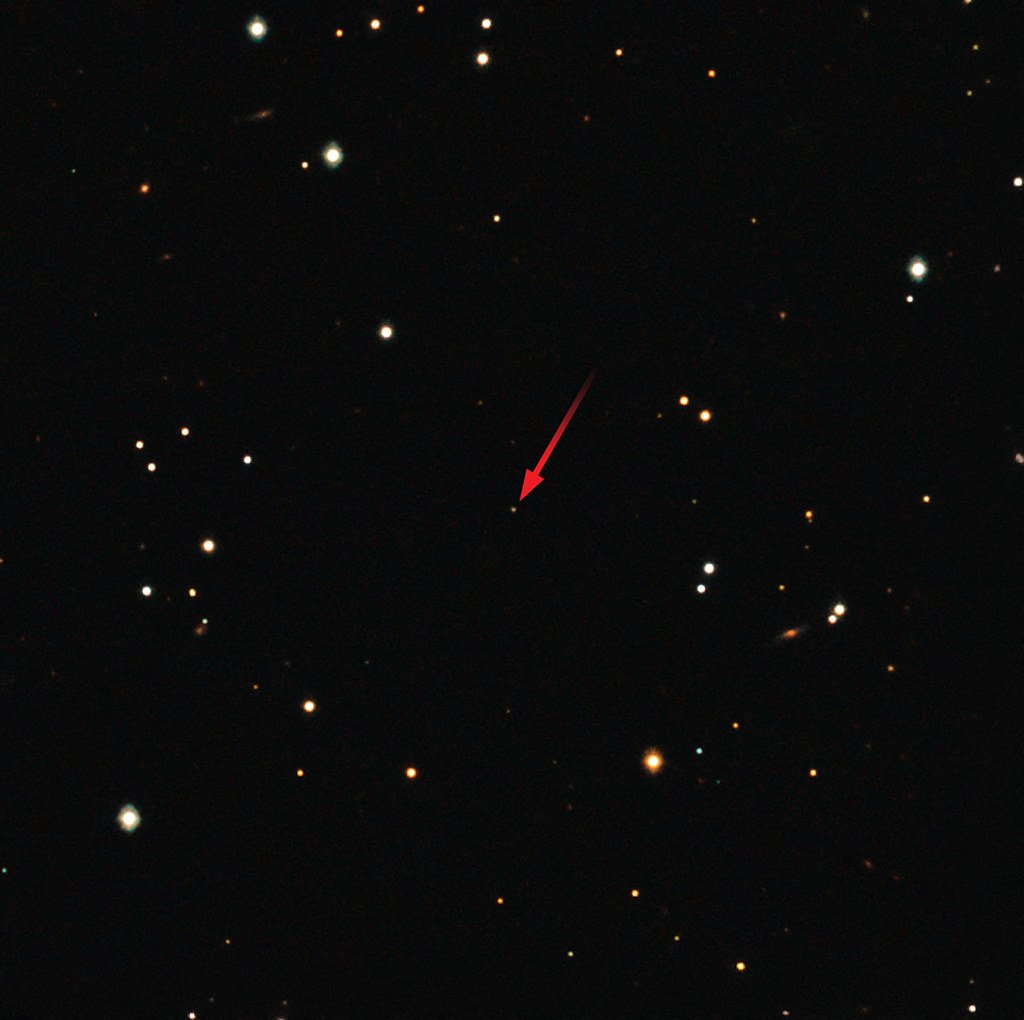
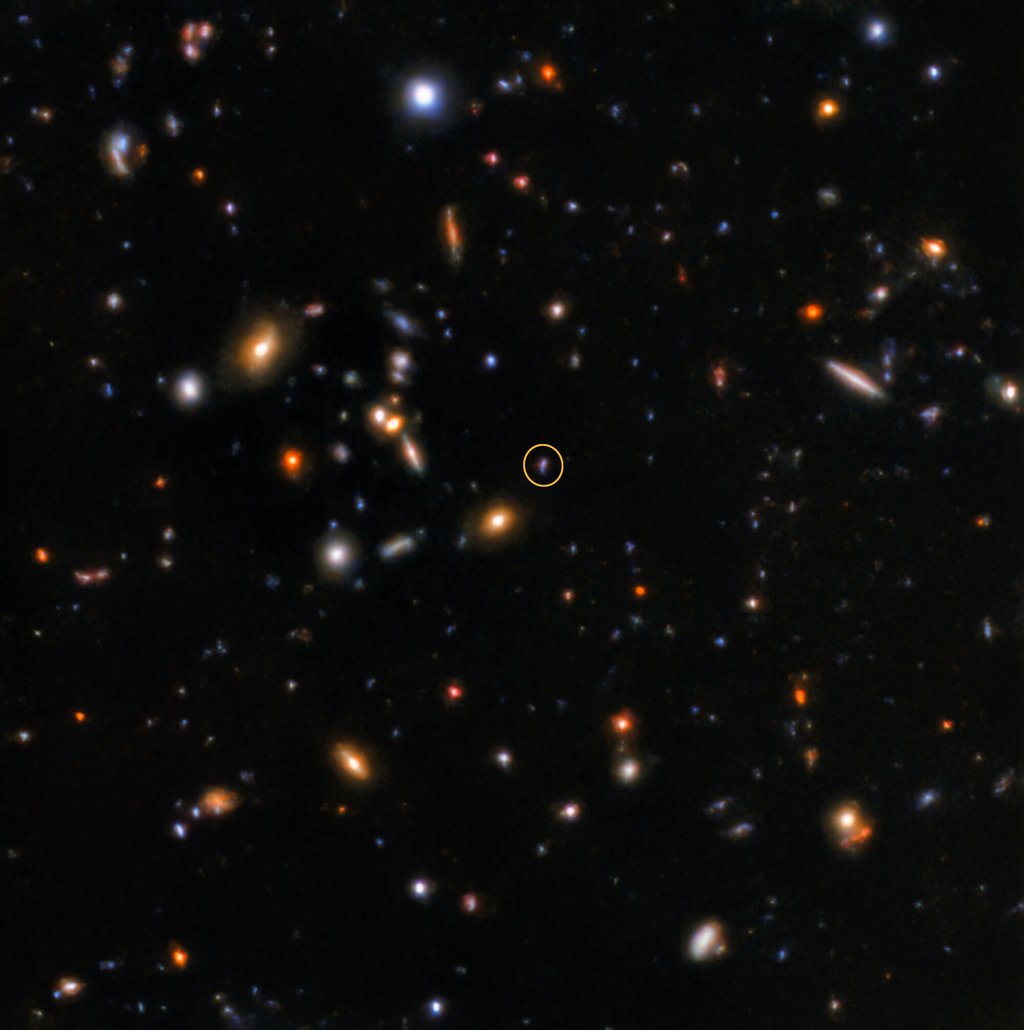
A different group followed the fading afterglow about seven hours later. Nial Tanvir of the University of Leicester and colleagues pointed the Very Large Telescope in Chile at it and measured a redshift of 0.555. The host looked unusual too: an extended object that breaks into two knots, with two sets of emission lines moving at slightly different speeds. Their interpretation was that the object was an interacting pair of galaxies.
Whether one system produced both episodes is the question the work leaves open, and the authors do not claim to have closed it. What they report is a single event: one detection, one position on the sky. Swift's initial position carried an error circle wide enough that two unrelated bursts could in principle fall inside it by coincidence, which remains an alternative explanation. Both episodes belonging to one object is the team's interpretation of the data rather than a directly established fact.
The split the result presses on goes back to a 1993 analysis by Kouveliotou and colleagues, and it has been under strain for several years. GRB 211211A and GRB 230307A were long bursts followed by kilonova emission associated with mergers; GRB 200826A was a short burst associated with the collapse of a massive star. All three sit in this paper's own reference list. The two-family scheme has already been questioned; what's new here is that both signatures turn up inside a single event, a narrower and harder claim.
The authors put it carefully. The coexistence of merger and collapse signatures in one event challenges existing ideas about what produces these bursts, they write, and calls for a re-evaluation of how bursts are classified. No replacement scheme is put forward, and no new class is declared.
One limit is worth naming. Fermi's Gamma-ray Burst Monitor, which watches the whole sky, was also checked for the event but showed no clear signal around the trigger time, so both episodes rest on Swift's Burst Alert Telescope alone. The Swift data are public, held at the UK Swift Science Data Centre, and the satellite is still flying and still catching bursts. That leaves the reading open to further evidence, whether from another event like this one or a second group reanalyzing the same archive.
Sources
- Nature AstronomyPeer-reviewed
- gcn.nasa.gov
- gcn.nasa.gov