Two Telescopes Find the Glowing Spots Along a Black Hole's Jets

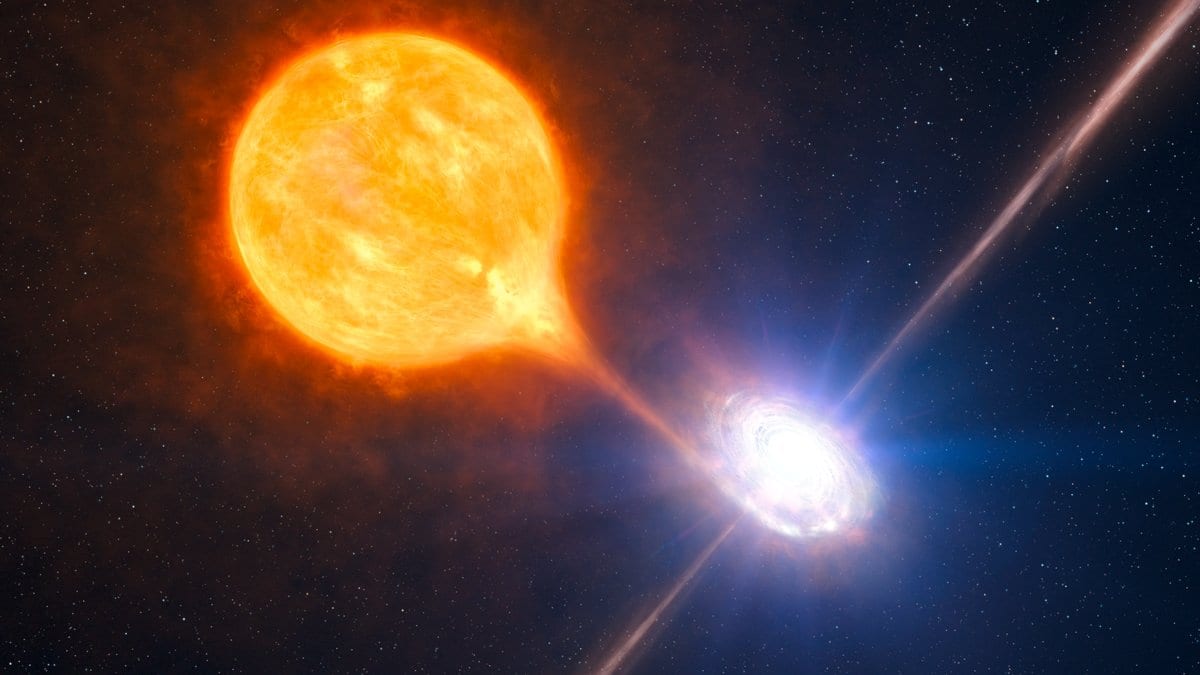
X-ray astronomers have spent decades watching V4641 Sagittarii at its loudest. The system is a black hole pulling gas off a companion star in the constellation Sagittarius, and every few years it flares. Those flares are when the telescopes look. In September 2025, a team pointed ESA's XMM-Newton at it while it was quiet instead and surveyed the apparently empty sky on either side.
Something was there. North and south of the binary, roughly symmetric about it, the images showed two faint patches of X-ray light lying close to the axis of the radio jets seen during the system's 1999 outburst. The team called them n1 and s1. Each sits about 20 parsecs from the black hole, a figure that comes from the angle measured on the sky and an assumed distance of 6.2 kiloparsecs to the system. Naomi Tsuji of the Institute for Cosmic Ray Research at the University of Tokyo and colleagues report them as the first evidence for parsec-scale X-ray jet structures in this microquasar, a black hole binary that launches jets, in a paper posted to arXiv on Oct. 2 accepted for publication in The Astrophysical Journal Letters; the journal version is not out yet.
Two faint smudges earn a paper because of where they sit. V4641 Sgr is only the second microquasar ever identified as a PeVatron, a source that pushes particles to around a quadrillion electronvolts, far beyond the reach of any accelerator built on Earth. The LHAASO observatory in Sichuan has traced gamma rays from the region to 0.8 petaelectronvolts with no sign of a cutoff, and HAWC had already found that the gamma rays come not from the binary but from a pair of lobes flanking it. Neither measurement belongs to the new papers; both are the reason the teams went looking for an X-ray counterpart. The knots fall inside those lobes.
Two telescopes, not two independent teams
While XMM-Newton was looking, the Follow-up X-ray Telescope on the Einstein Probe was looking too. Yi-Heng Chi of Nanjing University and colleagues, in a companion paper posted the same day, report diffuse X-ray structures 20 to 40 parsecs from the binary. Two of those are n1 and s1, in the same places; the third, which they call s2, sits roughly twice as far out and is fainter still. The 20 to 40 parsec span belongs to that paper alone, and the far end of it is s2.
That is two observatories, two observing campaigns and two independent reduction chains placing the knots in the same locations. The flux each reports differs slightly, which Chi's team attributes to instrument calibration and differences in how the data were processed, and which is itself a sign that the two analyses were done separately. It is not, though, a blind replication, and the papers do not pretend otherwise. They are explicitly coordinated companions, each naming the other on its arXiv page. Nine authors appear on both bylines, including each paper's lead. Chi's author-contribution statement records that the XMM-Newton group shared its results with them to coordinate the publication. What the two telescopes buy is a cross-check inside one program, which is a real thing and a different thing.
Nobody knows yet whether it is electrons or protons
The X-ray light from the knots is probably not the glow of hot gas. Tsuji's team finds its spectrum a poor match for a thermal plasma and a good match for a power law, which it describes as likely non-thermal, pointing to synchrotron radiation, the light charged particles emit when they spiral in a magnetic field. Chi's team is more cautious, saying its own spectra support the presence of fast-moving electrons without establishing the origin. Tsuji names NuSTAR, which can see harder X-rays, as the observation that would help distinguish between the possibilities.
The question underneath all of this is whether the petaelectronvolt particles are electrons or protons, and neither paper answers it. Tsuji's team writes that the overlap between the X-ray and gamma-ray emission favors electrons, then immediately notes that the X-rays are more compact than the gamma-ray lobes and that protons cannot be excluded. It goes on to lay out a hybrid picture in which protons make the gamma rays while electrons make the X-rays in small patches of stronger magnetic field, which would explain the mismatch in size. Chi's paper states plainly that the origin of the highest-energy gamma rays remains open. Only the fully proton-dominated version looks unlikely, because it would require more jet power than the system plausibly has and a gas density that is not observed.
The magnetic field in those regions is weak either way. Tsuji's team gets 3 to 5 microgauss for the knots themselves by modeling the X-rays and gamma rays together, and no more than 1 to 2 microgauss for the parts of the lobes where no X-rays were detected at all. Chi's one-zone model lands at 1 to 2 microgauss for the region as a whole. They are three different numbers for three different volumes, and the comparison the authors reach for is SS 433, the first microquasar found to be a PeVatron, whose jet knots carry a field at least several times stronger than the fields inferred here.
What XRISM saw, taken apart
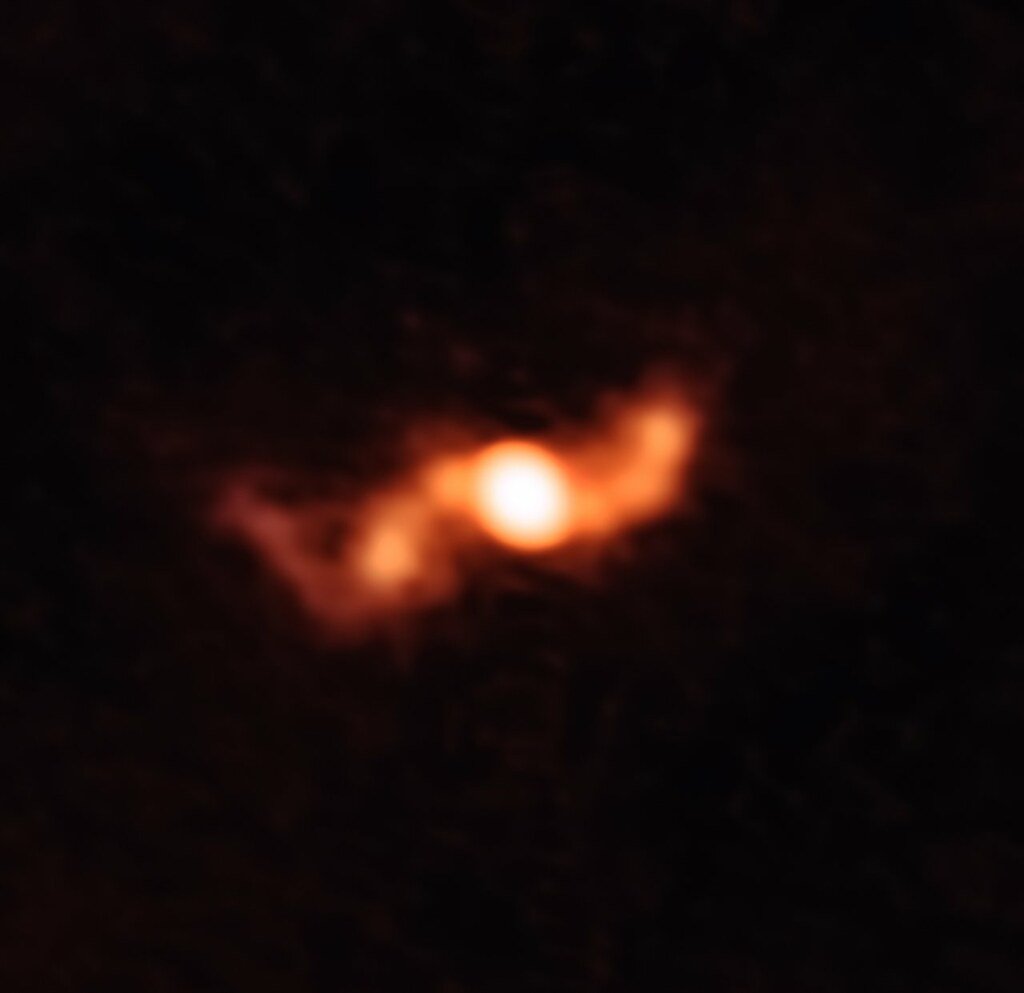
There was one earlier X-ray detection around V4641 Sgr. XRISM's wide-field camera found extended emission there in 2024, days after an outburst, with the central source still bright and only about half the gamma-ray region in its field of view. The new data do not confirm that blob so much as resolve it into separate sources: Tsuji's team finds the XRISM emission roughly reproduced by n1, s1 and a set of point sources too faint for the shorter XRISM exposure to separate out. The Einstein Probe, pointed straight at the same spot, saw no diffuse emission there at all, though it should have been bright enough to see.
Tsuji's closing suggestion is the one that reaches past this object. Extended X-ray emission along the jets may be a key signature in PeVatron microquasars that has simply been overlooked, because X-ray studies of these systems have concentrated on their outbursts, when the central source drowns out anything faint beside it. A handful of other microquasars have now been picked up at the highest gamma-ray energies. If the knots are a general feature, the way to find them is the way these two teams found these: wait for the black hole to go quiet, then look at the empty sky on either side. Chandra and NuSTAR are already scheduled to observe the system again.
Sources
- arXivPreprint
- arXivPreprint
- The Astrophysical Journal Letters
- ALLATRA Media