Skip to content
See the World Through ScienceA project of ALLATRA
Source: Peer-reviewedThe Astrophysical Journal Letters1 source

Gamma-Ray Detectors at Both Poles Registered a Solar Particle Storm
Space

Republish this story

Our work is licensed under Creative Commons BY-NC 4.0. You may republish this piece for free — with credit to ALLATRA Media and a link to the original, unedited beyond length trims, and not for commercial use.

Read the full license

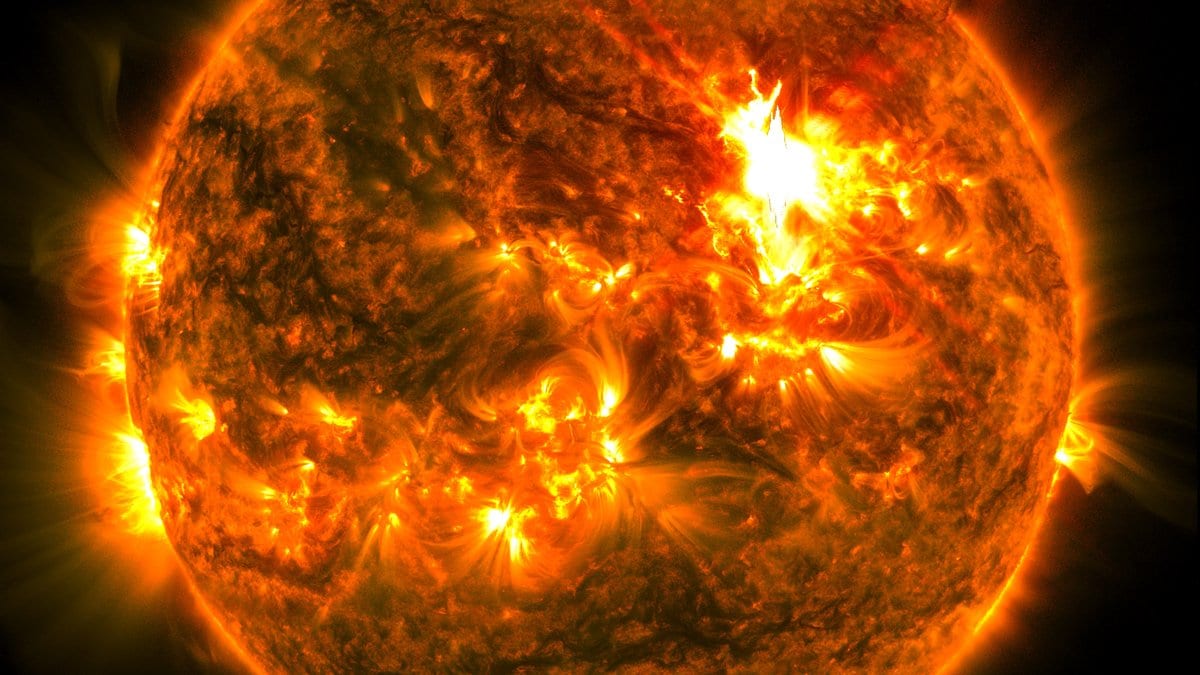
The full disk of the Sun in extreme ultraviolet light, with a brilliant flare burning above an active region at upper right.
The Sun at 10:04 UT on Nov. 11, 2025, imaged in extreme ultraviolet light, with a flare burning at upper right. That is the day the polar detectors registered the particle event."The Sun Unleashes Six November X-class Flares (SVS14927 - SDO 11-11-25 1004UT 131-171 4k)" by NASA's Scientific Visualization Studio - NASA/SDO, via Wikimedia Commons, Public domain

Ground-based gamma-ray detectors at an Antarctic and an Arctic station recorded the solar particle event of Nov. 11, 2025, in what the paper calls the first detection of a ground-level enhancement in gamma rays. A ground-level enhancement is a burst of particles from the Sun energetic enough to register in instruments at the Earth's surface; this one is designated GLE #77.

Pranali Thakur of the Indian Institute of Geomagnetism and colleagues reported the analysis in The Astrophysical Journal Letters on Nov. 19, 2026, more than a year after the event itself. They say that polar gamma-ray detectors can complement the neutron monitor, the ground instrument traditionally used to catch these events, during extreme solar particle events, and that their own measurements agree with the monitor's.
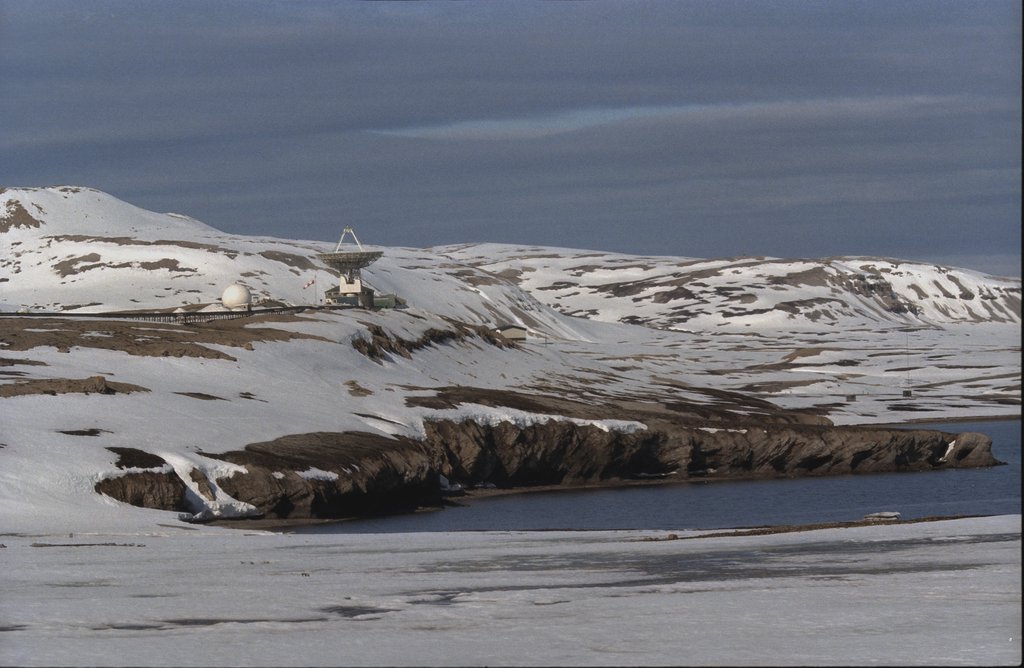
A snow covered Arctic coastline with a small research settlement and a large dish antenna standing on the ridge above it.
The Arctic research settlement of Ny-Alesund, Svalbard, under snow, with an antenna on the ridge above it (illustrative). Ground instruments at polar sites like this one are what register a solar particle event at the surface. "Ny-Alesund (js) 2" by Jerzy Strzelecki, via Wikimedia Commons, CC BY-SA 3.0, resized

The two stations did not record the same thing: a prompt response in gamma rays at Antarctica and a gradual one at the Arctic, differing in amplitude as well as in kind, with the signal an order of magnitude stronger at the Antarctic station than at the Arctic one — about ten times.

Timing is what ties the signal to the Sun. The authors report that the prompt peak coincided with the peak in the flux of solar particles above 150 MeV, and the gradual peak with the flux between 12 and 99 MeV. The event was associated with an intense flare of the X class, a fast coronal mass ejection, which is a cloud of plasma thrown off the Sun, and a strong burst of energetic solar particles.

The letter is free to read under a Creative Commons Attribution license. The same analysis was posted as a preprint in January 2026.

Sources

Spot an error?

Spot an error?

Report an error

Spotted a mistake on this page? Tell us what's wrong and our editors will take a look.

What kind of problem?

Only if you'd like us to be able to follow up. We won't use it for anything else.

We correct mistakes openly. Select any text to flag it. Fixes are logged under our Corrections Policy.

Report an error

Reporting on

Gamma-Ray Detectors at Both Poles Registered a Solar Particle Storm

What kind of problem?

Only if you'd like us to be able to follow up. We won't use it for anything else.

We read every report. Corrections are logged publicly.