Iron Is Leaving This Black Hole at a Fifth of Light Speed

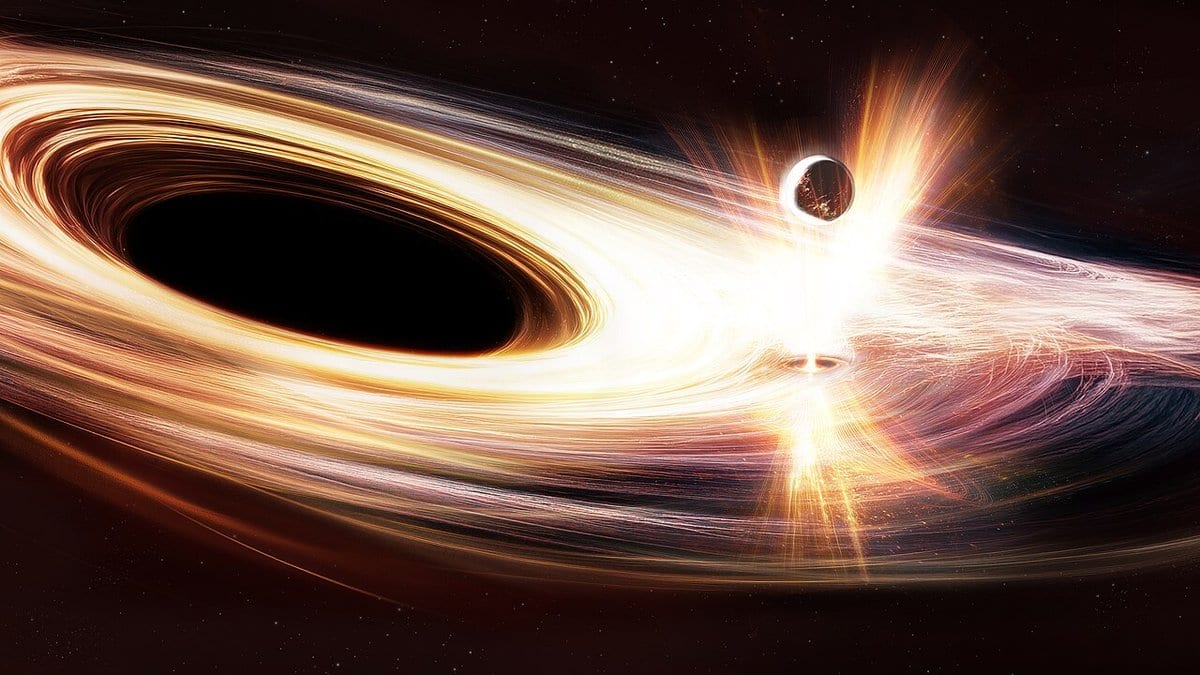
A handful of supermassive black holes have been caught doing something no textbook asked them to do. Every few days they switch on, flood their surroundings with X-rays, then switch off again. Days later they do it once more, on a schedule regular enough to predict. Astronomers call these quasi-periodic eruptions, and years after the first ones turned up nobody can say with confidence what makes them go.
One of them has now been caught throwing material away. Joheen Chakraborty of MIT and 19 colleagues pointed ESA's XMM-Newton X-ray telescope at the black hole nicknamed Ansky and collected what they describe as the deepest observations of individual bursts in any such object so far. In the spectra, during each eruption, iron gas is moving outward at roughly a fifth of the speed of light. The paper went up as a preprint on Aug. 28 and has been submitted to a journal. Nobody has peer-reviewed it; the authors' own note reads, "Submitted, comments welcome!"
What the spectra show is a shape that stellar astronomers have used for decades. On one side of an iron line, light is missing, absorbed and shifted toward the blue. On the other side it piles up, shifted toward the red. That pairing is what an expanding shell of gas looks like: the part in front of the source is coming toward the telescope and absorbs at shorter wavelengths, while the part sweeping around the far side is receding and re-emits at longer ones. It is called a P Cygni profile, after the star it was first recognized in, and it is how the winds pouring off hot stars get measured. Here it turned up in the X-rays of an erupting black hole, and it changed shape as the eruption ran.
The iron is stripped of most of its electrons, which is what the temperature inside these bursts does to gas, and the shift of its lines is what pins the speed. That number is read off the spectrum. It does not depend on any model of what the eruption is. Fast outflows in this speed range are routine around feeding supermassive black holes, so the speed by itself is not the news. Nor is this the first time gas has been caught leaving a quasi-periodic eruption; that was seen earlier in a source called GSN 069, and one of the authors of that work is on this paper. What Ansky adds is depth: enough photons to watch the lines move within a single burst rather than averaging over many.
From there the paper moves from measuring to interpreting, and the gap between the two is worth holding on to. The team builds a model of a wind switching on and works out how its brightness and its ionization should change. They find that a wide-angle outflow, rather than a narrow jet, can reproduce the light curve and the spectral lines at once, with about a tenth of the wind's kinetic energy emerging as X-rays. The findings demonstrate that relativistic outflows are sufficient to power the eruption, though other explanations remain possible.
Push the model further and the bookkeeping gets interesting. Each eruption, on this accounting, throws out about a thousandth of the Sun's mass and at least 10^49 ergs of kinetic energy, roughly what the Sun radiates in 80 million years. Those two figures are outputs of the model. They also come with a consequence. If the reservoir of gas feeding the eruptions holds roughly one solar mass, and that is an assumption rather than a measurement, then at that rate the whole cycle cannot run for more than about 30 years.
What none of this explains is the clock. Why the bursts repeat, and why on the timescale they do, is not something these spectra constrain; the paper lists the regularity and the timescales among the things that remain uncertain. The candidates on offer elsewhere are unchanged. A star or a stellar-mass black hole on a tight orbit may be punching through the disk on each circuit; the disk itself may be running through an instability. The wind, if the reading holds, describes what happens during an eruption rather than what sets one off.
The measurements do hand people something to work with. The authors offer the numbers as an "observational probe for direct comparison with physical models and hydrodynamical simulations," which in practice means a set of values any simulation of these eruptions now has to reproduce. There is an observational test too. If every burst really is dumping that much mass and energy into the gas around the black hole, the team expects it to show up at other wavelengths, as reverberation and as feedback on the surrounding material. Because Ansky erupts every few days, verification requires only telescope time.
Sources
- arXivPreprint