A Lava Planet Is Reflecting Three-Quarters of Its Starlight

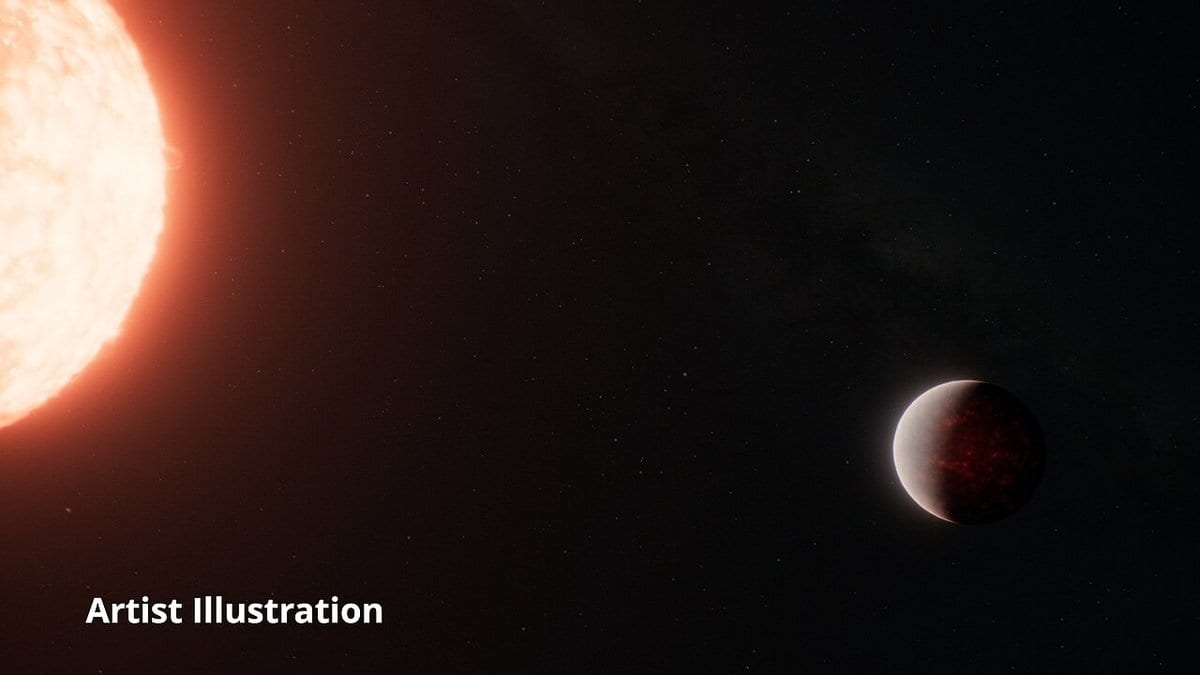
Stand on the daylit side of TOI-561 b and there would be nothing underfoot but rock hot enough to run like water. It is a rocky planet a little larger than Earth, orbiting so close to its star that a year lasts under 11 hours, with one face turned permanently to the furnace. Everything about that says the surface should be a dull, glowing cinder, and laboratory work agrees: molten rock is a poor reflector.
It is not behaving like one. In a paper accepted by The Astronomical Journal, Samuel Boucher of the Université de Montréal and the University of Waterloo, Johanna Teske of the Carnegie Institution for Science, and their colleagues report that TOI-561 b sends most of the starlight reaching it straight back out. The measured Bond albedo is 0.74, the fraction of arriving energy the planet returns without absorbing.
The result comes out of data that has been published once already. In May 2024, Webb's NIRSpec spectrograph watched the star continuously for 37 hours, catching four secondary eclipses and three transits. A team including Teske analyzed the eclipses alone and found a dayside too cool to be bare rock, the result that put an atmosphere on a lava world. Boucher and colleagues went back to the same observation and fitted the entire orbit. No new telescope time was involved.
Watching a planet all the way around does something an eclipse cannot. An eclipse measures the day side; a full phase curve measures the night side too, and the gap between them reads out how much heat the atmosphere is carrying around the planet. Across both of NIRSpec's detectors, the team gets a dayside temperature of 2,048 K and a nightside temperature of 1,089 K. A black airless rock, absorbing everything and sharing nothing, would be near 3,200 K by day and go dark at night.
Heat transport to the night side is real but modest: the fitted redistribution efficiency is 0.18, on a scale running from none at all to perfectly even. Cool day side, warm night side, high reflectivity, middling circulation. The combination, the authors write, is collectively inconsistent with a bare rock. A general circulation model reaches the same place, and needs a genuine atmosphere to do it, at surface pressures comparable to Earth's and up to ten times that.
Whatever is reflecting is not the ground
Two things argue against the surface. Laboratory measurements of lava show it absorbing nearly everything that lands on it. And rock that hot evaporates: the vapor is opaque at the visible wavelengths where the star pours out most of its energy, so even a bright surface would sit hidden behind a haze of its own making. The reflector has to be in the air.
The clouds are in the model, not in the data
The team's candidate is clouds made of the same stuff as the ground: silica and magnesium silicate condensed out of vaporized rock. Feeding their circulation model into a condensation calculation, they find air cold enough for those minerals to freeze out on the dayside near the morning limb, the edge where night rotates into day.
Then comes the number that makes the argument worth reading, because it does not close. Working from the most conservative model run, the one with no albedo at all, so the planet is as hot as it can be, and crediting silica clouds with a generous scattering efficiency, the reflectivity those clouds can account for comes to 0.24. The measurement is 0.74. The authors' answer is a feedback loop: cloud cools the planet, cooling makes more cloud, more cloud reflects more, and the loop carries the albedo the rest of the way. That is a reasonable mechanism and it is not an observation. Nothing in this dataset shows a cloud. What exists is a model that puts cloud where the light curve needs a mirror, and a gap between the two that the modeling does not yet cover. A comparable reflective-cloud story has been proposed for the hot Neptune LTT 9779 b, so the idea is not invented for this planet.
The star was flickering too
The length of the observation is the quiet methodological point, and it is why this analysis should be trusted over the eclipses alone. Sun-like stars flicker on their own, as convection cells rise and sink across the surface. That granulation shifts the measured brightness by tens of parts per million on timescales of tens of minutes, the same range as the planetary signal being chased. An unbroken run of that length gave the team enough baseline to fit the star's flicker and the planet's phase curve at once, rather than assuming one of them away. The dayside spectrum that falls out agrees with last year's eclipse-only version to within its uncertainties, and independent reductions of the raw data agree with each other.
Not everything lines up. On the shorter-wavelength detector, the night side is an upper limit rather than a measurement, because the fit cannot allow the planet to emit negative light and the answer pressed against that wall. The same detector disagrees with the circulation model in a way the authors call still somewhat mysterious, and they name the suspects rather than picking one: instrument systematics, the star, or clouds that behave differently at different wavelengths. Their proposed test is a second phase curve with Webb's mid-infrared instrument, where the star is quieter.
The larger puzzle is untouched. Escape theory says a super-Earth this heavily irradiated should have been stripped bare long ago, and its host star is old enough that there was ample time. The Webb census of small rocky planets has mostly been read as a run of airless worlds, which is why whether such planets can hold an atmosphere remains an open question. The authors offer several ways around it and decline to choose between them: the planet began as a volatile-rich sub-Neptune; heavy secondary atmospheres leak more slowly than light ones; it migrated inward late and missed its star's fiercest years; or the gas was locked into the interior and outgassed afterward.
The paper has been accepted by The Astronomical Journal.
Sources
- arXivPreprint