A Robot Skin That Reports More Than 10,000 Touch Points at Once

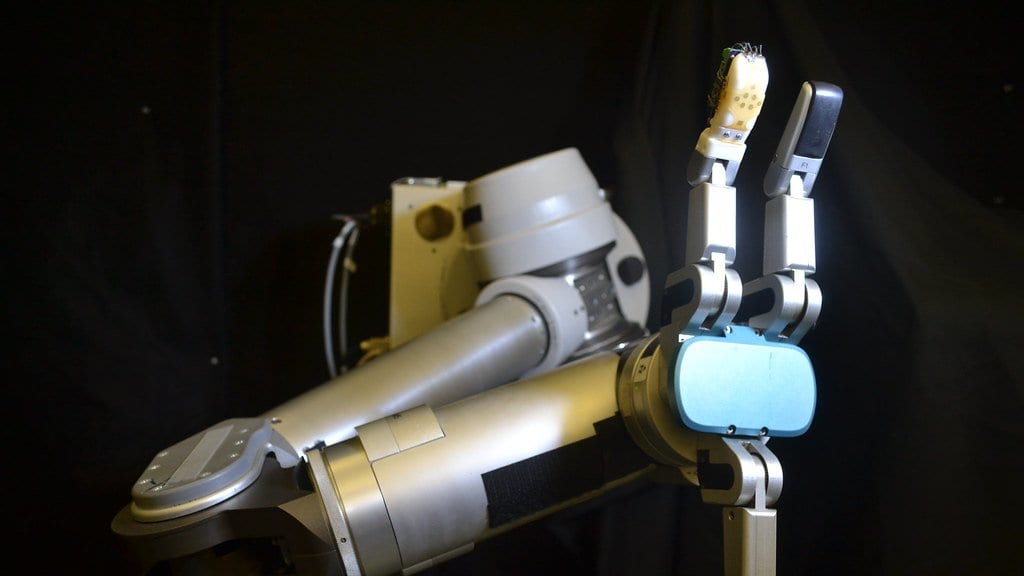
A robotic gripper closes on a pencil lead half a millimeter thick and does not snap it. The same hand meets something sharp and pulls back. Neither trick turns mainly on how sensitive a single touch sensor is. Both turn on a problem that sounds like plumbing: how thousands of sensors spread over a robot's body can all report without talking over one another, or arriving too late to be of use.
That problem is the subject of a paper published Oct. 16, 2026, in Nature Machine Intelligence by Zhibin Li, Chuan Fei Guo and colleagues, working mainly at the Southern University of Science and Technology in Shenzhen. The authors open with a comparison. Human skin gathers and encodes signals from more than 200,000 mechanoreceptors, the body's touch detectors. The sensor arrays built for robots have far fewer sensing points, and they read them one after another.
Reading one sensor at a time is the part that does not scale. The delay before a signal arrives grows with the number of elements to be visited. Signals start to bleed into their neighbors. And the volume of data to be moved rises. Those three costs (latency, crosstalk and bandwidth) all grow as the elements are packed closer together. That is the trap. The obvious route to a more lifelike skin is more sensing points per square centimeter, and it makes the reading harder at the same time.
The team's device is an iontronic skin, which senses through ions rather than electrons. Their answer to the reading problem is to stop polling the sensors and give each one an address instead. A unit's position on the skin is encoded as its own frequency. Because the frequencies are distinct, many units can put their signals onto the same channel at the same time, and a decoder at the far end can work out which reading came from where. Radio stations share the air the same way. Nothing in the array has to wait its turn, and the authors report the system running at a rate of 100 frames per second.
That encoding is only the first stage of three, and the paper's larger claim is about the stack rather than the sensor. The team calls the architecture neural-hierarchical, after the way the human sensory system passes information upward in stages. Signals are encoded at the skin, converged on the way in, and only then handed to a model that interprets them. The convergence step is where the data problem gets solved. The team reports that a compression stage at the back end cuts bandwidth consumption by hundreds of times, leaving a stream light enough for a small model to work on.
The paper gives two numbers for scale: 1,110 sensing units per square centimeter, and more than 10,000 units in all. On humanoid robots, the skins resolved surface features of 300 micrometers in fine tactile work. The demonstrations run over a robot's body and through its hands. A skin maps the textures of a coin and of fabric. A robotic palm reads contact contours and sharp points. A gripper holds a 0.5-millimeter pencil lead steadily, and a soft solder wire thinner still.
One demonstration is the flinch. The skin registers what the authors call nociceptive stimuli, meaning contact that signals damage, and the robot withdraws from it. In another video a hand takes hold of a spiny chestnut safely. A machine that notices damaging contact and pulls away from it is a machine less likely to wreck itself on the job. The word choice is worth keeping as the authors made it: nociception is the detection of a harmful stimulus, not the experience of pain, and nothing in the paper claims the robot feels anything.
Two things make the work checkable from outside. The tactile interaction datasets and the code behind the visualization, the model training and the interactive control are public under an MIT license at github.com/jioy/NI-skins, with a Zenodo archive. And the journal publishes its reviewer reports beside the article. Chuan Fei Guo is affiliated with Sycsense Technology, a Shenzhen company, as well as with the university. The paper states that the authors declare no competing interests.
How far this goes is a question the authors answer in their own words, and they are careful with it. The work, they write, paves the way for humanoid robots to "approach human-level perception and manipulation." Set against the number they open with, the operative word is approach.
Sources
- Nature Machine IntelligencePeer-reviewed