A Bucket of Water, and the Likely Source of Kīlauea's Quiet September Vents

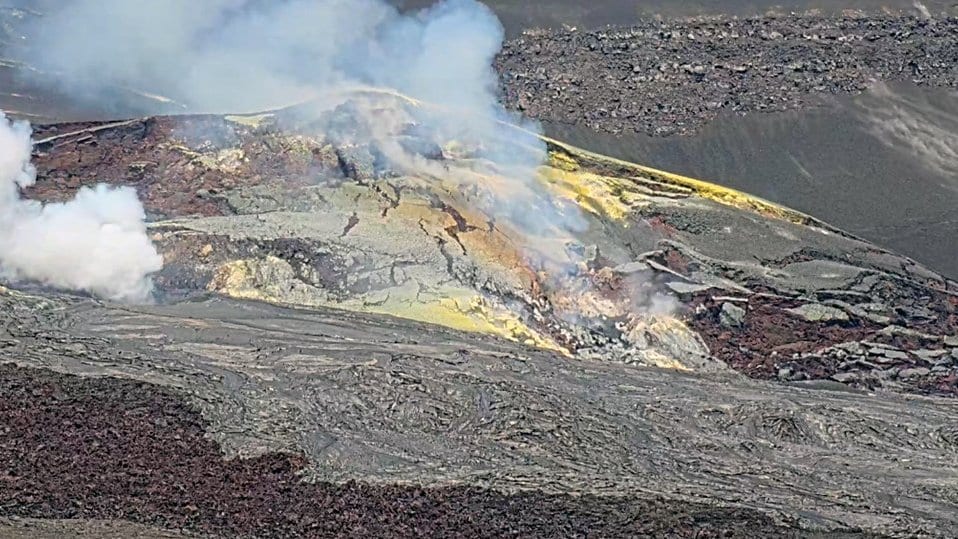
The quickest way to learn where a volcano's lava came from is to walk up to it with a bucket of water. Geologists at the USGS Hawaiian Volcano Observatory did that in the middle of September 2026, at six fissures that had just opened along the western wall of Kīlauea's summit crater, scooping molten rock into the bucket so that it chilled to glass before it had time to change.
Those vents opened from Sept. 14 to Sept. 16, 2026, and they opened almost quietly: no earthquake swarm, and no ground movement that satellite radar could see. Where the lava inside them came from is the question HVO geologist Heather Winslow and USGS data scientist Marco Bagnardi take up in the observatory's weekly Volcano Watch column, published Oct. 15, 2026. The lava most likely came from the shallow magma chamber beneath Halemaʻumaʻu, the same one that feeds the eruption's ordinary fountaining episodes.
The bucket is why they can say even that much. Lava that cools slowly at the surface keeps changing on the way: crystals grow in it, and the chemistry of the melt around them shifts. A piece picked off a cooled flow is partly a record of the cooling rather than of the eruption. Water stops that within seconds, and what survives is the chemistry the magma had underground, along with the crystal sizes it arrived with, which geologists call its texture.
The quenched lava came back mostly glass, with very few crystals, and about 6.9 weight percent magnesium oxide. That is very close to the tephra, or airborne fragments, thrown out during episode 54, the last fountaining episode before the vents opened. The first of the column's three inferences follows from the magnesium: the new fissures were not fed by fresh magma from deeper down, which would have carried more of it and been much hotter.
The second comes from the crystals, or their absence. Another way to open a quiet vent is for rising pressure to squeeze leftover mush out of an older lava lake buried under the crater floor, and that mush would be crowded with crystals. The column's electron microscope images set three textures beside one another: flow lava from an earlier episode, full of small crystals; tephra, all glass and no crystals; and the new vent lava, which has none either and looks more like the tephra than like the flows. The third inference is what is left standing. Similar magnesium and almost no crystals point to the shallow chamber. That reading is the observatory's own rapid analysis, published in a weekly outreach column rather than a peer-reviewed paper, and the two datasets behind it were measured and interpreted inside HVO.
The other half of the record is in the ground itself. The Uēkahuna tiltmeter measured about 13 microradians of downward tilt toward the center of the crater during that episode on Aug. 25, 2026, a slope change far too small to feel and an unmistakable sign of pressure falling as the fountain drained the reservoir. By Sept. 7, 2026, the tilt had returned to where it sat before the fountaining, and the summit vents began to overflow, which told the observatory that pressure had been rebuilt. Then came a break in the pattern that had made the episodes predictable: the overflows arrived and the fountaining did not. The summit went on pressurizing instead, intermittently, with satellite positioning instruments recording uplift and stretching across the whole summit area.
Then the pressure found an exit. The six vents run between 250 and 1,000 meters north of the main vent complex, and they sit about 45 meters below the base of the northern vent. Radar images from orbit, spanning Sept. 11 to Sept. 27, 2026, caught no significant movement of the ground near them or anywhere nearby; the satellite data came from the Italian Space Agency. The authors read that absence as evidence in itself: magma either slipped through cracks that were already there or opened a path of its own without badly fracturing the rock it passed.
What the noisy version looks like arrived two weeks later. From Sept. 30 to Oct. 1, 2026, magma pushed northeast of the erupting vents and never reached the surface: more than 100 earthquakes, significant deformation of the ground, fresh cracks across the caldera floor, and no lava. The quiet September openings and that loud October intrusion are one system under one pressure, taking different routes out.
Kīlauea has been erupting episodically inside its summit caldera since December 2024, and its alert level is WATCH. HVO reports the summit is still highly pressurized, with conditions favorable for another fountaining episode or for some other change. The September analysis does not say which comes next. It says that when the volcano opened six new mouths in the wall of its crater, the chemistry gave no sign that anything new had arrived from below; what came out was what was already there.