At the Leaf, Wind Saves Water. Across a Whole Landscape, It Spends More

Stand in a dry field on a windy afternoon and it is easy to assume the wind is stealing water from the plants around you. For a single leaf, that has been known to be wrong for about a decade. In 2016, two researchers at ETH Zurich, Stanislaus Schymanski and a co-author, showed with theory and with experiments that moving air mostly helps a leaf. Wind carries heat away, so under strong sun the leaf stays cooler and loses less water, while the carbon dioxide it needs keeps arriving. Leaf water use efficiency, meaning carbon gained per water lost, goes up.
A study published Oct. 15, 2026, in Nature Climate Change asks the same question of whole fields and forests, and the sign reverses. Xiang Wang and Zheng Fu of the Institute of Geographic Sciences and Natural Resources Research in Beijing, with 18 colleagues, report that during the growing season the water use efficiency of most land ecosystems falls as wind speed rises. A windier growing season means the landscape gives up more water for each unit of carbon it fixes, not less.
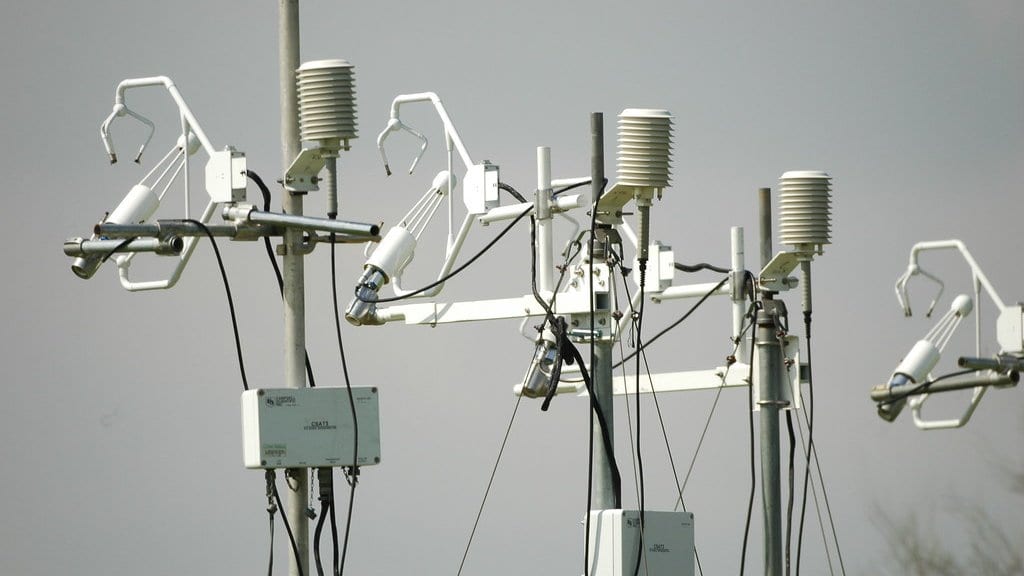
The record behind it comes from eddy covariance towers, instruments that log the gas and water moving between land and air. The measurements cover about 146 sites in the ICOS, AmeriFlux, OzFlux and FLUXNET2015 networks. The decline splits into two unequal parts, and the order matters. Most of it is water: stronger wind raises evapotranspiration, the water leaving soil and plants for the air. A smaller part is carbon: gross primary productivity, the total the vegetation takes in, falls too.
The route is aerodynamic. Still air against a leaf and inside a canopy works as a buffer; wind thins that layer and couples the surface to the atmosphere above, which during the growing season is usually thirstier than the canopy is. The chain runs through three quantities: how easily moisture is carried away from the canopy, how much the pores let through, and a standard index of how tightly canopy and air are tied together. To keep the weather out of the comparison, the sensitivity tests hold air temperature, rainfall, carbon dioxide, sunlight and the dryness of the air steady while wind varies. The authors call wind a regulator of the carbon and water exchange rather than its cause, and the wording is careful for a reason: the towers recorded what the air did, and no one turned the wind up to see what followed.

Both results can stand because they describe different objects. A leaf is small enough that cooling dominates its water budget. A canopy is big enough that its connection to the air above dominates, and wind works on that connection. The paradox was not lost on the people who checked the paper: Nature Climate Change names Stanislaus Schymanski as one of its two peer reviewers. The scientist whose leaf-scale result points the other way reviewed the ecosystem-scale paper that reverses it. The second named reviewer, Haohao Wu, led a global analysis in 2025 that found plant productivity measurably sensitive to wind speed.
The second half of the paper is modeled, and it answers a different question. Earth system models reproduce the negative relationship the towers measured, which is the test of whether they can be trusted with it at all. The same models then project the ratio forward under the standard emissions paths. Those projections are model output, not measurement, and the paper does not claim that any observed change in efficiency has been traced to wind.
That projection is where the result turns awkward. Land winds have been slackening for decades, and the models slacken them further the higher emissions go. So in the paper's projections the high-emission paths, with their deeper stilling, raise water use efficiency. The low-emission paths weaken the stilling and shrink the gain. The wind half of that rests on work outside this group: a 2022 study in Earth's Future by Deng and colleagues projects that the slackening continues across Northern Hemisphere midlatitudes through the century under middling and high warming, and that only deep emissions cuts interrupt it and probably turn it around after mid-century.
None of that is an argument for high emissions. Water use efficiency is a ratio, not a harvest: a landscape can take in more carbon per unit of water while getting less of both, and the heat and drought of a high-emission world reach the same plants by other routes. The leaf-scale paper even points the other way on the same trend. It estimated that the decline in wind speeds already measured could have cut leaf-level efficiency by about as much as rising carbon dioxide has raised it.
What the new work adds is a sign and a mechanism at the scale at which a landscape's water budget is actually set, for a variable the carbon and water literature has treated as background. Wind's effects on growth, on plant plumbing and on the timing of the seasons had been measured before. The global accounting for the exchange rate itself had not. The preprocessed data and the analysis code are posted openly, so the next group to test it does not have to start at the towers.