Ice Cliffs Break Apart Faster Than Models Assume, but Don't Run Away
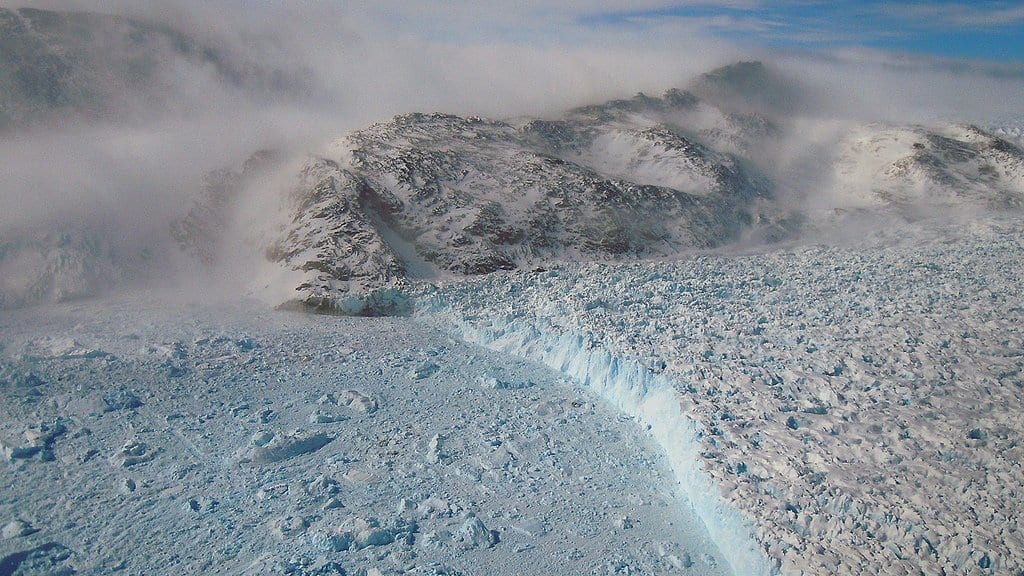
A team at the Woods Hole Oceanographic Institution, MIT and the University of Michigan has measured 15,330 ice cliffs around the margins of the Greenland and Antarctic ice sheets with satellite laser altimetry, and reports that the tall ones break apart faster than ice sheet models assume. The same cliffs gave no sign of the runaway collapse that tall ice is supposed to set off.
The survey, published Oct. 15, 2026, in Science, was built to test an idea called marine ice cliff instability: once a cliff standing in water passes a critical height, it gives way under its own weight, and the retreat behind it runs away. The authors note that cliffs tall enough to show the effect have rarely been observed, and closing that gap is what the measurements were for.
Across the survey, the paper reports, cliff height tracked three things closely: the thickness of the raft of icebergs and sea ice packed in front of the cliff, the depth of the water the cliff stands in and how heavily the ice above is cracked.
Both halves of the result bear on models. The authors draw two conclusions from them. Model projections may underestimate how much ice these cliffs shed over periods shorter than a year, because tall cliffs break apart faster than the simplified rules written into ice sheet models allow. And the potential for instability depends on several quantities rather than on cliff height alone, because the glaciers thinned and backed into ice that does not thicken much farther inland, and the retreat stopped feeding itself.
The work was led by Caroline Needell of the MIT-WHOI Joint Program in Oceanography and Applied Ocean Science and Engineering, with Catherine C. Walker of Woods Hole and Jeremy N. Bassis of the University of Michigan. The paper credits the National Science Foundation, NASA, the Department of Energy and the UK's Natural Environment Research Council among its funders.
Sources
- SciencePeer-reviewed
- www.whoi.edu