A Rocket Sampled a Radio-Bending Cloud in Five Places at Once

Picture watching a street parade through a crack in a wall. Whatever passes the slit, you see. What passes to the left and right of it you miss, and the sliver you do see tells you nothing about whether it is typical. That is the standing predicament of a sounding rocket: one flight, one path, one line of numbers drawn through something that may be lumpy in every direction.
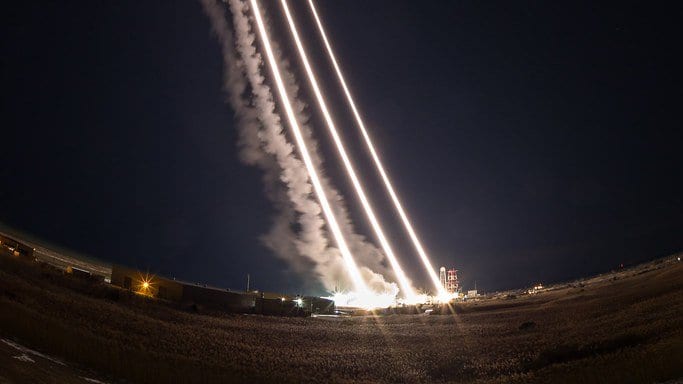
On Aug. 24, 2022, a rocket lifted off from NASA's Wallops Flight Facility in Virginia to try a way around it. About 100 kilometers up, inside a thin nighttime sheet of metallic haze, it let go of four small probes called dropsondes. They drifted away from the main payload and from one another, each measuring the plasma along its own track and radioing the numbers back to the ground. Together with the instrumented rocket body, that made five sets of measurements inside one layer at one moment.
The mission was called SpEED Demon, and the account of what its probes recorded appeared in August in the peer-reviewed Journal of Geophysical Research: Space Physics. The lead author is Henry Valentine, who did the work at Embry-Riddle Aeronautical University and is now a researcher at the U.S. Naval Research Laboratory. The mission's principal investigator is Aroh Barjatya, a professor of engineering physics at Embry-Riddle.
What is new in that is the vantage point. Radar and other measurements made from the ground have pointed for decades at layers that are lumpy rather than uniform. What nobody had done was go inside one and measure it in more than one place at the same time.
They are called sporadic E layers: sporadic for the way they appear and vanish without much warning, E for the region of the upper atmosphere where they form. The raw material is meteors. Rock and dust burning up on their way in leave behind traces of iron, magnesium and other metals, which occasionally gather into dense, cloud-like sheets in air that is already partly ionized. They are invisible from the ground and very good at reflecting radio waves. "Sporadic E layers are, in one sense, giant mirrors of radio frequency waves in the sky," Barjatya said in NASA's account of the mission.
A mirror in the sky is a problem for anyone who needs to know where a signal went. Transmissions meant to travel a short distance turn up hundreds of kilometers away; air traffic controllers and marine radio operators hear distant conversations as though they were local; radars that look beyond the horizon register targets that are not there. The effect reaches the phone in your pocket, too. "The biggest source of error in the GPS in your phone, for example, is from the plasma in the ionosphere, and sporadic E layers can contribute to this uncertainty," Valentine said.
Studying them is awkward. They sit too high for a weather balloon and too low for a satellite, and they assemble and disperse on their own schedule, which leaves sounding rockets, launched on short notice when a layer appears. Barjatya's image for the limitation of a single rocket is the crack in the wall. "Now with multiple sensors, we've turned that crack into a picket fence," he said.
What the picket fence showed is more specific than it sounds. All four dropsondes detected the same population of small-scale irregularities in the ion density: ripples with peak wavelengths of 20 to 40 meters, found along four separate tracks through the layer at the same moment. That is the part a single rocket could not have produced: the fine structure was general, not a feature of one lucky line. It is not a picture of any individual ripple. The probes are pushed apart as they fall and end up far from one another compared with the size of the ripples themselves, so the five tracks sample the layer rather than resolve it. The ripples were likely associated with an instability driven by the winds moving through the layer.
On the way down, the rocket met something larger: the layer split into two distinct density peaks instead of one. The team compared that profile with radio soundings of the ionosphere made from the ground, with what is known about when and where such layers form, and with simulated density profiles. It came out consistent with the pattern that Kelvin-Helmholtz billows would impose on the plasma: the curling, breaking-wave instability that prints rows of hooks along the top of some clouds. The rocket carried no instrument for the local winds or the electric fields, which is what would settle the question, so the mechanism cannot be confirmed with certainty. Valentine's version, in NASA's write-up: "Rather than a flat pancake, it's closer to a cinnamon roll."
SpEED Demon was built as a technology demonstration: the question was whether probes ejected from a rocket in flight would return usable plasma measurements at all. They did, and the technique has flown several times since: into the paths of two solar eclipses, and in June 2025 from Kwajalein Atoll in the Marshall Islands, aboard a mission called SEED that sampled the same kind of layers nearer the equator. Those papers are still being written. SpEED Demon itself measured one layer on one night, and its lasting contribution is likely to be the method rather than the layer.
Sources
- doi.orgPeer-reviewed
- science.nasa.gov