Three Models of One Galaxy Cluster Put a Supernova's Return at Least 70 Years Off

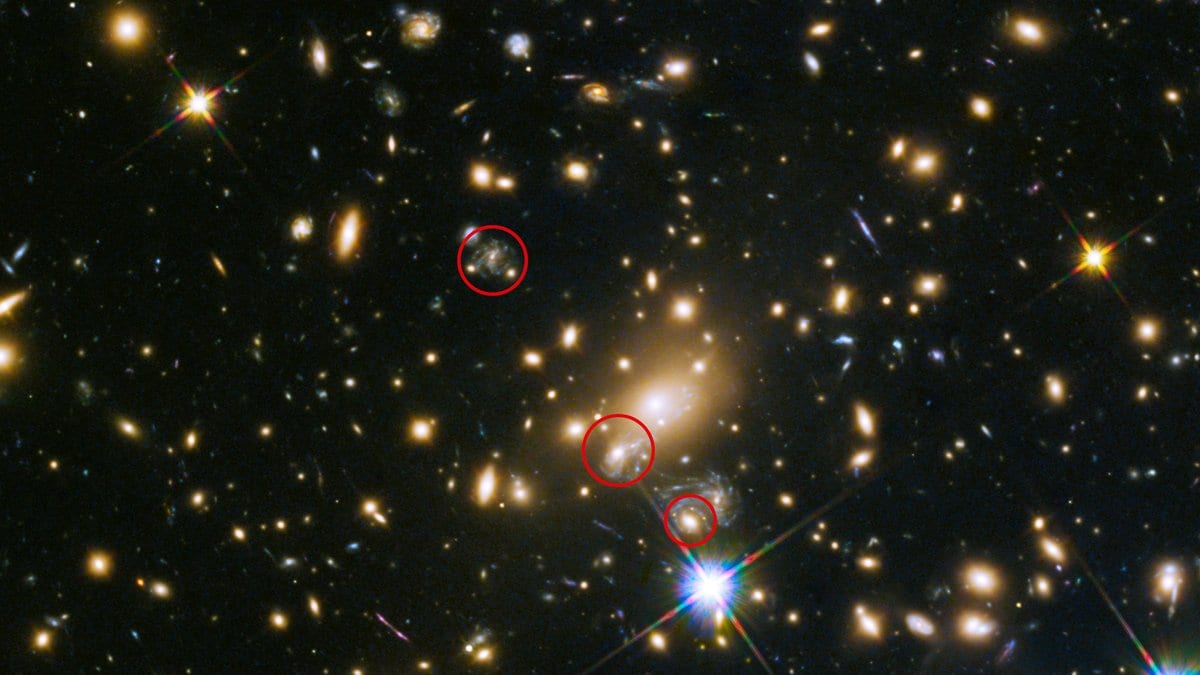
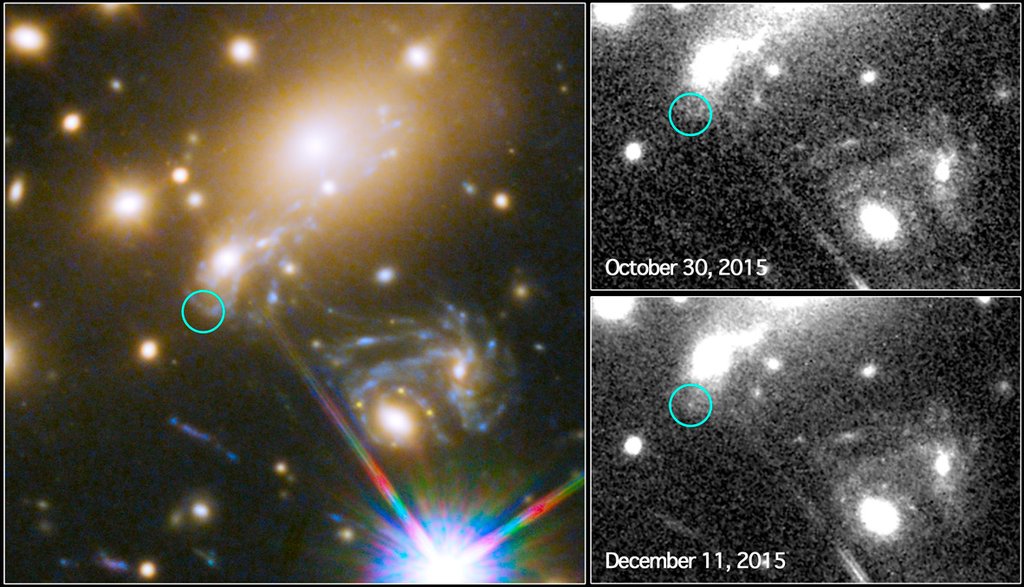
A star behind the galaxy cluster MACS J0308.9+2645 ran out of fuel, collapsed and blew most of itself into space. The light of that explosion turned up in images the James Webb Space Telescope took on Aug. 23, 2025, a faint smudge tucked behind a bright foreground star. What makes it unusual is that the flash was only the first delivery. The same explosion is due to arrive twice more, and the astronomers who catch it will not be the ones who found it.
Conor Larison, a postdoctoral research fellow at the Space Telescope Science Institute, and his colleagues posted the first full analysis of that supernova on Oct. 23. It is a preprint, submitted to The Astrophysical Journal and not yet peer-reviewed. They call it SN Ares. It was found by the VENUS survey, which is using Webb to look deep into rich galaxy clusters, and announced on Jan. 7. What the new analysis adds is the spectrum, which helps identify the type of supernova, and a model of when the other images of the explosion are due to arrive.
MACS J0308.9+2645 is a cluster of hundreds of galaxies, and its enormous mass bends the path of anything shining through from behind. The host galaxy of SN Ares lies almost directly behind it, and the cluster's gravity splits that galaxy's light into three separate images spread across the sky. Each image is light that took a different route through the cluster. The routes are not the same length, and they pass through different gravitational fields, affecting how long the light takes to reach us. So the three images do not arrive together.
Working out which image comes when means mapping where the cluster's mass sits. The team built three models of it independently, with three different pieces of software: Lenstool, glafic and AstroLensPy, each fitted to dozens of background galaxies the cluster shows more than once. All three put the image already seen first of the three, and the authors note that the arrival order follows from the geometry of the system rather than from any particular model. On the length of the wait, the three part company. Lenstool puts the second arrival 70 years after the first, glafic 72 and AstroLensPy 76, each quoting an error of a year or two. Those formal errors are smaller than the differences between the models, suggesting that uncertainty in the mass model matters more than the numerical precision of any individual fit. The last image follows a few years behind the second in all three. All assume the same expansion rate for the universe, and the paper notes that a change of 3 kilometers per second per megaparsec in that rate moves the delays by roughly five years. Its own statement of the prediction is a floor rather than a date: at least about 70 years.
That is by a wide margin the longest delay predicted for any lensed supernova yet found. Most repeat within days or years, and the previous record holder, SN Requiem, has its next image due roughly two decades after the first. The predicted minimum delay for SN Ares is about three and a half times as long. The gap between images depends on the scale of the universe, so a measured delay constrains how fast the universe is expanding, a number the two best ways of measuring it still disagree about. If the delay could be measured precisely, it could help constrain the universe's expansion rate. That is why the authors describe SN Ares as a chance at a highly precise cosmological measurement.
The spectrum is the paper's other half. Webb's NIRSpec instrument took it on Sept. 23, 2025, a month after the discovery images, and it shows helium in two strong lines together with hydrogen. That pairing is the signature of a Type IIb supernova, a massive star stripped of most of its hydrogen envelope but not all of it. The hydrogen rules out the fully stripped kinds of explosion, and the strong helium lines distinguish it from ordinary hydrogen-rich supernovae. The authors call SN Ares the most distant Type IIb identified from a spectrum, a claim they keep narrow: that class, and identification from a spectrum. The redshift, a measure of cosmic stretch, is 1.276. It comes from the host galaxy's emission lines, not from the supernova's own light.
Fewer than 10 strongly lensed supernovae have had their spectra taken, among them an unusually bright explosion magnified by a foreground galaxy. The cluster magnified SN Ares about five times, making it bright enough for spectroscopy. Its brightness over time places the observation roughly a month, in the star's own time, after the explosion peaked. Nothing about the star itself had to be extraordinary for Webb to catch it.
The number everything rests on is not independently checkable today. The methods behind all three lens models sit in papers the collaboration has not published, so nobody outside it can rebuild the prediction, and the authors expect it to move: Webb is set to take multi-object spectroscopy of the cluster in early 2027, measuring more redshifts across the field and potentially narrowing the range of predicted delays. What kind of star it was is a similar inference. The three local supernovae that match Ares best all had companion stars, so the authors consider a multiple-star origin likely, rather than established, and host-galaxy light overlapping the hydrogen feature leaves the size of the envelope poorly constrained.
Catching the return is somebody else's problem. "Such a long anticipated delay between images of a strongly lensed supernova has never been seen before and could be the chance for a predictive experiment that could put unbelievably precise constraints on cosmological evolution," Larison said in the announcement of the discovery on Jan. 7. A monitoring campaign that far out needs a telescope nobody has built, and the paper notes that even the Habitable Worlds Observatory, NASA's next flagship concept, might need servicing in orbit to last long enough.