Only the Models Say the Carbon in Living Plants Recovers After a 1.5 °C Overshoot

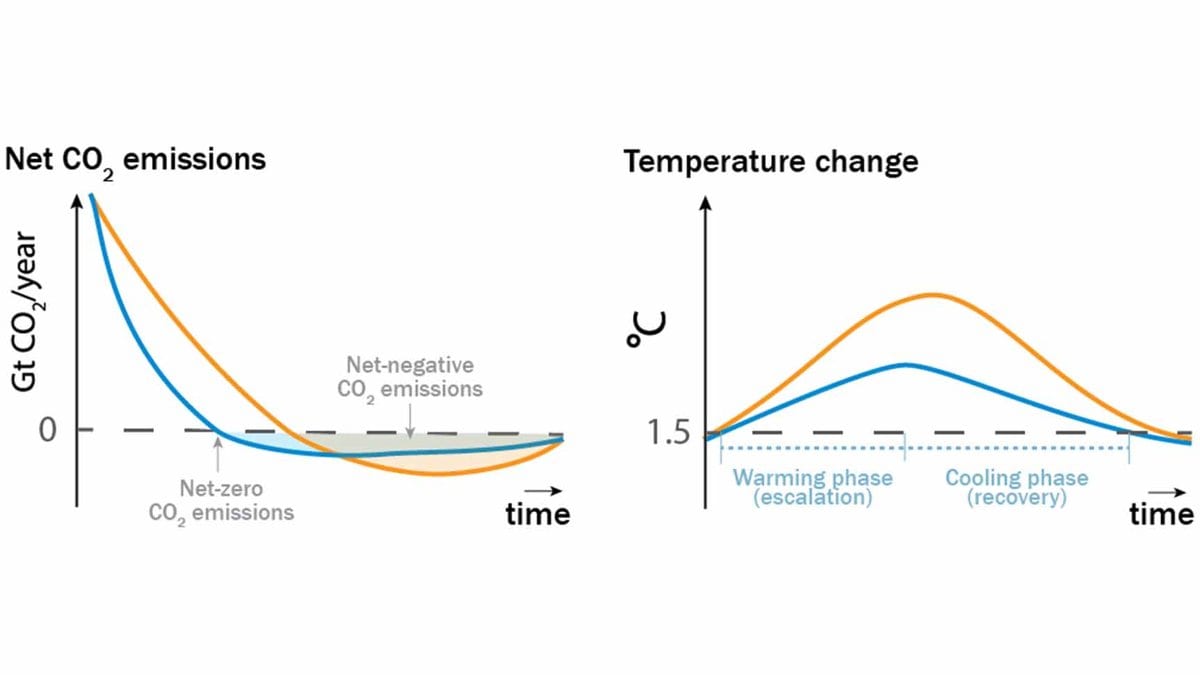
Almost every route the world still has to the Paris Agreement's temperature targets has the same shape. Emissions fall, the temperature peaks somewhere above 1.5 °C, and then carbon removal pulls it back down again. Inside that shape sits a biological assumption that rarely gets said out loud: that when the thermometer comes back down, the living world comes back with it. Forests regrow what they lost. The land returns to taking up carbon the way it did before.
How good is the evidence for that? A synthesis published Oct. 27, 2026, in Environmental Research Letters sets four kinds of it side by side. L E Boeschoten of Q-ForestLab at Ghent University and 30 co-authors drew on global climate models, on field experiments that push plots of land past their normal conditions, on two El Niño events and a European drought, and on warm periods in Earth's deep past. The paper makes no new measurements of its own; it is a reading of evidence that already exists, published as a peer-reviewed letter in a collection the journal devoted to overshoot. Only one of them is reassuring, and it is the one made of models.
The models are the current generation of global climate simulations, known as CMIP6. Run through an overshoot, they do show the land getting worse at its job: net ecosystem productivity, the land's net carbon uptake, declines after peak warming. In these runs it never turns negative. The land keeps taking up a little more carbon than it gives back, so the carbon stored in living plants stops falling and settles. A separate experiment, in which modelers ramp CO₂ up and then back down, goes further: those models predict that the carbon in living plants is close to reversible, ending up near where it began.
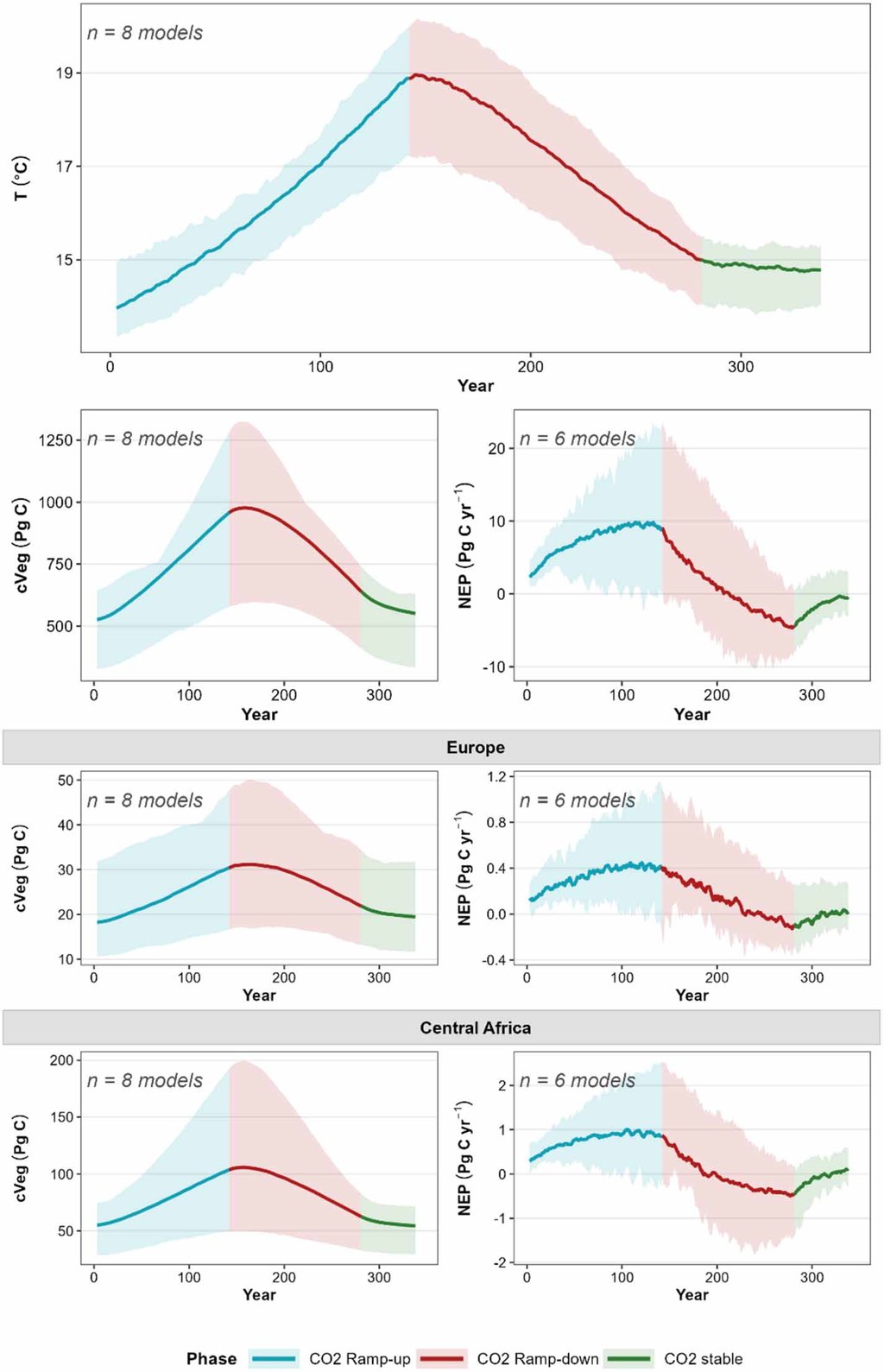
That is a claim about living plants, and only about them. The same modeling line says something less comfortable about the land as a whole, where the project that ramped CO₂ up and down found hysteresis in the land carbon sink: the way back is not the way out. The authors call those persistent legacy effects the core concern, and they write that ecological reversibility during an overshoot cannot be assumed.
The recovery phase almost nobody measured
If the models are the optimistic line, the experiments are a silence. Boeschoten and colleagues searched the literature for studies that warmed a patch of ground, dried it out, watered it, or raised the CO₂ around it. They found 256 such studies. Only 15 of them kept measuring after the treatment stopped. The rest switched a stress on and recorded what happened, which leaves the second half of an overshoot, the part where the stress eases, almost unobserved.
That makes the experimental record an absence rather than a contradiction. Where recovery was measured, the results were mixed, with lasting effects documented after drought, so those studies do not add up to a verdict either way. The authors name the silence itself: a gap in experimental design. Both counts come from their own search, whose underlying dataset is still under embargo, so nobody outside the team can recount them yet. The gap also says what would close it, and it is not expensive in principle: switch the treatment off, and keep the instruments running.
Two El Niños and three dry European summers
The third line is the closest thing to a rehearsal. Three episodes pushed real ecosystems into heat and drought at once: the El Niño of 2015–2016, the European droughts of 2018–2020, and the El Niño of 2023–2024. The first is linked to an estimated loss of 1.3 billion metric tons of carbon from plants above ground, most of it in Africa and the rest in tropical America. The second El Niño was weaker by the standard indices. It still arrived alongside record global temperatures and produced a tropical carbon anomaly comparable to the first, with the tropics acting as a net source of carbon in both years. What the three share is the shape of the return. Carbon lost quickly comes back slowly, and each extreme leaves the land a little less able to absorb the next.
The deep past does not give its changes back quickly
The fourth line goes back much further, and it shows how long a lag can run. Two warm episodes carry the argument. During the Holocene Climatic Optimum, a warm phase several thousand years ago, a cooling that lasted only a few hundred years was enough for grasses to spread across much of Europe. A short climatic wobble produced a continent-scale change in what grew. The Paleocene-Eocene Thermal Maximum is the larger case. The planet warmed by roughly 5 °C over 10,000 to 20,000 years, then took about 200,000 years to drift back to its background climate. The carbon held in the living world lagged even that: its recovery ran 70,000 to 100,000 years behind. Neither episode is a forecast for a modern overshoot, and the authors do not offer them as one. Its warming alone unfolded over tens of thousands of years, nothing like the pace of the present one. What the records show is narrower and still uncomfortable: once an ecological threshold is crossed, the changes in vegetation and in the carbon cycle can outlast the climate event that caused them.
None of this is a prediction of collapse, and the paper does not make one. Its conclusion is about uncertainty. The authors write that the trajectory of carbon on land during an overshoot is uncertain, because ecosystem responses are "often delayed, nonlinear, and threshold dependent." Delayed means the damage shows up long after its cause. Nonlinear means a small extra push can produce a large change. Threshold dependent means there is a line, and crossing it is not the same as getting close to it.
That bears directly on how overshoot is used in policy. A pathway that overshoots the target and then comes back down is, in its accounting, partly a bet that ecosystems will hand back what the peak took from them. On the evidence as it stands, the support for that bet comes mainly from models. The measurements say something slower, and in the case of the experiments, they have barely been asked.
Sources
- Environmental Research LettersPeer-reviewed