A Cosmic Magnifying Glass Reveals Odd Ultraviolet Light From a Distant Supernova

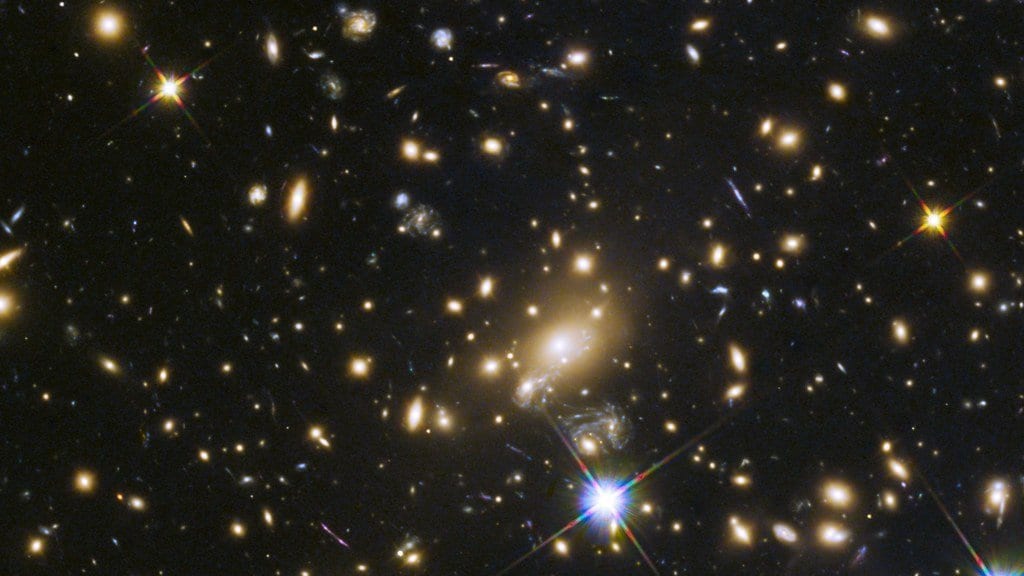
The star blew up when the universe was about a quarter of its present age, and by the time its light reached Earth it should have been a smudge: too faint to take a spectrum of, too faint to follow for months. Two galaxies in the foreground changed that. They were almost exactly along the line of sight, bent the light around themselves and concentrated it, splitting one explosion into four separate images and making the brightest of them far brighter than the supernova ever was.
That is SN 2025wny, first detected by the Zwicky Transient Facility in the late summer of 2025 and identified by Joel Johansson of Stockholm University and colleagues as the first gravitationally lensed hydrogen-poor superluminous supernova, a class of explosion that outshines an ordinary core-collapse supernova by a factor of 10 to 100. Their discovery paper, published in The Astrophysical Journal Letters in December 2025, resolved four images of the supernova around the foreground lens and put the magnification of the brightest at 20 to 50 times.
Paper II of the series, posted as a preprint on Aug. 28 and led by Maggie L. Li of Caltech, is about what that magnification bought. Photometry and spectroscopy came from JWST, Keck, the VLT, Gemini, the Palomar 200-inch, the Fraunhofer Telescope at Wendelstein and the Liverpool Telescope. Together they cover the first 80 days after peak in the supernova's own frame, about eight months as seen from Earth, since the expansion of the universe stretches time along with wavelength.
The first thing that campaign did was take the drama out of the object itself. Divide the lens magnification back out and SN 2025wny peaks at 4 × 10^44 ergs per second or a little more over the rest-frame ultraviolet and blue optical, which is bright and thoroughly ordinary for a superluminous supernova. That correction is model-dependent, drawn from comparisons with better-studied nearby explosions. What is exceptional here is not the supernova. It is the view.
There is a reason to want explosions from this era in particular. Stars in the young universe formed from gas with fewer heavy elements in it, which should weaken the winds that strip a massive star while it lives and leave it heavier and spinning faster when it dies. Supernovae are one of the few ways to check what that does to the end of a massive star's life, and superluminous ones are visible far enough away to sample it.
Distance also helps in an unexpected way. Light that leaves the supernova in the far ultraviolet is stretched on the journey and arrives at ground-based telescopes as visible light. The ultraviolet is where metal lines, the ionization state of the gas and the signature of whatever powers the explosion are written. Only about 21 superluminous supernovae are known at comparable distances, and most are represented by a scatter of measurements near peak and a single ultraviolet spectrum. This one, Li and colleagues write, has the most detailed rest-frame ultraviolet record of any superluminous supernova anywhere.
What the record shows is awkward. Between 20 and 60 days after peak the far ultraviolet carries more continuum than it should, with sharp features cut into it. Over the same stretch the far-ultraviolet light curve flattens into a plateau, and the temperature inferred for the emitting surface goes up rather than down. Metal lines that usually smother ultraviolet light in these objects are barely present. Singly ionized oxygen, which gas this hot should produce, leaves no obvious absorption. Carbon is there, hydrogen is there, and helium may be.
None of the standard ways of powering a superluminous supernova obviously accounts for that combination. The usual candidates are radioactive nickel-56 left in the debris and the spin-down of a newborn magnetar buried inside it. Two more involve what surrounds the star: a collision between the ejecta and hydrogen-poor material it shed before it died, or matter falling back onto the compact object the collapse produced. Fitting light-curve models to SN 2025wny suggests the explosion may require a hybrid or non-standard power source, pointing to a gap in the standard picture rather than a definitive replacement mechanism.
The findings were submitted to a focus issue of The Astrophysical Journal as part of a broader series on SN 2025wny. While the object's lensing and classification rely on the published discovery paper, the ultraviolet physics represents a new discovery.
The reason to spend this much telescope time on one explosion is arriving soon. The Vera C. Rubin Observatory and the Nancy Grace Roman Space Telescope will turn up distant superluminous supernovae in quantity, most without a lens in front of them and most known from little more than a light curve. Li and her co-authors argue that SN 2025wny, watched this closely, is the reference those thinner datasets will be read against.