Why Mars Kept Its Krypton and Lost Its Carbon

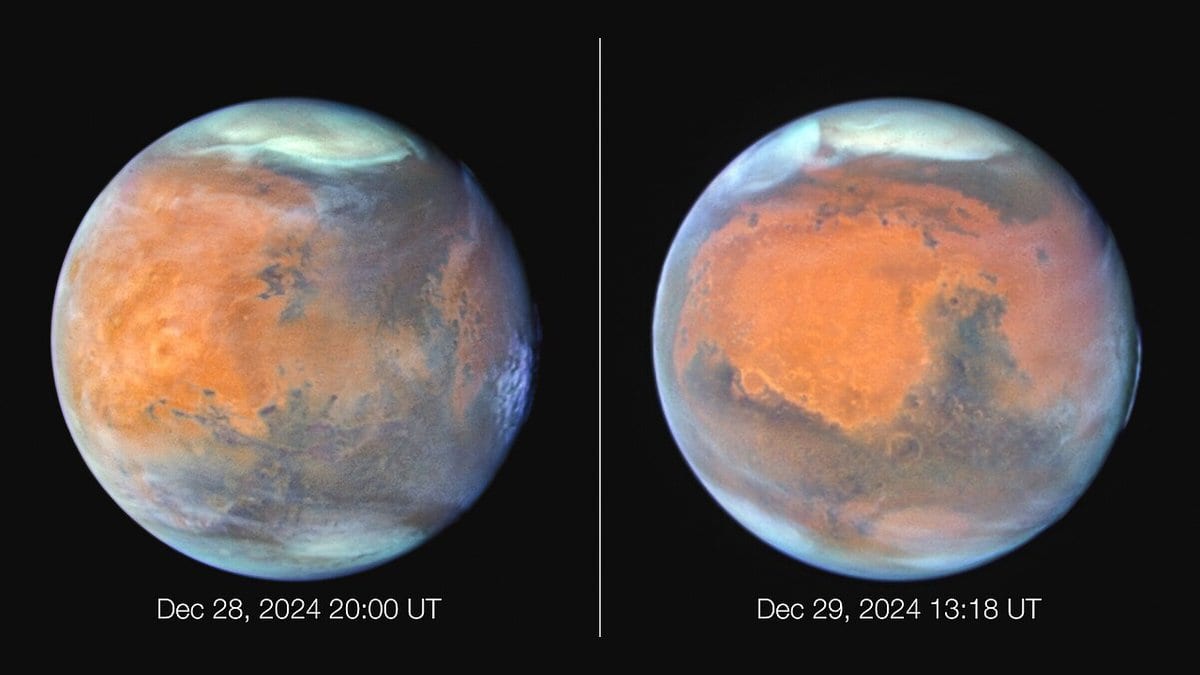
Mars has lost most of its air. Its krypton, though, is essentially where it started — a heavy noble gas still sitting in what is left of an atmosphere that a young Sun's wind spent hundreds of millions of years pulling at. A wind that empties a planet is easy to picture taking everything with it. This one sorted.
Working out which gases a wind takes and which it leaves is a problem at least half a century old, solved until now only one case at a time, with the escaping gases named in advance by whoever set up the calculation. Mara Attia and Tim Lichtenberg of the University of Groningen posted a general solution on Aug. 31: a pair of coupled equations rather than a costly simulation, in which the identity of the escaping gases is an output instead of an assumption. The work has been submitted for publication and not peer-reviewed. General is the authors' own word, and scoped: their wind is neutral, at a single temperature, with no chemistry in it.
The condition they find is about composition, not about how thick or thin an atmosphere is. A wind sorts gases only when the bulk of the atmosphere is heavy: operationally, when the light carrier is below roughly 1%. In such an atmosphere, the wind strengths needed to drag each gas away spread over four decades, in a fixed order running from hydrogen up through carbon, oxygen and sulfur to krypton and xenon. In a hydrogen-rich one, the same sequence is squeezed into a factor of 26, which is inside the uncertainty on the laboratory coefficients that set it. The sorting is still there. Nobody could measure it.
They checked the algebra against a purpose-built simulation of a transonic multifluid wind, which reproduces its fractionation factors to a few parts in ten thousand for gases well clear of their thresholds. The simulation shares the same frame, so it tests the arithmetic rather than the assumptions underneath it, and near a threshold it resolves a small tail of gas still leaking that the algebra sets to zero by construction.
The Solar System already ran the experiment
A meteorite called NWA 7034 carries an argon isotope ratio that records atmospheric escape on Mars 4.4 billion years ago. Attia and Lichtenberg scanned model histories for the ones that reproduce that measured ratio while losing at least half the planet's argon, and found that every surviving history removes at least 88 percent of the atmosphere's carbon and none of its krypton. Carbon's threshold, in other words, is below krypton's in every composition they tried. This is a constrained model scan rather than a new measurement, and every history that reaches the meteorite's band carries its carbon as carbon dioxide rather than carbon monoxide.
Venus looks at first like a counterexample. It lost a heavy, water-derived atmosphere and still holds abundant argon whose isotopes look solar. That is not what a sorting wind should leave behind. In the general solution, fractionation is a near-threshold effect: a gas far below its threshold is barely touched, one far above is carried off wholesale. Across four water-derived compositions, every history that strips the hydrogen and oxygen while keeping argon inside the measured band entrains at most 3 percent of it. Venus's untouched argon therefore bounds how hard its wind blew rather than contradicting the sorting.
Earth is where the solution stops. Its atmospheric xenon is isotopically heavy by about 4 percent per atomic mass unit, and Archean samples show that fractionation was still growing until roughly 2.1 billion years ago, while its krypton carries no escape signature at all. No neutral wind the authors can solve produces that pair. Krypton's threshold is below xenon's whatever the temperature or the depth of the gravity well, so any wind that reaches xenon has already taken krypton: every history matching the xenon record strips at least 77% of the krypton and fractionates the rest well past what the same samples allow. That is a null pointing outside the authors' own frame: toward xenon escaping as an ion, alone among the noble gases, dragged out along open magnetic field lines by a channel this solution does not cover.
Seventeen planets that could break it
Turned outward, the same thresholds become boundaries on a plot of starlight received against escape velocity: above the line, a planet's wind strips that gas. The family of boundaries reduces to the energy-limited form of the proposed cosmic shoreline, the single divide between planets that keep an atmosphere and planets that go bare, and then splits it into one boundary per gas. The escape-rate prescription is the weak point: it shifts every boundary together by roughly a factor of 12 in absolute flux, though the spacing between them does not depend on it.
The prediction covers seventeen low-mass planets in JWST's current thermal-emission programs, ranked by whether they can hold on to sulfur, the heaviest element a secondary atmosphere carries in any abundance. GJ 367 b sits far on the stripped side, LHS 1140 b far on the retaining side. The decisive cases are the pairs that share a star, and therefore the same irradiation history: TRAPPIST-1 b and c fall on opposite sides of the sulfur boundary, with the inner planet stripped and the outer spared. The authors name their own confounder: interior outgassing can resupply what a wind removed, so a single planet holding a gas it should have lost proves nothing, and only the pattern across the sample tests the physics.
The part a reader can check
For an unreviewed result, the strongest thing going for this one is that it is checkable. The reference implementation with its automated tests, the validation simulation with every stored run, the analysis code behind every figure and count, and the binary-diffusion-coefficient library with per-pair provenance are all deposited at Zenodo under an Apache-2.0 license, with a README mapping each element of the paper to the command that produces it. Table 1 recovers nine published escape formulas as special cases, each recovery an automated test against that code, and two come back only in corrected form.
Speed is the practical payoff. One evaluation takes under a millisecond, against minutes to an hour for a single converged run of the simulation it was tested against, which means a planetary evolution model can sort its escaping gases at every timestep instead of inheriting a two-gas formula and a carrier chosen by hand. On one published planet configuration, choosing the wrong carrier costs a factor of about 2,000. Peer review has not happened yet; in the meantime, anyone who doubts a number in the paper can run the command that made it.