A 26-Year Swing in Where Zero Longitude Falls on Mars

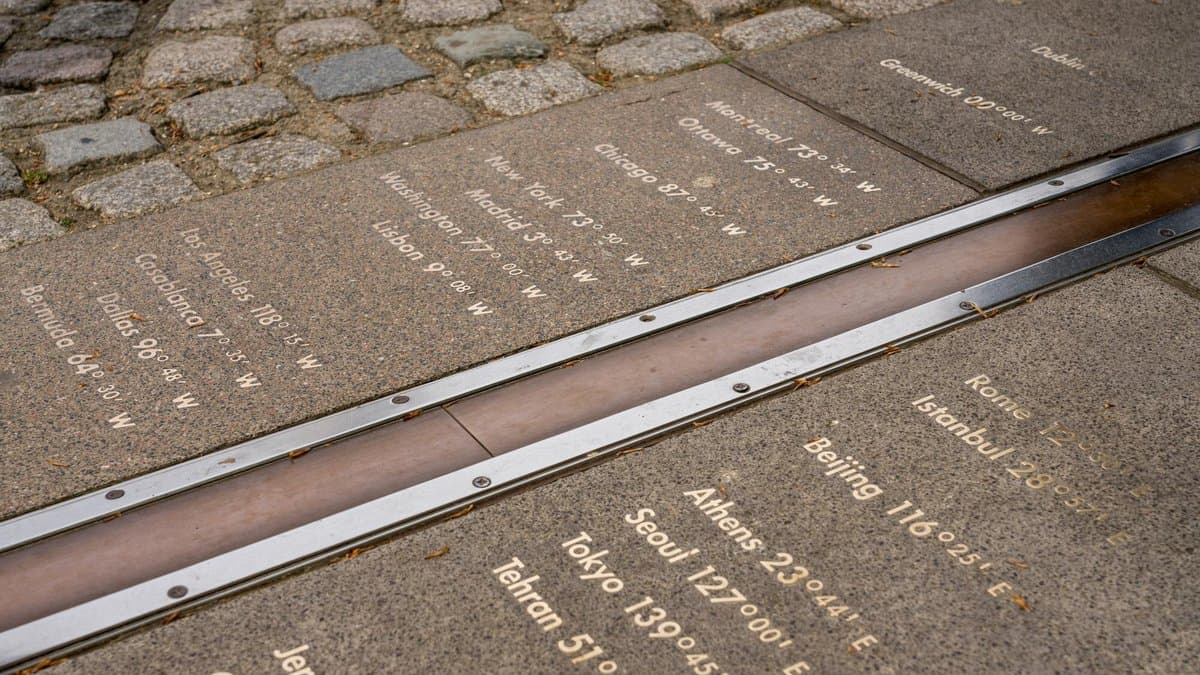
Zero longitude on Earth is a line through Greenwich. On Mars it is a small crater called Airy-0, and the line runs through it by definition. Every map coordinate on the planet, every landing ellipse, every rover position ever radioed home is measured from there. Which raises a question that sounds pedantic and is not: where is that line right now?
The answer depends on how far Mars has turned since you last looked, and Mars does not turn at a perfectly even rate.
A solution published Sept. 14 in The Planetary Science Journal now puts a figure on the unevenness. Alex S. Konopliv of the California Institute of Technology, with Sébastien Le Maistre of the Royal Observatory of Belgium and colleagues at both institutions, combined radio tracking of three spacecraft in orbit around Mars with tracking of four that were on its surface. The orbiters are Mars Reconnaissance Orbiter, Mars Odyssey and Mars Global Surveyor. The landers are Viking Lander 1 and 2, Mars Pathfinder and InSight, a tracking record that begins in the 1970s.
The landers are the more sensitive measure of Mars' rotation, since a transmitter bolted to the ground is carried around by the planet itself. But the orbiters, the paper reports, "provide evidence of long-term changes in the rotation rate of Mars." The team models that long-term drift as an oscillation in the position of the prime meridian, 245.7 ± 7.7 milliarcseconds in size, repeating every 25.8 ± 0.5 years. The milliarcsecond-scale swing can be put into perspective as roughly four meters of ground at the Martian equator.
Four meters is nothing at all if you are looking at Mars from a distance. It matters a great deal if you are trying to set a lander down on a chosen spot, or to tie a picture taken by Viking to one taken by an orbiter half a century later.
That period is close to the length of the record it emerges from. Mars Global Surveyor began returning tracking data in 1997, and an orbiter has been overhead almost continuously since. The landers anchor the earlier end, but only as snapshots: Viking in the late 1970s, Pathfinder in 1997, InSight from 2018. So the decadal term rests on less than one full cycle of observations, which is why the paper's own title offers it as an indication of decadal changes rather than a measurement of them. The new orientation model also lines up with the orientation results InSight produced on its own, which matters: the orbiter and lander measurements are sensitive to different things, and they did not have to agree.
None of this makes Mars newly unsteady. Its spin rate has a known seasonal swing, measured since Mars Pathfinder landed. Every Martian winter freezes part of the atmosphere onto a polar cap and every summer gives it back, and shifting that much mass changes how fast the planet turns. In 2023, Le Maistre and colleagues reported evidence of a slow acceleration in the Martian rotation rate from InSight's radio tracking, a trend they wrote could come either from the planet's internal dynamics or from its atmosphere and ice caps. What the new solution adds is the decadal term, seen from orbit rather than from the ground, along with a more precise estimate of the spin pole and a new gravity field.
The practical product of all this is a coordinate frame, and it is the frame everything else on Mars hangs from. Orientation and gravity are solved together, which is why the paper also delivers a new gravity field for the planet, MRO120G. The resulting model places Mars' spin pole, meaning where the axis points, to within about a meter, and fixes the prime meridian's position relative to earlier epochs to somewhere between one and ten meters. Those are the numbers used to locate a landing ellipse and a rover's position.
Rotation and gravity are also ways planetary scientists probe what is inside a planet, since both respond to how its mass is arranged. The same style of measurement, applied to InSight's tracking, helped constrain the radius of Mars' liquid core. Whether the decadal swing turns out to be a genuine cycle or the first arc of something slower, the answer will come from the evidence that accumulates. The orbiters are still up there, and the record grows by a year every year.
Sources
- The Planetary Science JournalPeer-reviewed
- doi.org