Skip to content
See the World Through ScienceA project of ALLATRA

Where the Sun Connects to Earth's Magnetic Shield Keeps Shifting, NASA's TRACERS Reports
Space

Republish this story

Our work is licensed under Creative Commons BY-NC 4.0. You may republish this piece for free — with credit to ALLATRA Media and a link to the original, unedited beyond length trims, and not for commercial use.

Read the full license

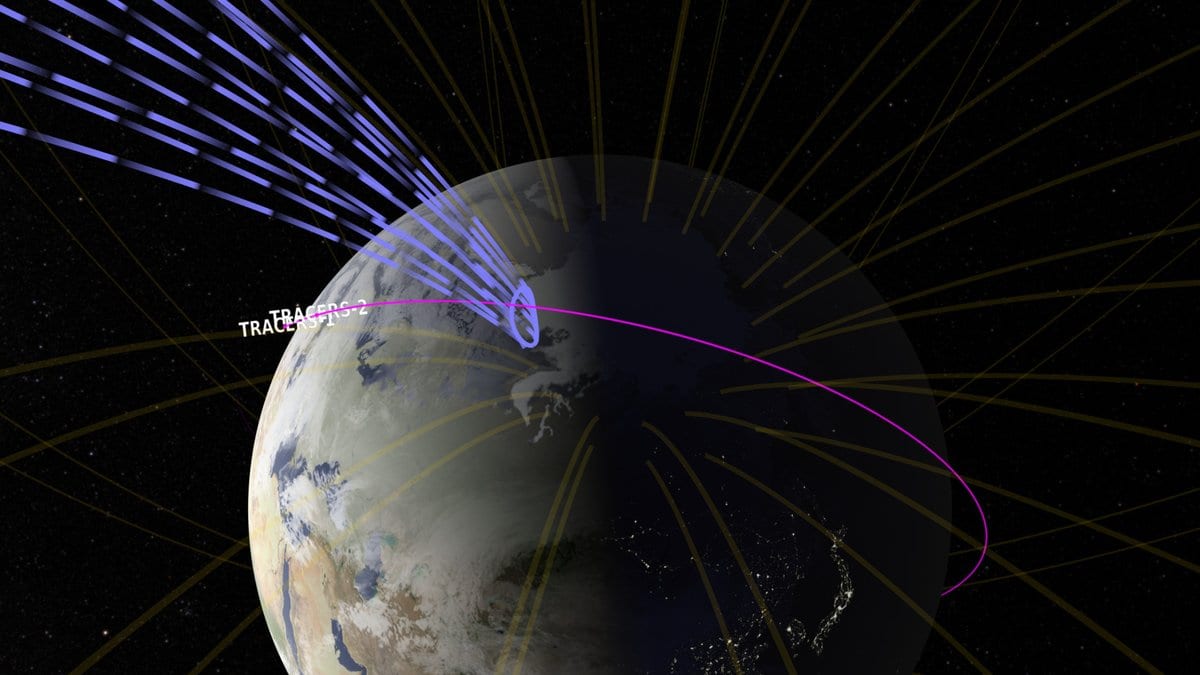
A visualization of Earth from space with yellow magnetic field lines, a purple funnel over the northern polar region, and a magenta orbit track labeled for the two TRACERS satellites.
The magenta track carries the two satellites one behind the other through the purple funnel, where solar wind particles stream down along the field lines drawn in yellow."TRACERS through Earth's Polar Cusps (SVS5555)" by NASA's Scientific Visualization Studio - Global Science and Technology, Inc./Tom Bridgman, eMITS/Lacey Young, NASA/GSFC/John Charles Dorelli, Lockheed Martin Solar and Astrophysics Lab/Steve M. Petrinec, ADNET Systems, Inc./Laurence Schuler, ADNET Systems, Inc./Ian Jones, via Wikimedia Commons, Public domain

NASA's twin TRACERS spacecraft have returned their first science result, published Oct. 29, 2026, in the Journal of Geophysical Research: Space Physics. The authors report that magnetic reconnection, the explosive linking of the Sun's magnetic field to Earth's, varies mainly by where it happens rather than by when, and they call the result preliminary.

The mission was built to settle that one question. The paper gives its goal as determining whether reconnection at the magnetopause, the outer edge of Earth's magnetic shield, is primarily variable in space or in time across a range of solar wind conditions. NASA says that the answer matters because reconnection is the fundamental link between the solar wind and the space around Earth, and that studying it helps forecast the geomagnetic storms that can disturb power grids and communications.
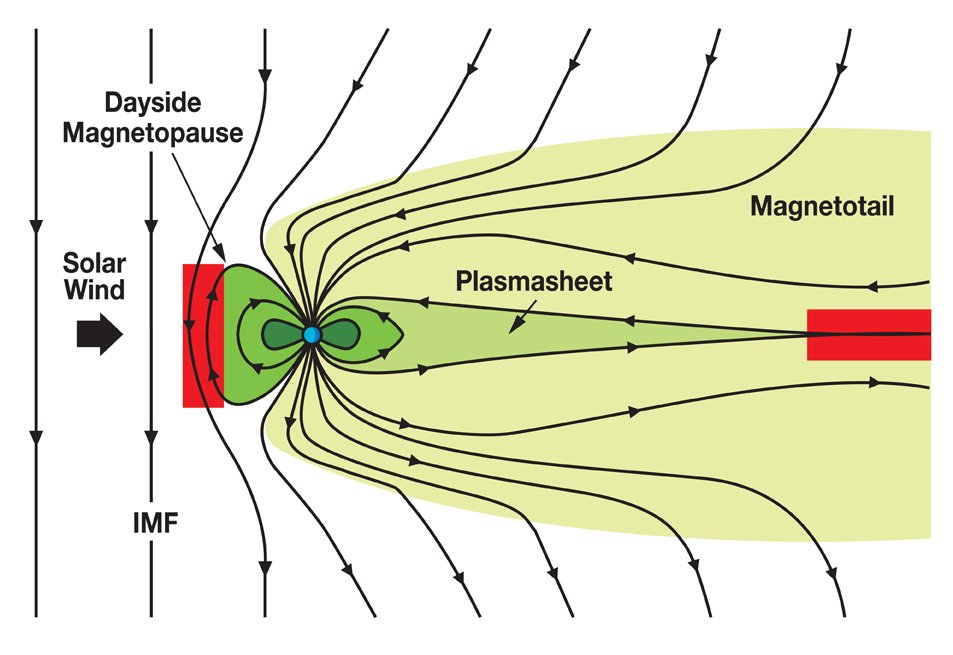
A schematic of Earth magnetic field lines swept back by the solar wind, with red boxes marking reconnection regions at the dayside magnetopause and far out in the magnetotail.
The red patches mark where field lines break and rejoin: on the dayside boundary at left, and far down the tail at right. The arrows at the left show the solar wind and the interplanetary magnetic field. "Magnetic reconnection zones in the earth's magnetosphere Science 1 th-jpg" by NASA, via Wikimedia Commons, Public domain

The measurements are tandem cusp passes recorded from November 2025 to February 2026 by the Analyzers for Cusp Ions instruments on the two spacecraft, which fly one behind the other through the magnetic funnels over Earth's poles. The authors report that spatial variability dominated by at least a factor of two, across every orientation of the Sun's arriving magnetic field and every solar wind pressure they tested. Almost all the passes they classified as spatial showed "some temporal variability embedded in the larger spatial variability," and more tandem passes are needed to verify the preliminary results.

"Analyzing the data TRACERS collected gave our team a clearer view of solar wind particle behavior and how it connects to reconnection events," said Stephen Fuselier, the paper's first author and the mission's deputy principal investigator at the Southwest Research Institute in San Antonio. NASA's post says future measurements will help confirm the results.

The agency approved an extension in September 2026 that runs into spring 2027, and the spacecraft now observe the southern cusp several times a day.

Sources

Spot an error?

Spot an error?

Report an error

Spotted a mistake on this page? Tell us what's wrong and our editors will take a look.

What kind of problem?

Only if you'd like us to be able to follow up. We won't use it for anything else.

We correct mistakes openly. Select any text to flag it. Fixes are logged under our Corrections Policy.

Report an error

Reporting on

Where the Sun Connects to Earth's Magnetic Shield Keeps Shifting, NASA's TRACERS Reports

What kind of problem?

Only if you'd like us to be able to follow up. We won't use it for anything else.

We read every report. Corrections are logged publicly.