A Pair of Swinging Pendulums Did the Computing to Balance a Third

A pair of double pendulums drove a torque-limited pendulum from hanging to upright and held it there, with no equations of the pendulum they were controlling. Fan Ye, Fumiya Iida and colleagues at the University of Cambridge report the result in Communications Engineering, published Oct. 30, 2026.
The group calls the method physical reservoir control. In reservoir computing, a messy physical system's own dynamics do the computing, and only a simple readout of its measured state is trained. The pendulum sends its angle and speed to the hardware; the hardware sends back a torque. The authors write that conventional control needs precise models or heavy training data.
The authors call the task a canonical nonlinear-control benchmark. Torque in their setup is capped so tightly that direct actuation moves the pendulum only 14.48 degrees from hanging, so energy has to be pumped in over repeated swings. A controller with no model has nothing to plan from.
The reservoir is two double pendulums, driven at their upper joints by servo motors and free at the lower ones. The pendulum they control is simulated in MATLAB Simulink and trades signals with the hardware in real time, so the computing is mechanical and the controlled pendulum is not.
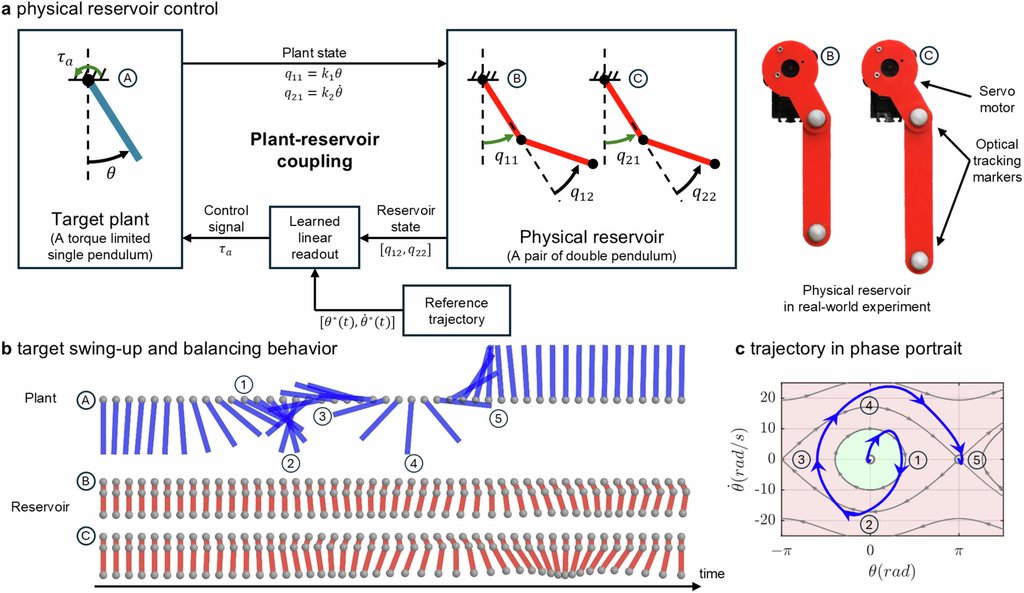
The group released the pendulum from near upright, recorded 20 seconds of free swinging, and fitted the readout by ridge regression, a standard linear fit. The torque it learned from came from acceleration alone; gravity and damping were left out as unknown without a model. In the hardware run the pendulum reached upright at 17.49 seconds.
The authors report that torque pulses up to 0.062 newton meters knocked the balanced pendulum down, and it swung itself back up; stronger ones left it hanging.
Driving the double pendulums with their own periodic signal instead of the pendulum's state made the swing-up fail; swapping them for a four-node oscillator network still worked. The demonstration covers that one task: the authors write that more complex systems will likely need reservoir designs tailored to them, beyond the present work. Their data and code are posted on GitHub.
Sources
- Communications EngineeringPeer-reviewed