Giant Black Holes Switch on Their Jets Where Small Ones Do

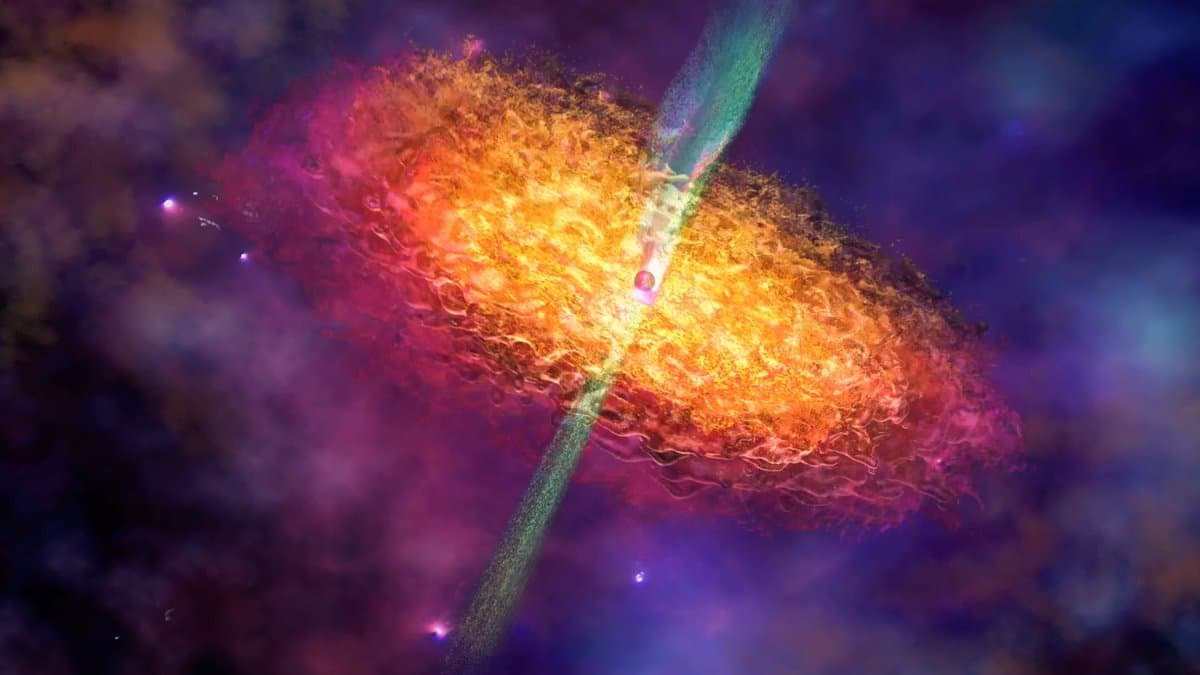
A black hole the mass of a star is, by the standards of this subject, in a hurry. Gas spirals in, the system brightens over weeks and fades over months, and somewhere on the way down a jet of plasma switches on and shoots out along the axis. Astronomers have watched that sequence in the X-ray binaries of our own galaxy for decades, often enough to know roughly where on the dimmer switch the jet appears.
A supermassive black hole does the same thing on a timescale no career can cover. In an ordinary active galaxy, the feeding flow changes over thousands of years, so the moment a jet is launched cannot be pinned down in any single system. One of the oldest suspicions in the field has therefore gone untested: that a black hole a million times heavier behaves, in this respect, exactly like a small one.
Adelle J. Goodwin of the International Centre for Radio Astronomy Research at Curtin University and Andrew Mummery of the Institute for Advanced Study in Princeton found a stopwatch instead. They used tidal disruption events, the flares that follow a star straying close enough to be pulled apart. A shredded star supplies gas to the black hole on a timescale of years rather than millennia, and the disk that forms can be followed as it evolves. That compresses the evolution of a giant black hole's feeding flow into something a telescope campaign can follow. Their analysis was published Sept. 17 in Nature Astronomy.
What they report is two outflows, not one. Early on, while the black hole is being fed faster than it can comfortably swallow, gas is driven off in a super-Eddington phase. Later, well down the fading curve, a second and physically distinct outflow appears. It is that delayed one that carries the result.
It appears at a critical accretion rate of about 0.02 times the Eddington luminosity, the luminosity at which radiation pressure can balance gravity under the relevant assumptions. Two percent of the limit. One system, the flare ASASSN-14li, is worked through in detail.
The number itself is not new. Two percent is where black holes of stellar mass have been seen to change state, switching accretion states, for the better part of two decades. The X-ray binary literature constrained that value precisely because those systems run through their cycles so fast. What is new is that the supermassive side landed on it.
The match is approximate, written in the paper with an approximately-equals sign. Individual X-ray binaries scatter around the mark, from a few tenths of a percent of the Eddington rate up to a few percent. Two populations have met in the same neighborhood, which is not the same thing as a constant of nature quoted to three figures.
From that agreement, Goodwin and Mummery argue that the threshold for jet formation is scale invariant, and that one process governs jet launching in all black holes. Their own wording is careful. The match across such different masses, they write, "strongly indicates" it.
That hedge is worth keeping, because the comparison stands on two points. Stellar-mass systems sit at one end and the giant black holes hosting these flares at the other, with nothing sampled in between. An intermediate-mass black hole, the few-thousand-solar-mass kind that is hard to find and harder to catch feeding, would be the obvious middle rung and is not in this work.
The payoff they claim is a prediction. If jets switch on at a fixed fraction of the Eddington rate, then knowing how fast a black hole is being fed tells you whether it will launch one and roughly when. Transient surveys can check that against the flares they turn up over the next few years. The disk-modeling and radio-fitting code is posted publicly, so the framework can be run on somebody else's flare.
It is a claim with a clean way to break it. Find a black hole that fires its jet somewhere else on the dimmer switch, and the universal threshold goes away.
Sources
- Nature AstronomyPeer-reviewed