Astronomers Measure the Distance to a Planet-Size Object Adrift Without a Star
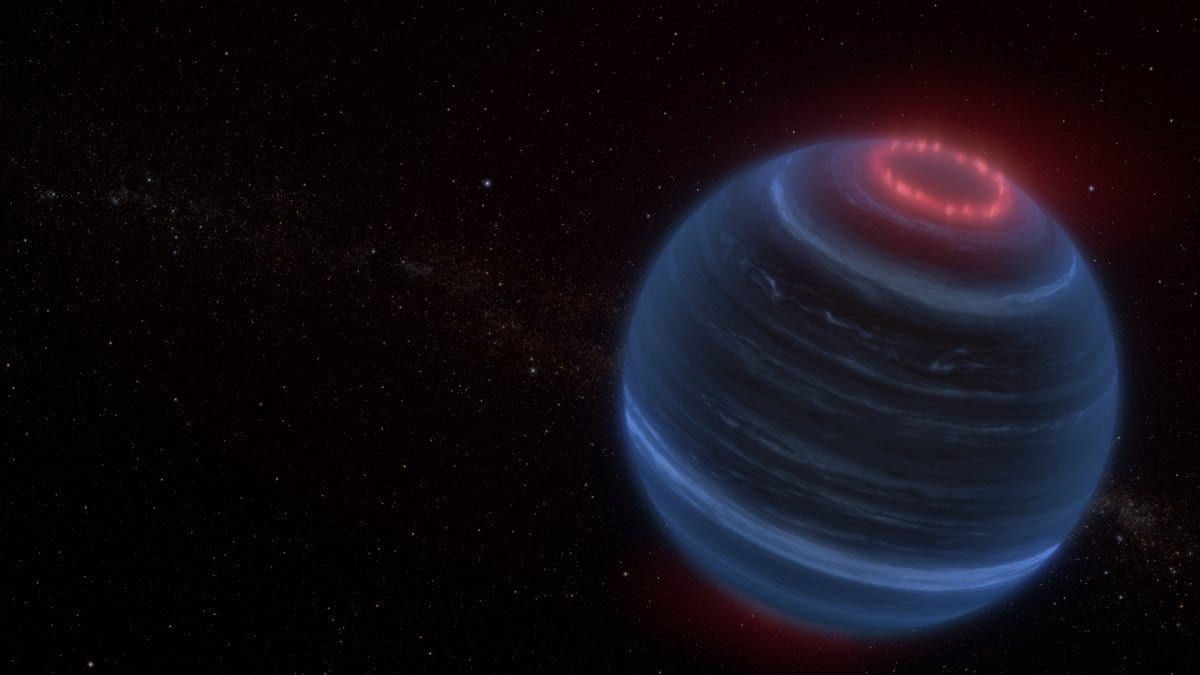
An extremely cold brown dwarf, an object too small to shine as a star, lies 64 parsecs from Earth, about 210 light-years away. It was found in a James Webb Space Telescope survey built to study distant galaxies, and according to the astronomers who measured the distance, it is roughly three times farther than any other ultra-cold brown dwarf whose distance has been pinned down directly.

Once the distance is known, it turns an object's faintness into a real measure of how much light it gives out, and from there into a mass. The authors describe the object, known as JADES-GS-BD-5, as a rare stand-in for mature gas-giant planets and one of the few isolated examples available for studying their atmospheres. Their paper was posted as a preprint on Nov. 5, 2026 and submitted to Monthly Notices of the Royal Astronomical Society; it has not completed peer review.
Feng-Yuan Frey Liu of the Institute for Astronomy at the University of Edinburgh and colleagues worked from repeat images from Webb's NIRCam camera taken about two years apart, tracking the small shift in the object's apparent position as Earth moved around the Sun. Running that distance through evolutionary models, they put the object at roughly the size of Jupiter, with about eight times its mass and a temperature near 300 kelvin, close to room temperature. That places it at the very low-mass end of the brown dwarf population, in what the authors call the planetary-mass regime. They found no companion, no clear change in its brightness and no plausible host star.
The ultra-cold dwarfs found before this one came mostly from NASA's WISE infrared survey and lie close to the Sun. The authors argue that deep JWST fields, which revisit the same patch of sky, reach much fainter objects and can supply their distances. They also report that current atmospheric models do not reproduce the object's measured light in detail.
The same analysis measured how fast eight of the nine other candidate ultra-cold dwarfs in the same survey are drifting across the sky. None of them yielded a second reliable distance.
Sources
- arXivPreprint