A Clue to Earth's Missing Carbon, From a Protostar in Orion

Pound for pound, Earth's rocky material contains about 10,000 times less carbon than the Sun. The element every living thing is built from is the one our planet nearly did without, and years of modeling have not settled how it was lost. One possibility is that carbon was stripped from the dust that became Earth before that dust ever stuck together.
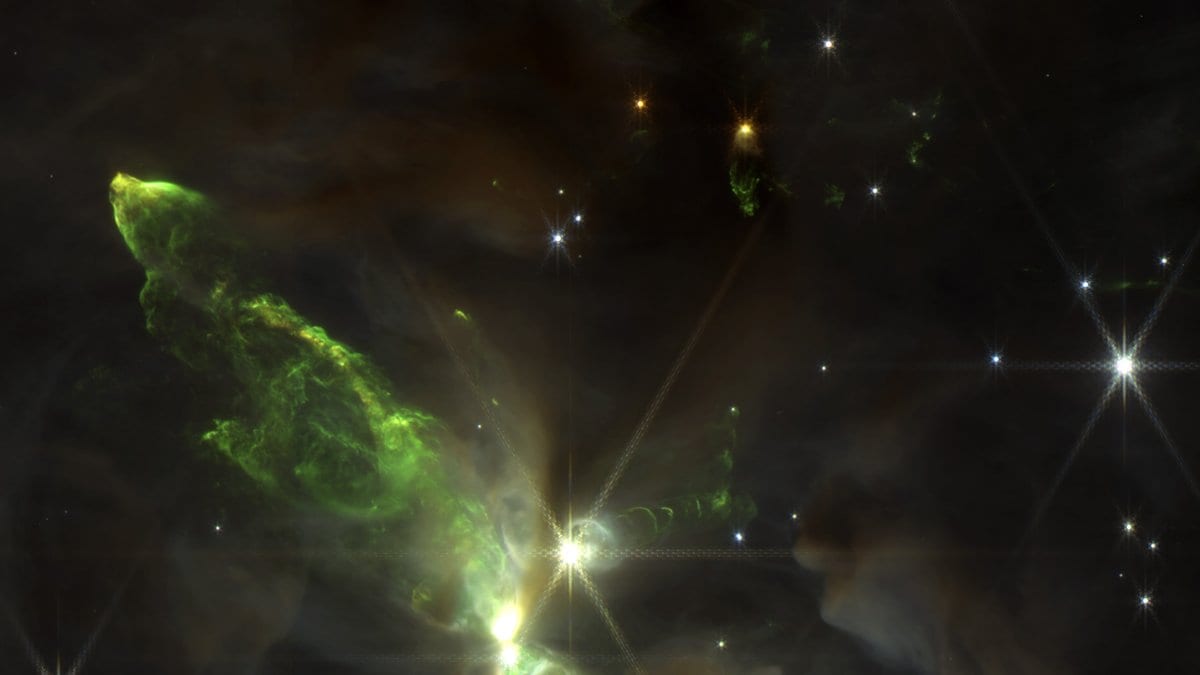
A group led by F.J. Ballieux at Leiden Observatory thinks it has caught part of the process in the act. In a preprint posted Nov. 3, the team reports that the James Webb Space Telescope has detected warm, carbon-bearing gas at the base of a disk wind around HOPS-68, a young protostar in the Orion Molecular Cloud. The gas is thought to originate in the hot inner region where rocky planets assemble. The paper has been accepted for publication in The Astrophysical Journal Letters, but the journal version is not yet available.
What Webb recorded is a set of shadows, bands of infrared light absorbed by molecules along the line of sight to the star's hot inner disk. Two belong to hydrogen cyanide and acetylene, both simple carbon compounds. Fitted with a standard model of a thin absorbing layer, those bands give temperatures of 319 and 432 kelvin, warm rather than searing. Both features are also blueshifted by roughly 40 to 50 kilometers per second relative to the star's systemic velocity. The shift means the absorbing gas is moving toward us. Given the geometry of HOPS-68, the authors associate it with gas flowing outward in a disk wind.
Molecules that are hard to come by
Neither molecule is commonly detected in young protostars. A Webb survey of 18 low-mass protostars in the JOYS program found hydrogen cyanide in two and acetylene in three. In HOPS-68, both are unusually abundant: the column density of each along the line of sight is about 20 times higher than in HOPS-315, the only other known protostar thought to be at a comparable early stage.
The same spectrum may contain a first. A band at 16.1 microns is attributed to triacetylene, a chain of six carbon atoms, which the authors report as the first detection of the molecule in a protostellar system. It is not the first detection anywhere: triacetylene has been seen around a dying star and in another galaxy. No temperature estimate is available, either. The molecular data needed to model triacetylene were missing from the reference databases the team used, so the band could not be fitted. The authors say its narrow shape suggests that the gas may be cold. Methane is detected too, but that is all the paper can establish about it: its band is blended with absorption from methane ice and other gases, and the fit was not robust enough to include it in the final analysis.
The zone the authors have drawn, not measured
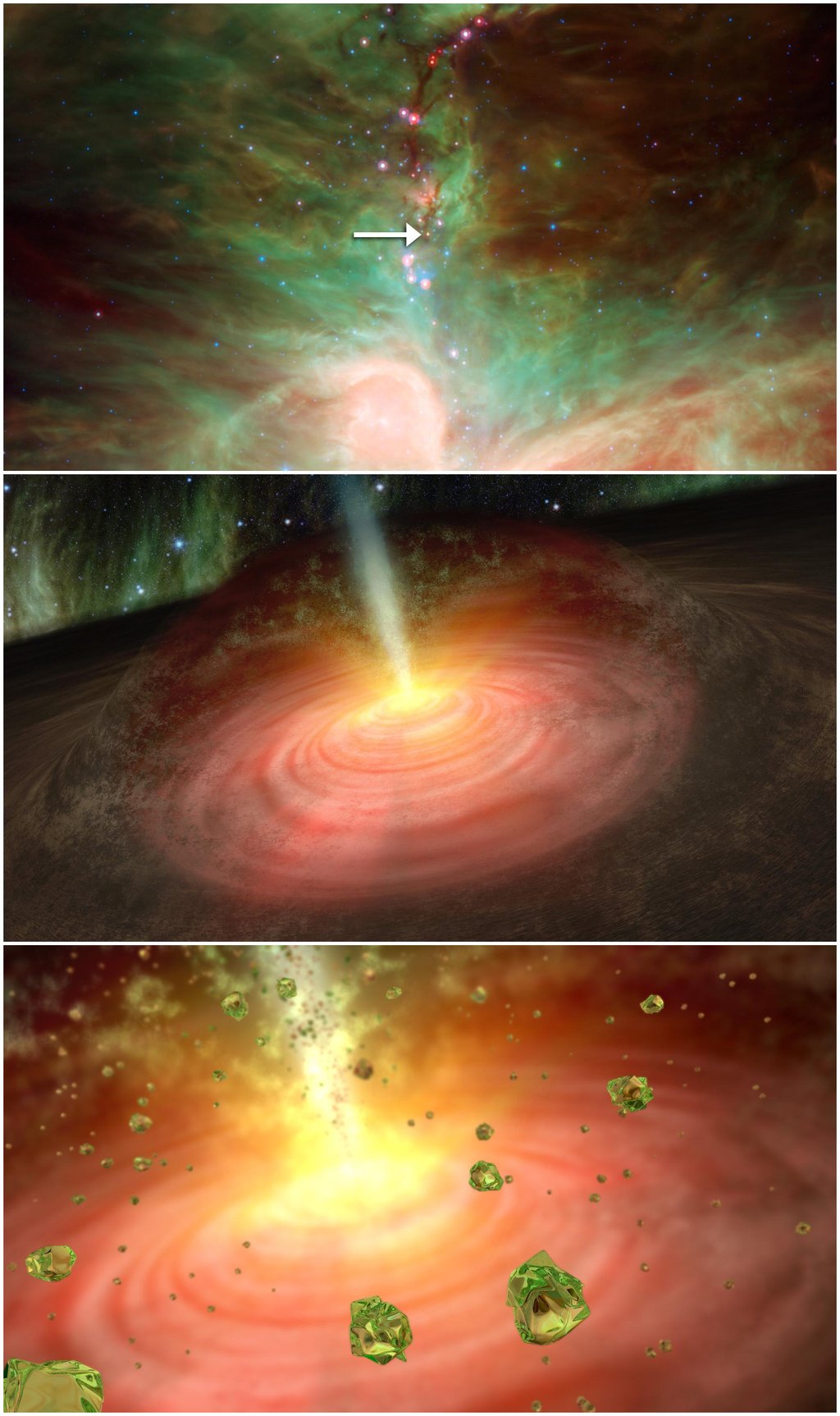
Laboratory experiments and modeling put the soot line, where more volatile carbon begins to leave dust grains, somewhere near 500 kelvin. The most resistant component, amorphous carbon, is thought to remain solid until roughly 1,200 kelvin. Between those temperatures, Ballieux and colleagues argue, refractory carbon should be released from the grains, and they call that band of the disk the "refractory carbon destruction zone." Nothing in the Webb spectrum establishes where those temperatures occur in HOPS-68. The figure illustrating the zone is captioned "Proposed scenario," and its temperature contours are estimated from the model in the companion paper.
That the warm gas is moving is measured; that it is carrying carbon out of the planet-forming region is an inference, and it relies on the same team's earlier work. The hydrogen cyanide and acetylene have temperatures and velocities similar to those the group reported for the oxygen-bearing gas in the same spectrum. ALMA observations had linked that gas, through its motion, to the base of a disk wind, so the authors place the carbon-bearing molecules in the same outflowing layer. The temperature structure of the inner disk and the identification of the wind both come from that earlier paper. Determining how much carbon the wind removes would require measuring the amount of gas it carries, an analysis the authors say is "outside of the scope of this letter" and leave for future work.
Chains built in the outflow, and where they may end up
A second group of molecules behaves differently. A four-carbon chain, the methyl radical and carbon monosulfide all absorb at temperatures of around 40 kelvin. That is cold enough for the team to place them far from the star, in the upper layers of the outer disk or along the walls of the outflow cavity. Archival ALMA data from 2016 show another molecule there: C₂H, a fragment produced when ultraviolet light breaks acetylene apart. It appears along those walls in two lobes that bracket the jet and share its blueshift. From these observations, the authors propose a route to the longer chains, in which C₂H reacts with acetylene to form the four-carbon chain, then helps build the six-carbon one. They also consider another possibility: that the four-carbon chain is debris from larger soot-like molecules, although this star's spectrum shows no evidence of those molecules.
The chains also challenge a standard explanation. Long carbon chains around young protostars have usually been attributed to chemistry beginning with methane released from icy grains in infalling gas. Here, they are found in material moving outward instead. The authors suggest that their proposed pathway could offer an alternative, with the chains forming in outflow cavities rather than in infalling gas. Confirming that pathway in HOPS-68 would require millimeter-wavelength observations of longer carbon chains.
The last step reaches into our own Solar System's record. Samples returned from the asteroids Bennu and Ryugu contain abundant organic matter, including carbon-rich material of the kind found in the fine-grained matrix of primitive meteorites. The team suggests that the chains detected in HOPS-68 could contribute to forming such material. The proposal comes with an important constraint, stated in the paper: because the chains form in the cavity walls rather than in the wind itself, they are not carried away with the outflow and may instead settle back into the outer disk.
All of this rests on one star, caught, the authors note, at a fortunate moment and viewing angle. A second young disk also shows warm, outflowing hydrocarbons. A study of ISO-Oph 37 led by María José Colmenares, published in The Astrophysical Journal May 10, interpreted its absorption bands similarly, as evidence of carbon released from dust grains near the soot line. That paper shares a senior author with this one, Edwin A. Bergin, so it provides a second dataset, not an independent confirmation by a separate team. As for this letter's conclusion that carbon sublimation in HOPS-68 "likely contributes to the mechanism responsible for the carbon-depletion of the Earth," the measurement needed to quantify that contribution is one neither paper provides: how much gas the wind carries away and, from its composition, how much carbon that represents. The team says that analysis is next.
Sources
- arXivPreprint
- The Astrophysical Journal