A Fifth World May Hide in HR 8799, and Two Teams Place It Differently

There is a stretch of the HR 8799 system that conventional direct imaging has struggled to see. Four giant planets circle the star in the best-known set of pictures in exoplanet astronomy, and every one of them orbits far out. Closer in, within a few times the distance from Earth to the Sun, the star's glare makes direct imaging difficult, and the usual fallback fails too: the star pulsates, and its own shivering drowns the small wobble a planet would add. In September 2026, two groups working with different telescopes reported evidence for something in there. They do not agree on what it is, or where.
On Sept. 9, Jayke S. Nguyen and colleagues posted a preprint reporting a candidate fifth planet in HR 8799, detected with the Near Infrared Imager and Slitless Spectrograph (NIRISS) aperture-masking interferometer aboard the James Webb Space Telescope. Eight days later, a group led by A.-M. Lagrange at the Observatoire de Paris posted a different preprint, reporting a fifth companion in the same system from a completely different kind of evidence: the motion of the star itself, constrained by measurements from Europe's Gaia satellite. Neither paper has been through peer review, and the two candidates have very different inferred orbits and masses.
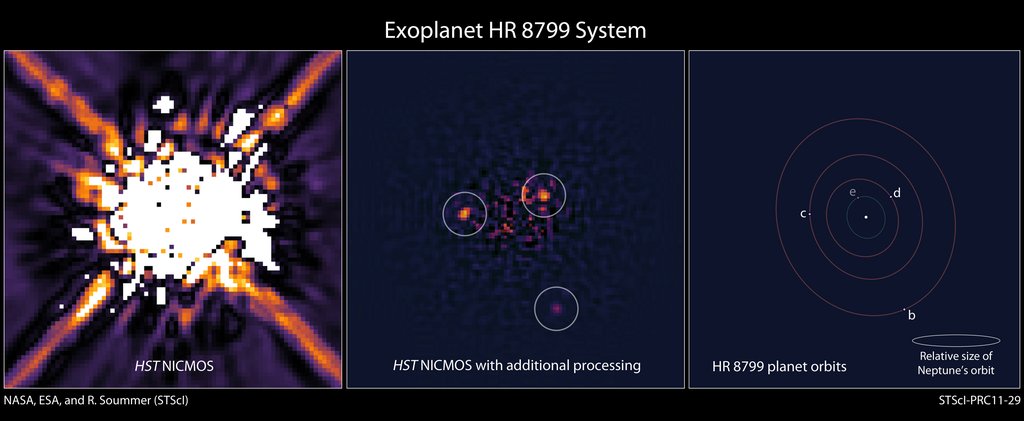
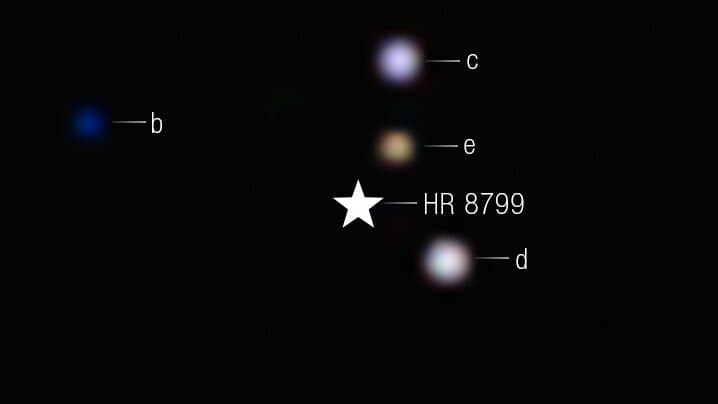
The system earned its status in 2008, when Christian Marois and colleagues published images of three planets circling HR 8799, the first time more than one planet had been directly imaged around another star. A fourth, closer planet, HR 8799 e, turned up in 2010. The four-planet family everyone recognizes has been on view for more than 16 years, and all of those planets orbit far outside the gap these two new papers are about.
The numbers are the clearest way to see the problem. The Webb candidate sits at a projected separation of about 150 milliarcseconds, corresponding to an orbital radius of roughly seven astronomical units, one astronomical unit being the Earth-Sun distance, and a mass the team puts at a few to several times Jupiter's. The Gaia analysis allows orbital solutions spanning about 0.3 to 6 astronomical units, with the probability piling up at two to three, and a mass of 10 to 14 Jupiter masses. The Webb candidate's inferred orbital radius lies outside the range of the Gaia solutions, and is about three times the distance the Gaia analysis favors.
That leaves two candidates in the same detection gap, not one discovery with two witnesses. The clearest sign is what the later paper does not say. The Gaia preprint appeared eight days after the Webb one and does not appear to discuss the Webb candidate. Its only mention of Webb's masking technique is a line about the future, noting that the companion might one day be reachable by Webb or by an interferometer at the Very Large Telescope in Chile. Lagrange's team does not claim anyone has directly imaged its object.
Gaia saw a star that will not sit still
The Gaia evidence is not a picture of anything. It is a statistic. When Gaia fits a star's motion with its standard five-parameter astrometric model, it records how well that fit works, including a goodness-of-fit statistic called RUWE. For HR 8799, that number comes out at 1.47, above the value expected for a well-behaved single-star solution. Something is not fully accounted for by the smooth astrometric model.
The four known planets are not that something. A second measurement, the difference between the proper motion measured over the Hipparcos-to-Gaia baseline and the proper motion Gaia measures now, looked at first like a second hint of a hidden body. When the team modeled the astrometric effect of the four imaged planets and subtracted it, that drift was fully accounted for. The remaining astrometric residuals were not. That gap, and only that gap, is what the team interprets as evidence for a new object.
This also clarifies the one place the two papers appear to agree. The Webb team notes that its candidate's separation is compatible with the Gaia and Hipparcos proper-motion constraints, assuming the object is bound to the star. That sounds like independent support, and it is not: it uses the same astrometric constraint that the Gaia analysis says can be explained by the four known planets.
A planet is the best reading, not the only one
Even taken at face value, the Gaia result does not necessarily point to a planet. About four-fifths of the probability is concentrated in the favored solution, a body near 11.5 Jupiter masses at two to three astronomical units, below the commonly used 13-Jupiter-mass deuterium-burning threshold. The remaining fifth is distributed among much heavier objects closer in, near 40 and even 80 Jupiter masses, which would be brown dwarfs outright. The paper's own title calls the object a companion, not a planet, a distinction the authors keep on purpose.
HR 8799 has produced candidate fifth planets before. The Lagrange paper's own introduction records a tentative signal from Keck telescope at about the same distance, a signal that subsequent analyses of Very Large Telescope data did not confirm. A third hypothesis is already in circulation, and it is a different object again: in 2025, a peer-reviewed study of the system's debris disk by Pedro P. Poblete, Tim D. Pearce and Carolina Charalambous found that models including a low-mass fifth planet beyond the four known ones better reproduced some of the disk's observed structure. That is the version the popular press has already run; it is not this one.
What it would take to settle it
Both teams say what would settle the question, and it is the same answer: look again. The Gaia group writes that future observations are needed to refine the orbit and mass and to test its dynamical picture; a direct detection would pin down the object's position and could reveal its atmospheric properties. The Webb candidate sits only just above the threshold its team set for a believable signal, and a second visit would show whether it moves consistently with a bound companion.
The two candidates even imply different histories. The Webb candidate sits near a possible orbital resonance with the innermost known planet, its orbit ticking in step with it. The Gaia object would interact only weakly with the outer four, which is the paper's explanation for why decades of tracking those four never gave it away, and could also help shape the inner edge of the system's warm dust belt. They may not be describing the same object at all. What both agree on is narrower: the one part of HR 8799 that conventional direct imaging could not reach is no longer out of reach.