A Black Hole That Has Been Feeding Since 1992 Is Going Quiet

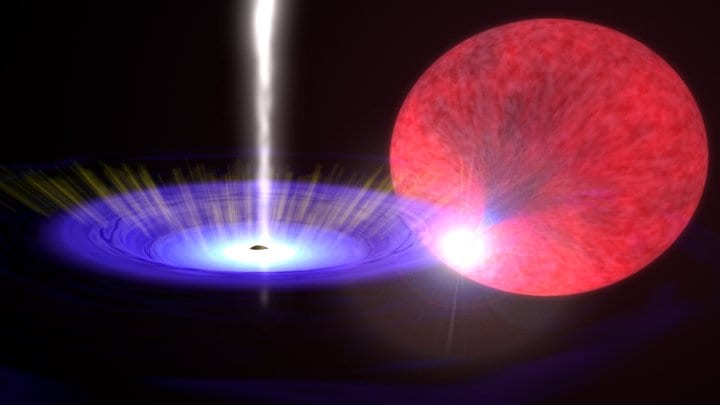
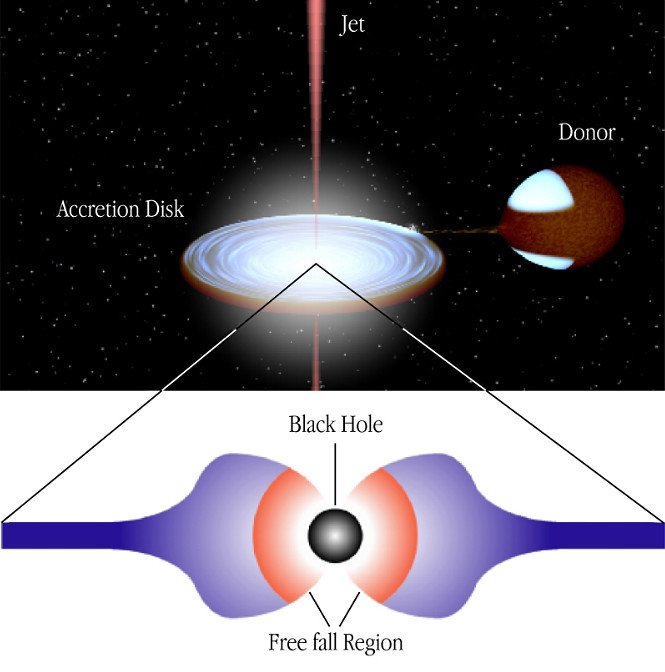
For thirty-four years, GRS 1915+105 has been the black hole that would not stop eating. Astronomers discovered it in 1992, at the start of an outburst, and the outburst never ended. Most black-hole binaries that pull gas from a companion star flare for a few months, then go dark for years at a stretch. This one kept going decade after decade, sustaining near-Eddington activity for about 25 years and throwing out jets that made it a reference case for studying jets from stellar-mass black holes.
That run is over, or very nearly. In a paper posted to arXiv on Nov. 4, S. E. Motta of INAF's Brera Observatory in Merate, Italy, R. P. Fender of the University of Oxford and 22 colleagues report that the radio emission from GRS 1915+105 has fallen to about 150 microjanskys, the faintest level recorded from the system since its discovery. The paper has been accepted for publication in Astronomy & Astrophysics, but the journal version is not yet available.
The fall reads as a staircase. A flare in early 2025 took the source above 1 jansky. By October 2025, it had fallen to around a thousandth of that level, and after May 9, 2026, routine ten-minute monitoring scans could no longer formally distinguish it from the noise. MeerKAT had failed to detect the system in only eight of 155 observations since monitoring began in 2018, and all eight non-detections occurred during this decline.
That last point is a statement about the scans, not about the black hole. To find out what was left, the team was granted director's discretionary time on MeerKAT and spent about eight hours on target in each of two frequency bands over six days in July. The source was there, and steady: 150 microjanskys in the lower band and 90 in the upper one. It had fallen below the detection threshold of a ten-minute observation. It had not gone away.
The one window the gas cannot close
That measurement matters because of a problem that began in mid-2019, when the X-ray flux dropped and the gas in front of the system grew dense enough to absorb or scatter almost all the X-rays reaching us. A paper in The Astrophysical Journal described the newly obscured state, and other groups have since confirmed it. The state has persisted for more than six years. So every X-ray measurement of this black hole has carried two possible readings: the engine is running down, or the curtain in front of it is getting thicker.
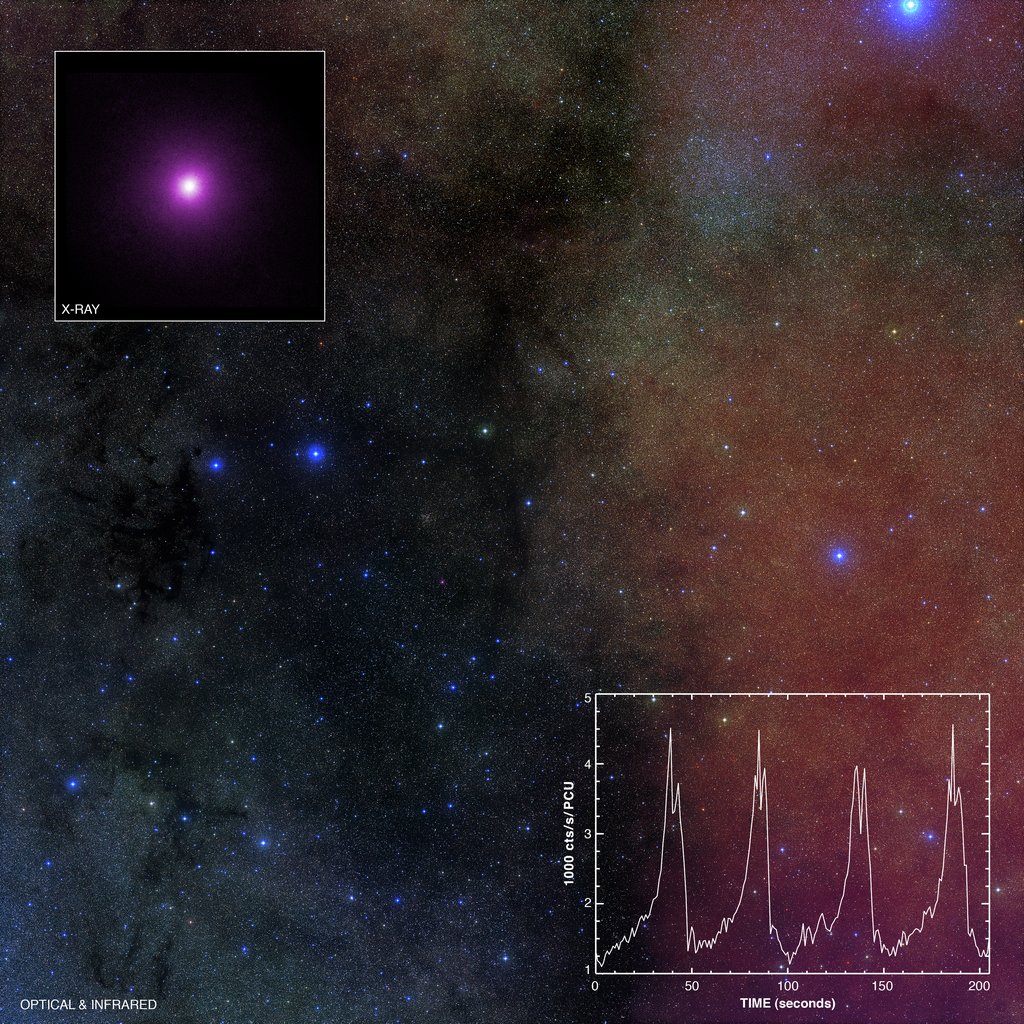
Radio emission provides a view through that obscuring material, and that is the basis of the argument. Because the radio-emitting jets remain visible even when the accretion flow is hidden in X-rays, the authors write that the radio decline is the first direct evidence that the central engine itself is fading rather than merely receding further behind the absorber. Radio emission is an absorption-independent tracer of the engine's activity, not a direct measurement of the accretion flow.
The idea was not new. In July, Gandhi and Boorman argued in a preprint, which has not been peer reviewed, that the same black hole was weakening intrinsically. Their case drew on mid-infrared measurements by SPHEREx and a NuSTAR observation in November 2025 that failed to detect the source in X-rays. What the MeerKAT work adds is not the idea, but a measurement in a band that provides an independent tracer of the system's activity, largely unaffected by the X-ray absorber.
The X-ray side was checked too, and the authors are careful about what the results show. Three pointings with the Einstein Probe satellite, between late June and early August, failed to detect the source in X-rays. That sounds like confirmation, but it is not. The team states that the Einstein Probe non-detection cannot by itself distinguish increased absorption from intrinsic fading, because a column of gas comparable to the one already inferred could hide an intrinsically faint source just as effectively.
What it looks like when a black hole starts to shut down
Several other things line up. The outburst has lasted thirty-four years, within the 20-to-100-year duration that models of how such a disk empties predicted. The decline has been steady and unbroken since the last flare, with no rebrightening at any point. For the first time, the system is faint across all the bands in which it has been monitored. Earlier low-flux episodes were always confined to one band: the radio-faint spells occurred while the system was bright in X-rays, and the X-ray-faint period began while it remained bright in radio. And the brightness MeerKAT measured sits about 4% above a prediction. Black hole binaries in quiescence, the dark phase between outbursts, tend to grow brighter with longer orbital periods. GRS 1915+105 has a 33.85-day orbit, the longest known among X-ray binaries. The relation predicts a radio luminosity remarkably close to what MeerKAT measured.
On that basis, the team argues that GRS 1915+105 may have reached the end of the outburst that began in 1992 and may now be entering quiescence. Those qualifications matter: the paper's abstract describes the July observations as possibly marking the onset of a final descent, not the descent itself. If this is the beginning of quiescence, the models predict that the quiet phase could last around 10,000 years, far beyond any human observing career.
One measurement does not sit neatly in that picture. The deep July observations provided the first radio spectrum of the source across these two bands. It slopes downward with increasing frequency, whereas a compact jet normally has a flat or rising spectrum. The authors' preferred interpretation is that most of the emission MeerKAT detected comes from expanding, optically thin material ejected during the last flare, rather than from an active compact jet. The caveat runs one way only: if the compact core contributes little to the measured 150 microjanskys, its own emission is fainter still, strengthening the case that the system is approaching quiescence rather than weakening it.
The quiet is its own experiment
A switch-off also opens two lines of investigation that three decades of glare kept shut. The disk's light and the obscuring gas have made the companion star, an aging giant, difficult to study since the system was discovered. A dimmer accretion flow could allow astronomers to determine the star's type and study its stellar wind more clearly. GRS 1915+105 is also associated with very-high-energy gamma rays whose origin remains unsettled. If those gamma rays continue arriving at their present level while the central source fades, they are likely being produced farther out, where the jets collide with interstellar gas. That would support a similar origin in other systems. If the gamma rays fade over the next few years instead, their source is probably closer to the black hole.
No black hole like this has been watched into retirement before. GRS 1915+105 is the only known system to have sustained outburst-level activity for three decades, and the record offers no second chance to observe this transition.
Sources
- arXivPreprint
- arXivPreprint
- The Astrophysical Journal