Chemists Strip an Electron From Uranium's Sandwich Molecule
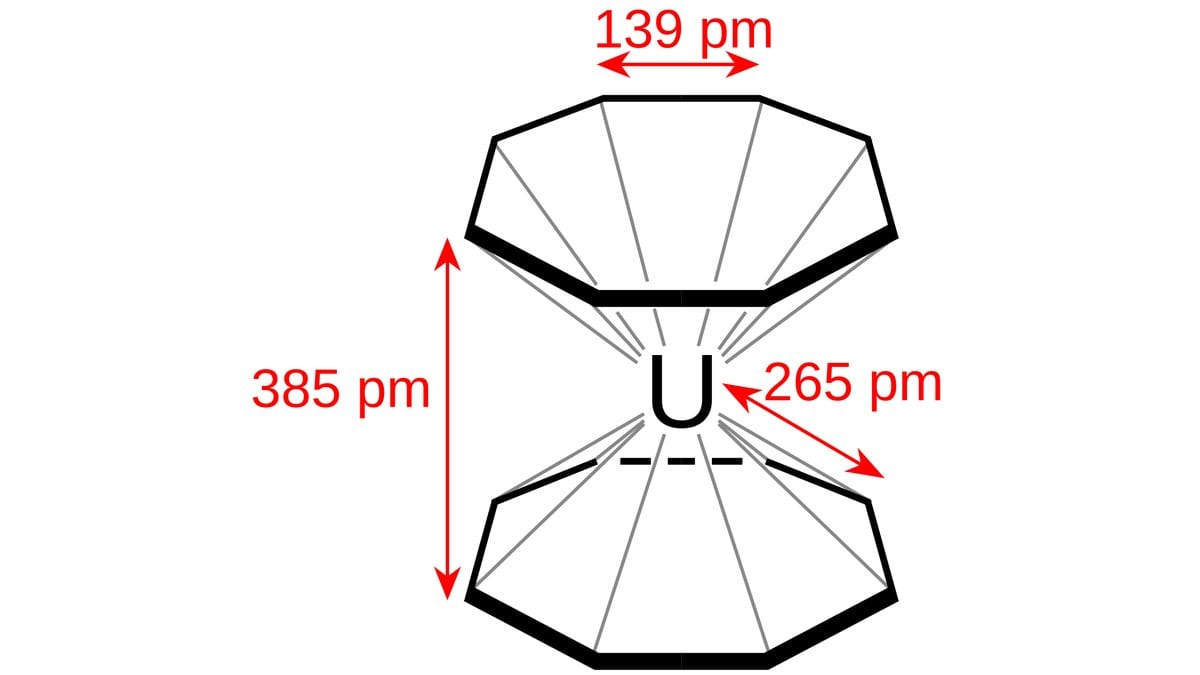
Chemists at the University of Manchester have isolated uranocenium, the positively charged form of uranocene, a uranium atom clamped between two flat rings of carbon. Uranocene is the uranium cousin of ferrocene, the iron sandwich compound that gives up an electron easily, and the authors report that no higher-charge form of it was known before this work.
The paper was published Oct. 23, 2026, in Nature Communications. The authors say the two salts they made open the way to well-defined electron-transfer chemistry in this family of molecules and give chemists a platform for tracking how uranium shares electrons with the rings across several charge states.
Cameron N. Deakin, Conrad A. P. Goodwin and colleagues at Manchester, with Andrew Kerridge at Lancaster University, treated uranocene with an organic oxidant in a fluorinated solvent and obtained crystals of a borate salt stable indefinitely at room temperature. Magnetic measurements and electron paramagnetic resonance, which detects unpaired electrons, placed one unpaired electron on the uranium.
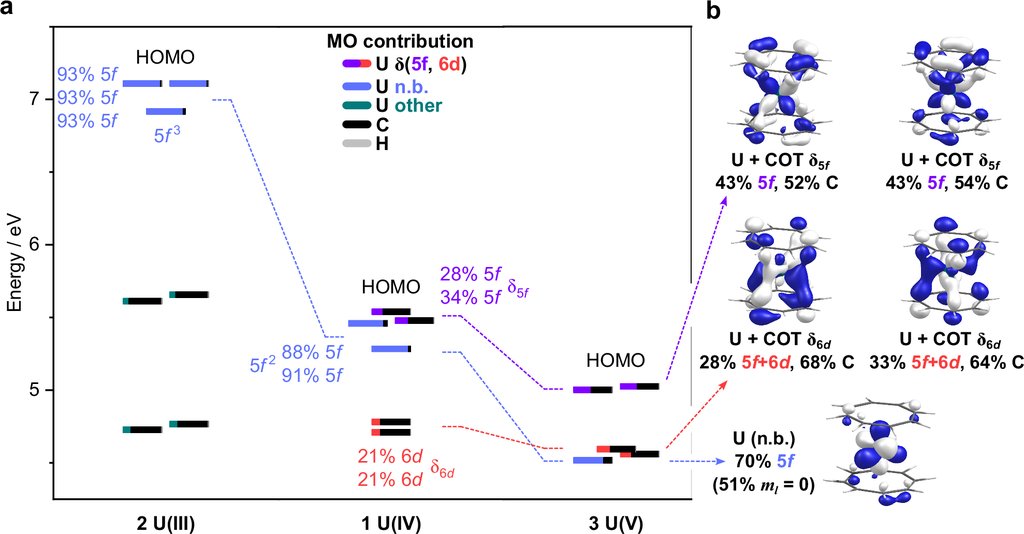
The bonds barely moved. Taking an electron away shrinks the uranium ion, which would usually pull the surrounding bonds in sharply. X-ray diffraction instead put the shortening of the average uranium-carbon distance at two to three times smaller than the change in ion size predicts. The authors attribute that to uranium taking a larger share of the bonds: their calculations put its contribution to the two bonding orbitals at about 43% in uranocenium against 28% and 34% in uranocene. They also report that in solution the pair switches back and forth about as cleanly as ferrocene does.
Earlier studies had recorded the oxidation of uranocene as irreversible and its products as poorly defined. The team traced that to the electrolyte those experiments used: uranocenium pulls fluorine off it, and the group isolated the fluorine-bridged uranium product. Uranocenium is also short-lived in tetrahydrofuran, a common laboratory solvent, with a half-life of 21.4 minutes in a dilute mixture.
Crystal structures are deposited with the Cambridge Crystallographic Data Centre, and the raw instrument and calculation outputs are posted on Figshare.
Sources
- Nature CommunicationsPeer-reviewed