Old Webb Observations Can Be Reprocessed for Planets They Seemed Not to Hold

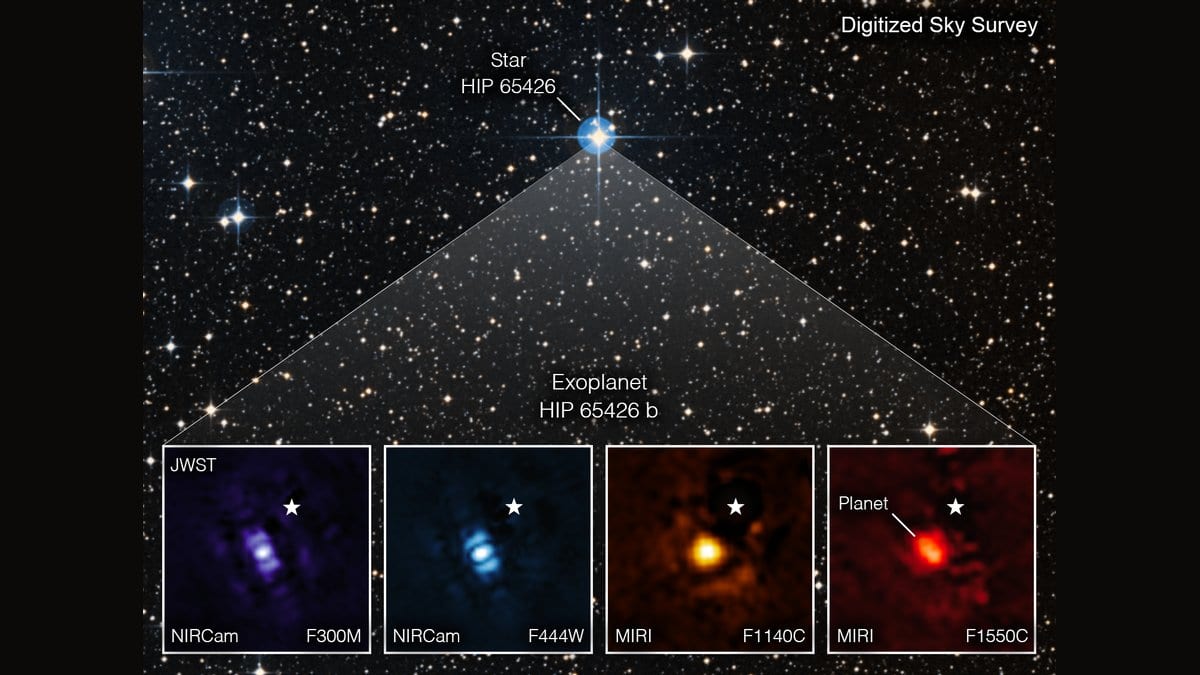
The glare is the whole problem. A young giant planet in the near-infrared is roughly 100,000 times fainter than the star it circles, so nearly everything between an astronomer and a picture of it is light belonging to the star. A mask inside the instrument, called a coronagraph, blots out most of that light. What leaks past the mask decides whether the planet can be seen, and the standard way to remove the residual starlight is to photograph a second star and subtract its glare from the first.
That works because the leaked light has a shape, and the shape can repeat. It fails because the shape belongs to the instrument as much as to the star: between the reference picture and the real one, the telescope may have shifted or its optics may have changed slightly, so the patterns no longer match and the residue can bury a planet. On Nov. 4, 2026, a team led by Rodrigo Ferrer-Chavez of Northwestern University published a new method in Nature, Its title states the ambition plainly: Imaging exoplanets below the telescope stability limit.
Modeling the optics directly instead of borrowing another star's glare is an old idea, and it had repeatedly fallen short. Optical systems are complicated enough that simulated glare had been reliable only in unusual cases, and the authors note that, to their knowledge, no such model had previously achieved substantially better sensitivity than the standard method on real observations.
Fitting the telescope instead of borrowing a star
What changed is the arithmetic. FLIP, the authors' name for Physics-based Learning for Imaging Planets, starts from STPSF, the Space Telescope Science Institute's own model of Webb's optics, and rebuilds it in PyTorch so that it can be differentiated: the software can work out exactly how each knob in the model would change the simulated picture. That is automatic differentiation, and it is what makes a model with about a million knobs fittable at all. The knobs are physical: the star's position behind the mask and its brightness, two maps of how far the arriving light has drifted out of step with itself, and the response of every pixel in the detector.
The fit runs twice, and the second pass is what answers instability. The first calibrates the whole model on a reference star with every parameter free, a reference star being unlikely to have a planet beside it to lose. The second takes that calibrated model to the real observation and tunes only a few parameters, which is where a different pointing error and a different mirror shape get absorbed rather than subtracted. Given enough freedom, a model this flexible will learn the planet and remove it along with the glare, so the team plants fake planets and tracks their signal strength as the fit proceeds, stopping when it peaks or flattens. A run takes about 35 minutes on one NVIDIA A30 graphics card, and the code is public.
None of the three ingredients is new. Physics-based models, automatic differentiation and staged fitting come out of earlier work, including a 2025 study by Brandon Y. Feng, a co-author here, that showed the idea on simulated data. The authors scope their own claim: "This is the first time, to our knowledge, that such an approach has demonstrated substantially improved sensitivity on real, on-sky coronagraphic imaging."
The gain depends on which star, and how close in
FLIP was run on four data sets from Webb's Near-Infrared Camera and set against KLIP, the standard subtraction method, with the settings the original authors had published. Sensitivity improved by 2 to 15 times. The range is not one number with error bars; it is different targets at different distances. The 15 belongs to TYC 5899 at half an arcsecond from the star, which on the sky is very close in; on the 51 Eridani field the gain at that separation is about five times.
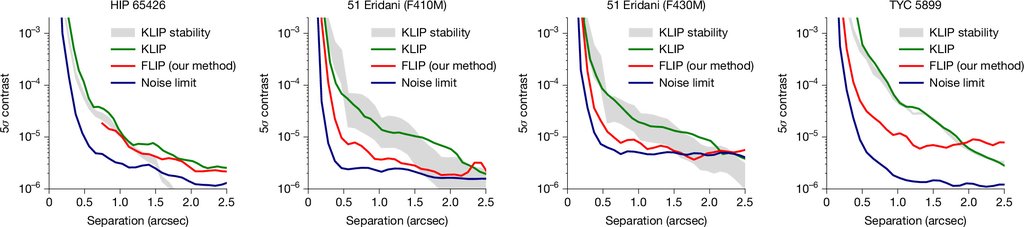
TYC 5899 is the one with no planet in it. The paper calls it "a star from a planet search survey with no known companions and with notable aberration drifts between reference and science observations"; its reference images were taken four months before the science ones. Fake planets injected there came back clearly under FLIP and nowhere near detection under KLIP.
The one real recovery in the set is 51 Eridani b, a planet found from the ground in 2015 by the Gemini Planet Imager. At 4.3 microns, a 2025 analysis of the same Webb observations had found nothing. FLIP returns it at a signal-to-noise ratio of 6.3, a solid detection rather than an overwhelming one, and the first picture of the planet at that wavelength. That wavelength matters because it is where the absorption band of carbon dioxide is located; the 2025 study, which detected the planet at shorter wavelengths and not at longer ones, read that as a sign of carbon chemistry out of equilibrium and a higher abundance of heavy elements. Measuring the planet's atmosphere from the new detection is future work.
What it would mean for the telescopes still on paper
The reason this reads as more than a reprocessing trick is the generation after Webb. The Habitable Worlds Observatory is meant to photograph planets like Earth around stars like the Sun, and its design asks the optics to hold still 100 to 1,000 times more steadily than Webb's. If software can absorb part of the drift instead, the authors write, the framework could be extended to other current and future observatories, "potentially relaxing the unprecedented stability requirements needed to make these a success." The hedge is the authors' own, and nothing has been shown yet on Roman or on the Habitable Worlds Observatory itself.
Dimitri Mawet, a senior research scientist at NASA's Jet Propulsion Laboratory who was not involved in the work, told Scientific American that model-based glare removal had been discussed for more than a decade without beating methods built on reference stars. "Ferrer-Chavez and colleagues show that it can," he said, and on the future observatory he was careful: "Physics-based postprocessing like this could plausibly ease part of HWO's stability error budget, and that alone would matter." The same account notes that its optics will still need to hold steady to within a trillionth of a meter to photograph Earth-like planets.
The authors are equally plain about where FLIP stops. The photon noise limit, the floor set by the light itself, is not reached in any of these observations, and the models cannot yet hand back the telescope's drifts as numbers with uncertainties on them. Ferrer-Chavez put the goal to Scientific American in the plainest terms available: "If our approach works, building this new observatory may be really hard but not really, really, really hard."