Models of How the Sun Formed Now Have to Carry a Magnetic Field

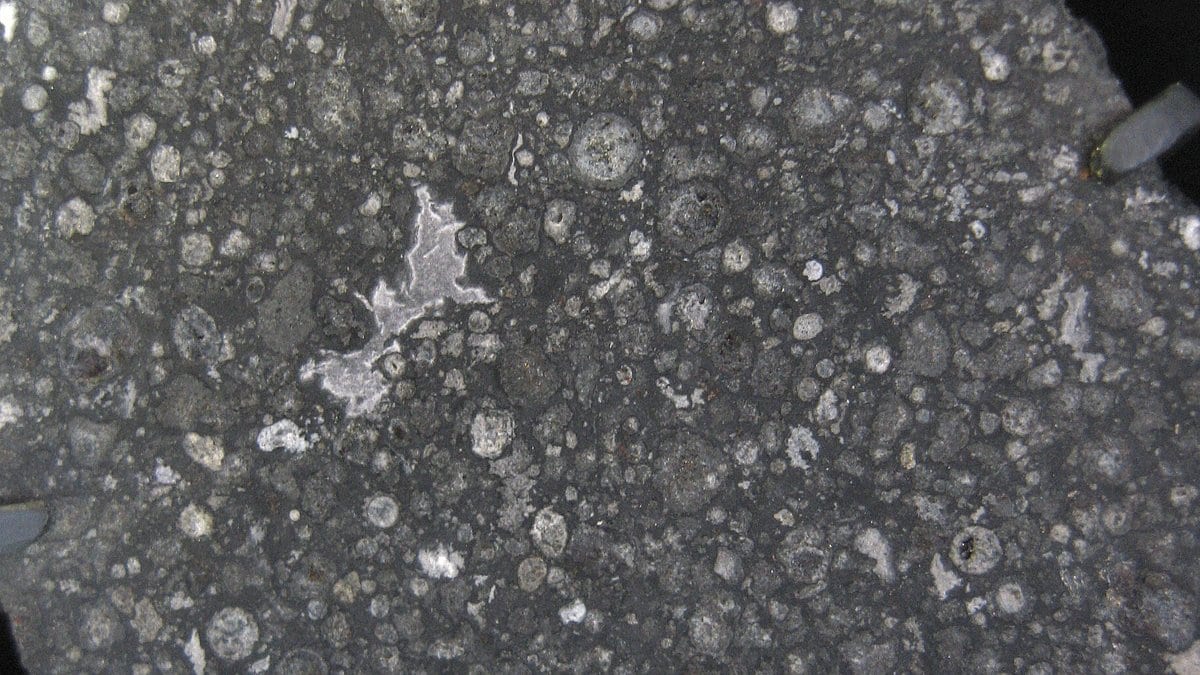
A rock came off the East Antarctic Ice Sheet in 2008. Cataloged as DOM 08006, for the Dominion Range where it was collected, it is one of the most primitive meteorites ever recovered, a lump that escaped almost everything that normally happens to rocks in space. Inside it sit grains that condensed straight out of hot gas during the solar system's first 200,000 years, possibly before the sun had finished forming.
Those grains have a name, calcium-aluminum-rich inclusions, or CAIs, and a distinction: they are the oldest known solar system solids, the first material to go from gas to rock. They also turn out to be magnetized. Writing in the Proceedings of the National Academy of Sciences, a team led by Cauê Borlina and Benjamin Weiss of MIT reports that the CAIs in DOM 08006 record a magnetic field of roughly 150 to 600 microtesla, a few times to more than ten times the strength of Earth's field at the surface today.
The measurement speaks to how a star gets fed. Gas orbiting a young protostar cannot simply fall inward; it has to lose angular momentum first, and a magnetic field threading the disk is one of the things that can carry that momentum away. Whether magnetism, gravity or both dominated at the very youngest stage, before there were planets, when there was only a disk, has been an open question.
"Nowadays people don't debate whether magnetism is present when planets are forming," Borlina, who led the work as an MIT graduate student and is now at Purdue University, told MIT News. "But the debate is around the very early solar system, before planets are forming, when there's just a disk. That's where the debate still resides, and that's where we're operating now."
How fast a disk feeds its star matters beyond the star. Gas that spirals inward and joins the sun is gas that is not available to build planets, and the rate at which it drains sets how long the raw material lasts and where it sits while planets are assembling.
The paper's own claim is carefully bounded. An intensity in that range, the authors write, "is consistent with magnetic fields playing a key role driving disk accretion." Consistent with is doing real work in that sentence. The abstract also frames the question as magnetism "and/or" gravity, which adds one to the other rather than replacing it. In MIT's announcement, Weiss goes further than the paper's wording does: "It has long been theorized that gravity caused this, but our measurements show magnetism likely played a role."
The same sentence carries a second consequence: a field that strong would also have heated the disk's very inner edge, not the disk as a whole, to around a thousand kelvin. That is the neighborhood CAIs come from. The paper describes them as high-condensation-temperature solids, so the heat and the grains belong to the same small region.
This is not the first magnetic record pulled from a meteorite. In 2024, Clara Maurel and Jérôme Gattacceca reported that the meteorite Erg Chech 002 carried a field of about 60 microtesla, acquired two million years after CAIs formed, and called it one of the two earliest records of the solar nebula field then known. Weiss's group had reached roughly the same depth in time. What CAIs offer is the zero of that clock: they are the material that clock is counted from. Astronomers can also watch disks around other young stars, but a meteorite, as Maurel and Gattacceca put it, gives a resolution "far superior to observations of extrasolar disks."
Reading a field out of a grain that old is the difficult part, and it is where such measurements fail. From small samples of the parent meteorite, the team isolated individual grains, picked out a handful of CAIs holding magnetic minerals such as iron, and tested them for whatever magnetization they still carry. The grains are not interchangeable. CAIs "are very complex and are not all the same, even within a 1-millimeter piece of the meteorite," Borlina says. "So we have to carefully identify what types they are."
DOM 08006 helps by being unusually untouched. "Other meteorites went through many different processes over this 4.5 billion year history," Weiss says. "They were formed in the solar nebula, then added to bodies with water, then got destroyed, moved to the asteroid belt, and then landed here. But somehow, DOM has experienced less alteration than any other meteorite."
For the people who model how stars and planets assemble, the result is a constraint at a moment that previously had none. "We think these kinds of magnetic fields were helping to move gas from the protoplanetary disk, in toward this central star, the sun," Borlina says. "Gravity is also playing a role. But we are now showing that, if you want to fully understand how the sun and planets formed, you should include magnetic fields in the ingredients that make them."
The paleomagnetic data behind the number are deposited in the MagIC database, where another group can take the same measurements apart.
Sources
- Proceedings of the National Academy of SciencesPeer-reviewed