Comets May Be Evaporating Around a Star Still Building Its Planets

The spectra had been sitting in a public archive for years, taken for someone else's project, a planet hunt at the European Southern Observatory in Chile. On night after night in the spring of 2018 they show the same young star doing something odd in one narrow band of yellow light. Dark lines of sodium cut into the starlight. Twenty-four hours later they have moved, or multiplied, or gone.
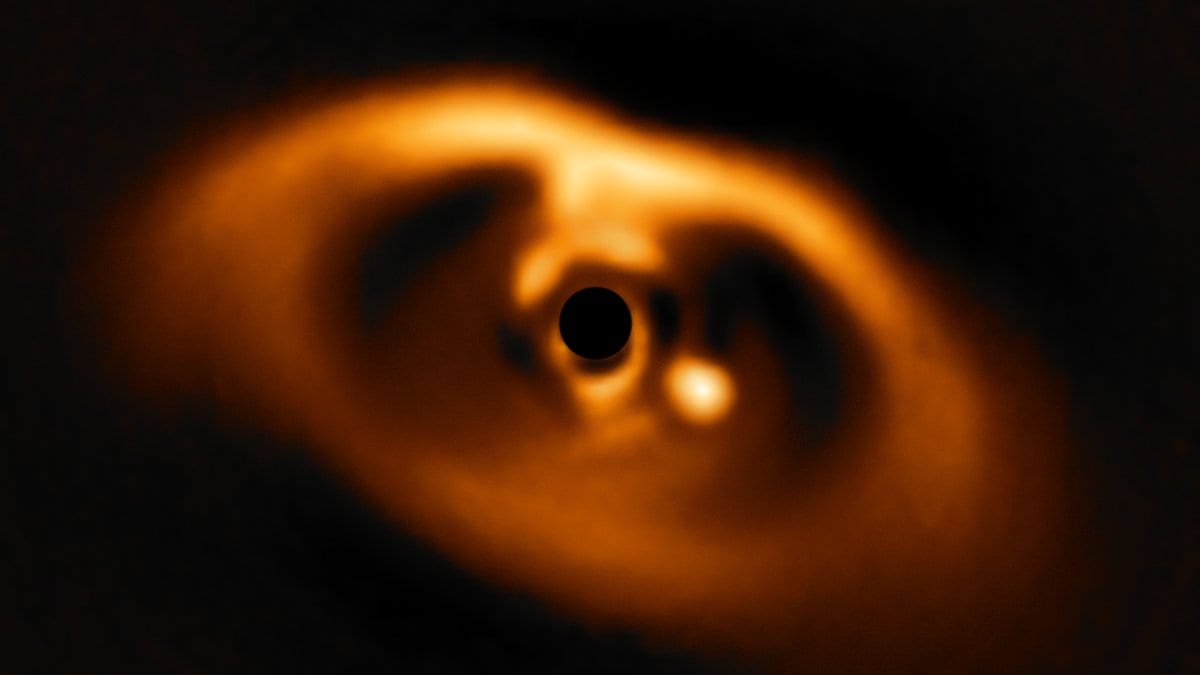
The star is PDS 70, and it is the reason the flicker is worth chasing. At 5.4 million years old it still sits inside the disk of gas and dust it formed from, and that disk has a wide gap torn through the middle of it. Two giant planets are in the gap, and they have been photographed there: not inferred from a wobble or a dip in brightness, but seen, still gathering mass. Plenty of exoplanets have been imaged. These are the only ones anyone can watch being built. So when Aline Novais and colleagues at Lund University in Sweden found sodium in the old spectra that would not hold still, the question of what was making it carried more weight than usual.
Their answer, published Aug. 24 in Nature Communications, is that the most likely source is comets: planetesimals of rock and ice on long, stretched orbits, boiling off material as they graze past the star. The paper's own title calls them potential.
What the instrument recorded is sodium. Across the spring of 2018 the team isolated 43 absorption components that shifted from one night to the next, and sometimes within a single night, at speeds between 25 and 115 kilometers a second toward Earth. The lines are deep enough to be saturated, and the fits show the gas covering only part of the star's face: clumps crossing the line of sight, not a uniform veil. No other element in the data behaves this way.
The obvious answer is a wind, and it does not fit
Young stars blow gas off their disks, and such a wind produces absorption lines much like these. It was the first thing to eliminate, and the arithmetic goes against it: a wind driven by PDS 70's measured accretion should carry roughly a hundred times less sodium along the line of sight than these lines demand. That estimate leans on numbers that are themselves uncertain, and the authors say so plainly. Their model, they write, "prevents us from definitively ruling out the disc wind scenario."
The behavior of the lines is the stronger case. Winds seen in other young stars sit at a fixed velocity for weeks, and where a clumpy wind does vary, as at RY Tauri and SU Aurigae, it repeats on a schedule as the disk turns. PDS 70's variable lines keep no schedule at all. The star shows no wind in hydrogen-alpha either, where one would be easiest to see. The data do contain one sodium line that behaves like a wind, fixed in velocity in every spectrum, and that is the one the team attributes to an outflow.
The second candidate came from RZ Piscium, an older star with a similar flicker, where the sodium has been attributed to a magnetic propeller: the star's magnetic field catching infalling disk gas and slinging it back out. That mechanism should tie the lines to the star's rotation, and PDS 70 turns once every three days without the sodium taking the slightest notice. Its accretion also runs at the upper edge of what a propeller permits. Neither alternative has been excluded. Both are disfavored, which is the weaker statement and the one the paper makes.
What is left looks like something falling apart
Exocomets are the interpretation left standing, and they are not an exotic one. Variable metal absorption has been read as cometary activity for decades at β Pictoris, the benchmark case, and the PDS 70 lines carry the same marks: appearing and vanishing overnight, speeding up and slowing down, confined to clumps. What nobody has measured here is ice. Sodium is a rock-forming element, and the step from it to comets runs through an assumption: that the material holds roughly as much sodium as primitive meteorites do. On that assumption, a body between about 300 meters and 1 kilometer across, boiled away entirely, would supply the sodium in one of these clouds.
New observations this year with UVES at the Very Large Telescope show the activity still running, and on two nights the variable sodium was red-shifted, moving away from Earth, which a wind streaming outward cannot easily produce. Those data come from the same group in the same paper rather than from an independent team, with a fuller analysis promised separately.
The search began with a question about water
None of this began as a hunt for comets. In 2023, JWST found water vapor in the innermost part of the PDS 70 disk, well inside the zone where rocky planets form, and nobody could say where it came from. Comets scattered inward from the outer disk would be one way to get it there. To test whether that is dynamically possible, the team simulated planetesimals interacting with the two known planets: a fraction of a percent to a few percent of test particles crossed the gap toward the inner disk late in the run, on the eccentric, tilted orbits the comet reading requires. That shows the delivery route is open, not that it was used. The paper's phrasing is that sublimating exocomets "could play a role." No water was measured in this work.
If exocomet activity at PDS 70 is confirmed, it is the youngest system in which the phenomenon has been seen (β Pictoris, the benchmark, is around 20 million years old), the coolest star known to host it, and only the second such system where planets have also been confirmed.
The paper is specific about what would settle the question. Catching a comet's dust tail as a dip in the star's brightness would do it, though PDS 70's own variability makes that hard. So would spectra taken densely enough to watch a single cloud accelerate through its closest approach, or a measurement of how the sublimating material's elements sort by volatility. A better census of the system's planets would help with all of it, and the team expects the Extremely Large Telescope to deliver one.
Sources
- Nature CommunicationsPeer-reviewed