Three Separate Times, Tiny Fishes Arrived at the Same Kind of Genome

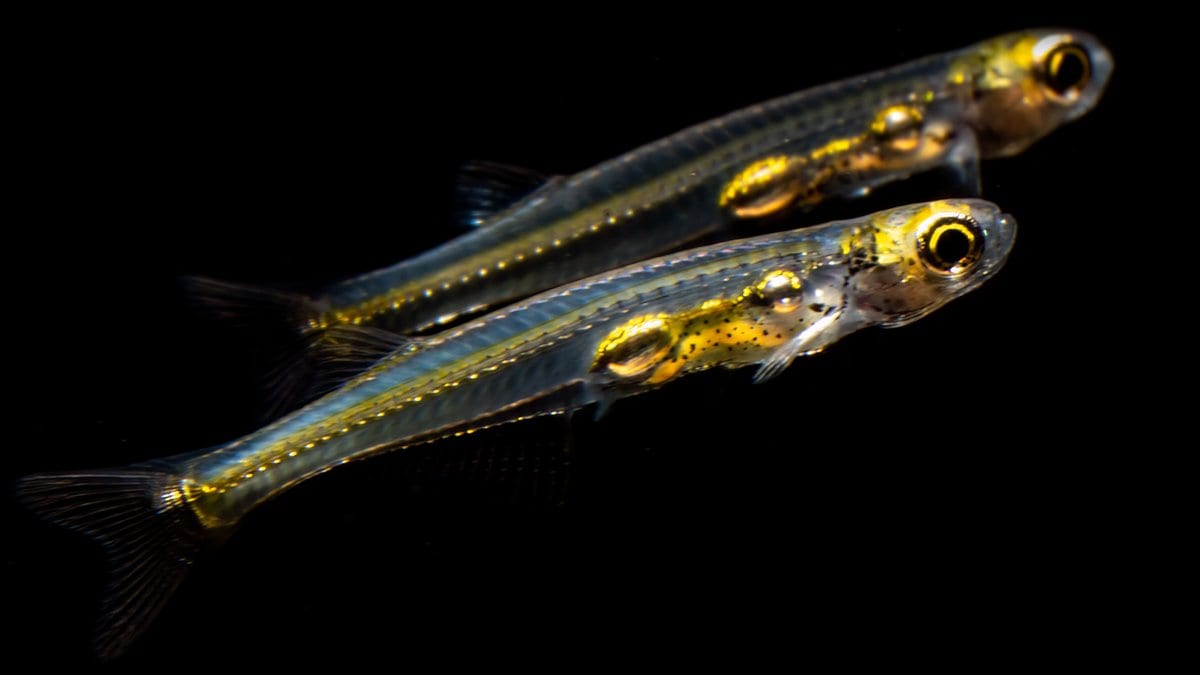
There are two ways for a fish to end up among the smallest vertebrates on Earth. One is to shrink in proportion. The result is a tiny animal otherwise built like its larger relatives, with everything in the same place, just less of it. The other is to stop developing partway and keep larval features for life, so the adult looks less like a miniature adult than like a juvenile that never finished. Both routes have produced extremely small fishes many times over. A team led by Hiranya Sudasinghe and Lukas Rüber, of the Natural History Museum Bern and the University of Bern, reports in the Proceedings of the National Academy of Sciences that only the second route leaves a mark in the genome.
The study, published Oct. 14, 2026, works at two scales. The authors built a new family tree of 309 species of cypriniforms, the carp-like fishes and the most species-rich order of freshwater fishes, and put dates on its branches. Then they compared 33 high-quality genome assemblies spread across that tree. Pairing the two matters: a difference between two genomes only means something once you know how closely the two fishes are related, and the dated tree supplies that.
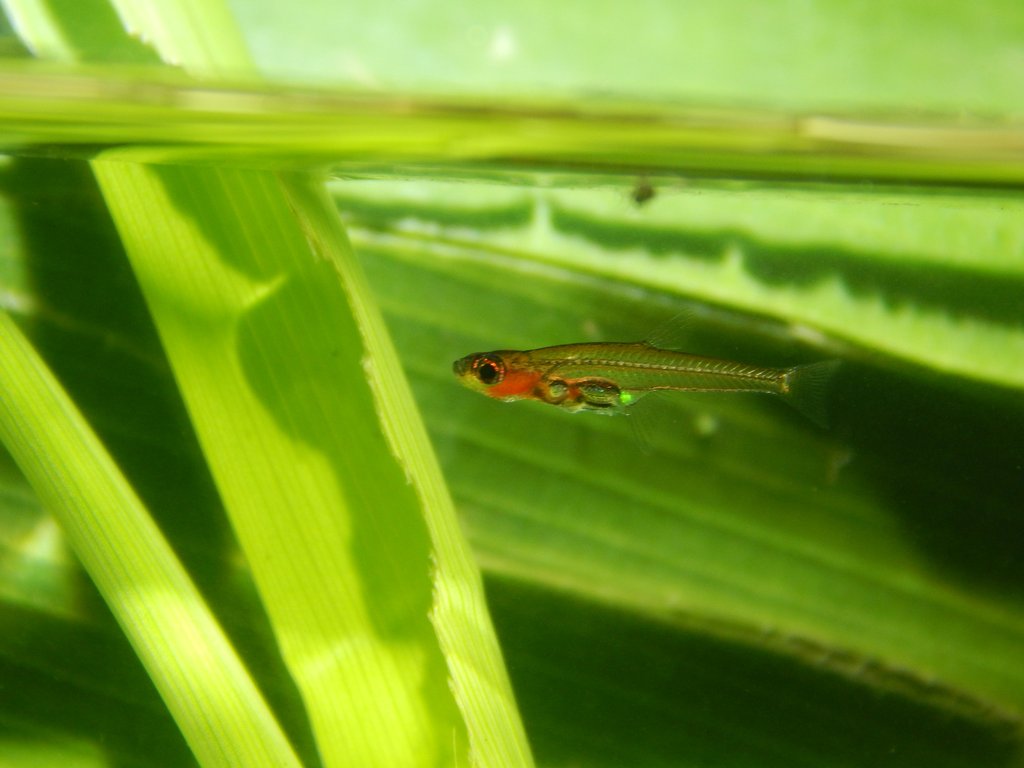
On that tree, extreme smallness is not a one-off. Reading body size back down the branches, the authors find multiple independent origins of both kinds of miniature, non-randomly distributed, and they rarely recover a lineage that reverted to a normal-sized body. That last point is a statement about what the method returns, not a fossil observation. The two kinds of miniature also arrived at different times: the stay-larval ones predominantly in the Eocene, tens of millions of years ago, and the proportioned dwarfs mainly in the much later Miocene.
The genomic comparison is where the two routes part company. All three independently evolved lineages of stay-larval miniatures, progenetic miniatures in the paper's terms, share the same pair of structural changes. They have lost repeated DNA, the duplicated stretches that make up much of a typical vertebrate genome. And their introns, the filler inside genes, are shorter right across the genome. The authors report both patterns absent in the proportioned dwarfs. Three lineages that were not following one another arrived at the same arrangement.
Streamlining is the authors' own word; the paper is titled "Convergent genome streamlining accompanies independent miniaturization in the world's smallest fishes." What it names is how the genome is built, not how much of it there is. On the authors' account, genome size across the carp-like fishes has been overwhelmingly driven by polyploidy, the duplication of whole chromosome sets. The progenetic miniatures show no more than a directionally consistent, though nonsignificant, trend toward smaller genomes. That hedge is theirs. Repeat loss and shortened introns are the finding; a measurably smaller genome is not.
The authors call this the broadest evidence to date that progenetic miniaturization, despite independent origins, is underpinned by predictable structural genomic changes. Broadest evidence to date, not proof. And the link they draw is to developmental truncation specifically, the halt in development itself, rather than to small size: what the genome registers is the route an animal took to being tiny, not the tininess. A comparison across lineages shows the two traveling together. It does not show which pulls the other.
Convergent miniaturization has turned up in fishes with other kinds of evidence. A separate PNAS study, published Oct. 22, 2025, compared gene activity across goby fishes, another group that includes some of the smallest vertebrates. Emily M. Troyer, Dahiana Arcila and colleagues found the miniature species consistently turning up the same growth-restraining genes. That is a different layer of biology, and it does not test the repeat-and-intron signature. What the two studies share is the shape of the answer: smallness in fishes keeps arriving by the same molecular routes.
Both papers are peer-reviewed and open access, and the new one goes further: the data behind it was deposited publicly under a CC BY license on Sept. 28, 2026, before the paper appeared. A group that doubts the signature, or wants to see whether it holds when more genomes are added, can start from the same files.
Sources
- Proceedings of the National Academy of SciencesPeer-reviewed