The Moon's Radius Has Fallen 42 to 46 Meters, Counted One Fault at a Time

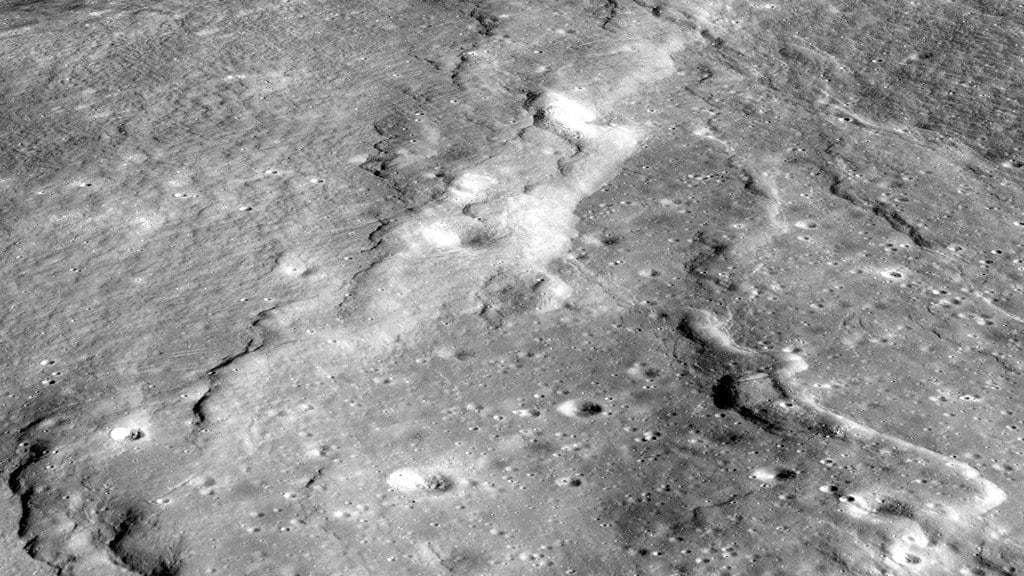
Look closely at the Moon's highlands in a high-resolution photograph and the ground is not as dead as it looks. Thousands of low cliffs run across it, some only a few meters high, each one a thrust fault, where the crust has broken and one side has been pushed up over the other. On Earth, features that small and that fresh would be worn flat in a geological instant. On the Moon they are still sharp, which means the squeeze that made them is geologically recent.
On Oct. 14, four planetary scientists published the arithmetic of that squeeze. In The Planetary Science Journal, Thomas R. Watters of the Smithsonian Institution, Mark S. Robinson of Intuitive Machines and two colleagues add up what all those broken faces come to: a Moon whose radius has decreased by about 42 to 46 meters. The paper is free to read and openly licensed.
The faults come in two kinds, and the team counted both in images from the Lunar Reconnaissance Orbiter Camera, which has been photographing the Moon since 2009. In the bright highlands they are lobate scarps, cliff-like steps with a rounded front. On the dark volcanic plains, the maria, they are small ridges. The maria contribute little to the total, so the figure is carried almost entirely by the highland faults.
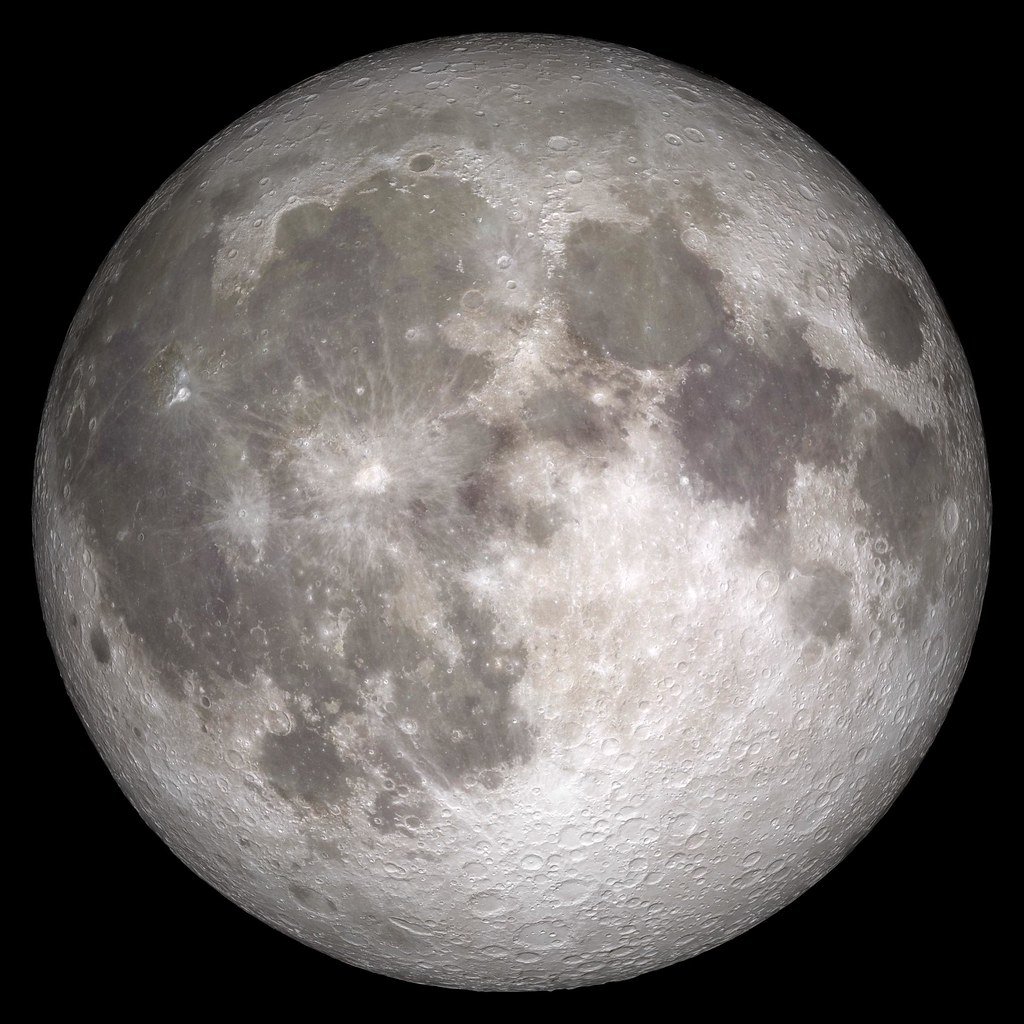
Getting from a cliff to a radius takes two steps. The first is to turn each fault's displacement into the amount of surface it swallowed, summed across both populations. The second is geometry: on a sphere, losing a given fraction of surface area means losing half that fraction of radius. The assumptions sit almost entirely in the first step, in how a cliff's height is turned into how far the rock on either side of it moved. That range is the authors' estimate, not an error bar.
The paper turns that total into a rate too. Assuming a uniform rate of change over the last 400 million years, the authors put it at a maximum of about 11 centimeters per million years. It is a maximum for a specific reason: that is the shortest interval they assume, and the same contraction spread over a longer faulting history would give a slower rate. The window is an assumption used to get the rate, not a measured duration of faulting, and the paper sets no upper bound on it.
From the same contraction the authors derive the stress behind it: a compression of about 4 megapascals, pressing equally in every direction, which they call consistent with the stress released in recorded shallow moonquakes. That is a loose fit rather than a match. Stress drops estimated from the Apollo seismic record span a very wide range, and the figure sits among the weaker events, far below the largest values reported in the seismic literature the paper cites.
What makes the figure interesting is how small it is. Models of a Moon that cooled steadily predict much larger amounts of contraction, and the highlands hold no population of old, worn-down scarps to make up the difference. The authors interpret this as support for a thermal history that was not smooth, and they offer two reasons without choosing between them. One is insulation: a thick, porous layer of broken rubble called the megaregolith trapped the heat and held off the cooling. The other is strength: a stiff outer shell resisted faulting until the accumulated stress crossed a threshold, which the paper places in the Copernican era.
The Copernican is the youngest of the Moon's five geologic periods, running from roughly 1.1 billion years ago to the present. That dating belongs to the standard lunar timescale rather than to this paper, which does not define “late-stage” in years. It is also the sense in which the contraction is late: at most the last quarter of the Moon's history, and the window the rate is computed over is a small slice even of that.
The figures above are the paper's, and they are not the ones most coverage is carrying. The announcement from the Smithsonian's National Air and Space Museum, where Watters is a scientist emeritus, puts the decrease at approximately 45 meters over the past 400 to 800 million years and counts more than 10,000 young faults. The peer-reviewed paper says thousands of faults, gives 42 to 46 meters, and uses 400 million years as the shortest interval considered when calculating the maximum contraction rate. The release also offers only the first of the paper's two explanations.
One consequence does not depend on which set of numbers you take. The Moon is a single-plate body, with no plate boundaries to concentrate its tectonics the way Earth's do, so its faults are scattered across the whole surface and a slip can occur almost anywhere. The museum's account adds that the thickest crust appears to carry the fewest faults, which would make those regions the most stable.
Whether the shrinking is still going on is a separate question, and the paper does not claim an answer. Watters expects that it is. "As the interior of the moon continues to cool and contract, it is expected that the growth of existing faults and formation of new faults continues today," he said in the museum's announcement.
Sources
- The Planetary Science JournalPeer-reviewed
- airandspace.si.edu