Five Supernova Remnants Found by Amateur Telescopes, Confirmed by a Professional One

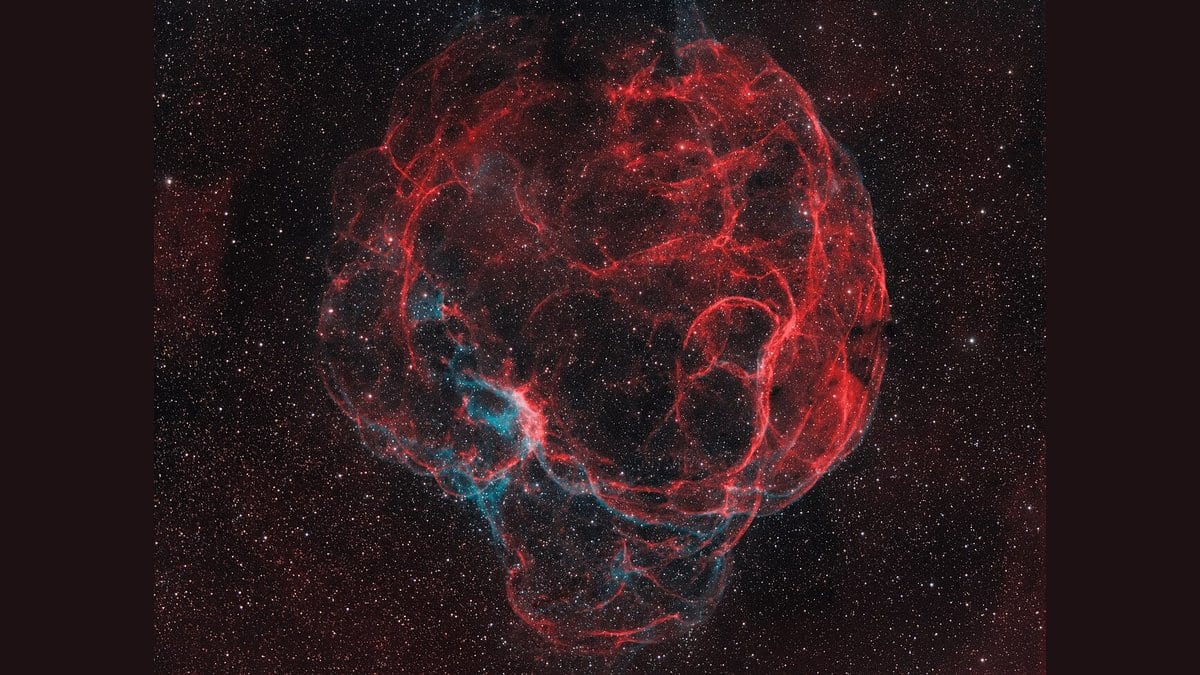
In 2023, the German astrophotographer Marcel Drechsler was working through online hydrogen-alpha sky-survey images of a patch of Sagittarius, far off the plane of the Milky Way, when he noticed a thin streak of light that nothing in the catalogs accounted for. Deeper exposures taken by Bray Falls from a site in Chile showed it running nearly three degrees across the sky, with a long, broken arc of fainter patches strung out to the east. Neither man is a professional astronomer. What they had found, a new paper argues, is the shock front of a star that exploded tens of thousands of years ago.
That paper went up on the arXiv preprint server on August 27. Robert Fesen, a supernova-remnant specialist at Dartmouth College, wrote it with a mostly amateur cast: astrophotographers observing from Chile, Morocco, New Mexico, Texas, France and New Zealand, alongside professionals including Werner Becker and Wolfgang Reich of the Max Planck institutes in Garching and Bonn. Between them the group logged more than 1,500 hours of open shutter time. That total covers the whole program of ten large nebulae, not the five new remnants alone, and all of it came through filters that pass just two narrow colors of light: hydrogen-alpha, and the green line of doubly ionized oxygen.
The telescopes that found these objects are the kind a committed hobbyist owns, small refractors on backyard mounts run for hundreds of hours per target. The instrument that decided what they were is not. Follow-up spectra of the brightest filaments were taken on the 2.4-meter Hiltner telescope at MDM Observatory on Kitt Peak, in runs that stretched from late 2023 into this year. That split is the real shape of the result: amateur-class optics for the wide, patient search, a professional mirror for the diagnosis.
Shocked gas gives itself away chemically. In a nebula lit by starlight, sulfur sits mostly in a doubly ionized state, so its singly ionized lines stay weak against hydrogen. Behind an interstellar shock the gas cools through a long wake in which singly ionized sulfur is abundant, and those lines come up strong. A ratio above roughly 0.4 has served as the standard test for shocked gas for decades. Five of the nebulae cleared it, or showed something rarer — filaments emitting hydrogen and almost nothing else, the signature of a fast shock moving through very thin gas.
Spectroscopically confirmed is the paper's own description, and the diagnostic behind it is long established. The spectra were also taken by the same team that found the objects, on a manuscript no reviewer outside the author list has been through. Fesen's group has done this before, in a peer-reviewed 2024 paper in The Astrophysical Journal Supplement Series that reported new remnants found the same way.
Why these were still out there is the more interesting half of the story. Around 95 percent of confirmed Galactic supernova remnants were first picked up at radio wavelengths, and radio surveys concentrate on the crowded band of sky near the Galactic plane. All but one of the new objects are well away from it. Most also glow more strongly in oxygen than in hydrogen, and the big optical surveys that searchers have leaned on were tuned to hydrogen-alpha, so a remnant that is faint there can go unnoticed. None of the five appears in a published radio or X-ray catalog of remnants, and the team saw no obvious radio counterpart in the GLEAM and Effelsberg maps it checked.
One of the five sits far north in Cepheus, near the well-known remnant CTA 1, its filaments reaching out of it like limbs; its discoverers nicknamed it Scylla, after the sea monster. Cataloged as G115.6+9.2, it is one of the two whose spectra came back dominated by hydrogen lines and almost nothing else, which points to a fast shock plowing through unusually empty space high above the Galactic plane.
The same imaging turned to a much older target. The Monogem Ring, a soft X-ray glow 25 degrees across toward Gemini and Monoceros, has been known since the 1970s and is read as the remains of an old, comparatively nearby supernova. In visible light it was nearly blank: a few isolated filaments in two earlier papers. Stitched into a single mosaic, the team's wide-field oxygen images trace emission around most of that X-ray boundary, turning a handful of fragments into something close to a complete optical outline. Spectra of those filaments are still needed to show they belong to the remnant.
Their physical properties are still estimates. With no radio or X-ray detection to lean on, the distances rest on hydrogen column densities and extinction models, and the paper's table of sizes, ages and explosion energies comes with the instruction to treat it as a rough guide. The coordinates, though, are now public, and so are the two candidates. A radio dish or an X-ray survey pointed at them would either turn up the counterparts nobody has found yet, or confirm that some of the Galaxy's supernova wreckage shows itself only to a small telescope, a narrow filter and weeks of staring at one patch of sky.
Sources
- arXivPreprint