A Comet From Another Star Is Missing the Signs of Ammonia

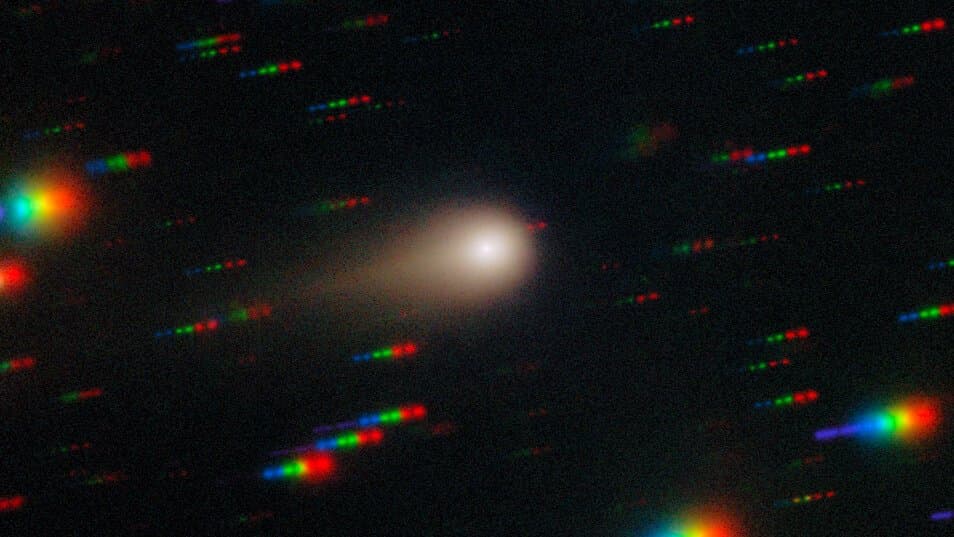
Comets are chemistry with a long memory. The ices in one were frozen out of the disk of gas and dust that built its planets, and they have sat in the cold ever since; bring one close to a star and the gas released from it carries that old recipe out to where a spectrograph can read it. Every comet studied that way before 2025 came from our own disk.
3I/ATLAS is the third confirmed interstellar object, and the first interstellar comet observed continuously across perihelion with the same instrument. K. Aravind of the STAR Institute at the Université de Liège and colleagues watched it on 17 nights with UVES, the ultraviolet and visible spectrograph on the European Southern Observatory's Very Large Telescope in Chile. The run started on Aug. 12, 2025, with the comet 3.14 astronomical units from the Sun, a little over three times Earth's distance, and ended on Feb. 22, 2026, with it outbound and farther away than when they began. Their report is a preprint posted Sept. 22, 2026, which the authors say has been accepted by Astronomy & Astrophysics; the journal version is not out yet.
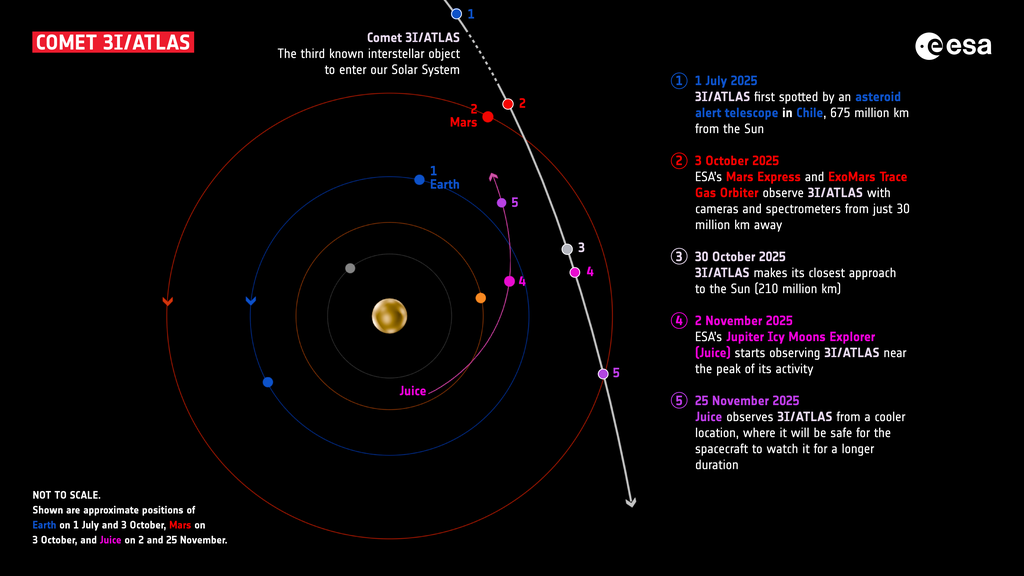
Almost everything has looked at this comet. The paper's own opening pages run through the campaign: a gas coma dominated by carbon dioxide, seen by the James Webb Space Telescope; ice mixed through with dark dust; methanol enriched relative to hydrogen cyanide; nitrogen and carbon isotope ratios unlike those measured in Solar System comets. What the Liège campaign adds is a slow, even record of the gases themselves, with one instrument used throughout.
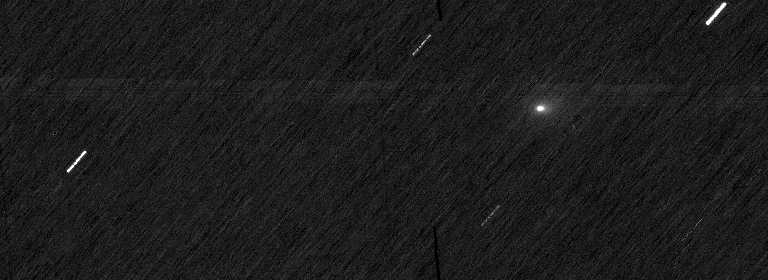
Ammonia is one of the ices astronomers most want to count, because how much of it a comet carries depends on how cold the place it formed was. Ammonia itself cannot be seen in visible light. What a spectrograph catches is the photochemical products: ultraviolet sunlight takes the molecule apart in stages, producing NH₂ and then NH, and both fragments glow at wavelengths UVES covers. In 3I/ATLAS, NH came out weak, and only near perihelion, its closest pass by the Sun. NH₂ was not detected: the modeled band the team fitted sits inside the noise of the spectrum, so what they report is a limit on how much could be present rather than an amount. Ammonia itself was not measured here, and the authors note that NH₃ has not been detected in infrared observations either.
A line that fails to appear is weak evidence on its own. What gives this one weight is the yardstick behind it. The ratio of NH to CN, a nitrogen-bearing radical common in comets, has been used to compare cometary compositions since a 1995 survey by A'Hearn and colleagues, and 3I/ATLAS lands clearly on the ammonia-poor side of that boundary, with little wobble across six months of watching. The authors judged it against a reference set of more than 200 comets drawn from several surveys, then checked that it keeps its odd position when the comparison is narrowed to comets measured with the same instrument, which is the obvious way a result like this could be an artifact of stitching surveys together.
The carbon side of the chemistry is slipperier, and the paper is careful with it. Measured against CN, the comet's carbon-chain molecules look depleted. Measured against OH, the stand-in for water, they sit inside the normal range, and the carbon-to-CN ratio drifts with distance from the Sun, climbing toward ordinary values near perihelion. Aravind's team reads that drift as something happening in the coma, the cloud of gas around the nucleus, rather than in the nucleus itself: the comet is hyperactive, with icy grains releasing carbon-bearing molecules far from the surface. The carbon depletion is a statement about one ratio, not about the comet.
The ammonia result, by contrast, does not rest on this campaign alone. Hideyo Kawakita of Kyoto Sangyo University and colleagues reported the same absence in The Astrophysical Journal Letters on March 31, 2026, from three nights of low-resolution spectra taken after the comet passed perihelion: "no NH₂ emission bands were detected in our spectra," they write, and the pattern "probably reflects a depletion of ammonia in the ices incorporated in 3I/ATLAS." Their CN and carbon-chain numbers against water came out normal, the same split the VLT spectra show. Kawakita is also an author on the Liège paper, so the two are not wholly independent; the observations were made with different telescopes and on different nights, but one author overlaps.
Plot the ratios against one another and 3I/ATLAS sits off the cluster that nearly every Solar System comet falls into, nearest the strongly carbon-poor ones such as 21P/Giacobini-Zinner and 73P/Schwassmann-Wachmann 3, but not on top of them: its CN relative to water is unusually high. The authors call it an extension of that group "toward a more chemically extreme volatile inventory" rather than a member of it. Carbon-poor comets have been argued to record formation in especially cold parts of a disk, so a comet more depleted still could have formed colder yet; that step is the authors' reading rather than a measurement, and separate isotope work by other teams has been interpreted as supporting the same general picture.
The cleanest comparison is with the only other interstellar comet measured this way. 2I/Borisov showed NH₂ plainly, at high and low resolution. 3I/ATLAS shows none, in either campaign. Two comets from two other planetary systems, and they do not resemble each other, which is most of what this kind of work is for. 3I/ATLAS is on its way out and will not be back; what stays behind is the measurement, and a yardstick for whatever arrives next.