A Black Hole Faded and Its Light Grew Hotter, Not Cooler

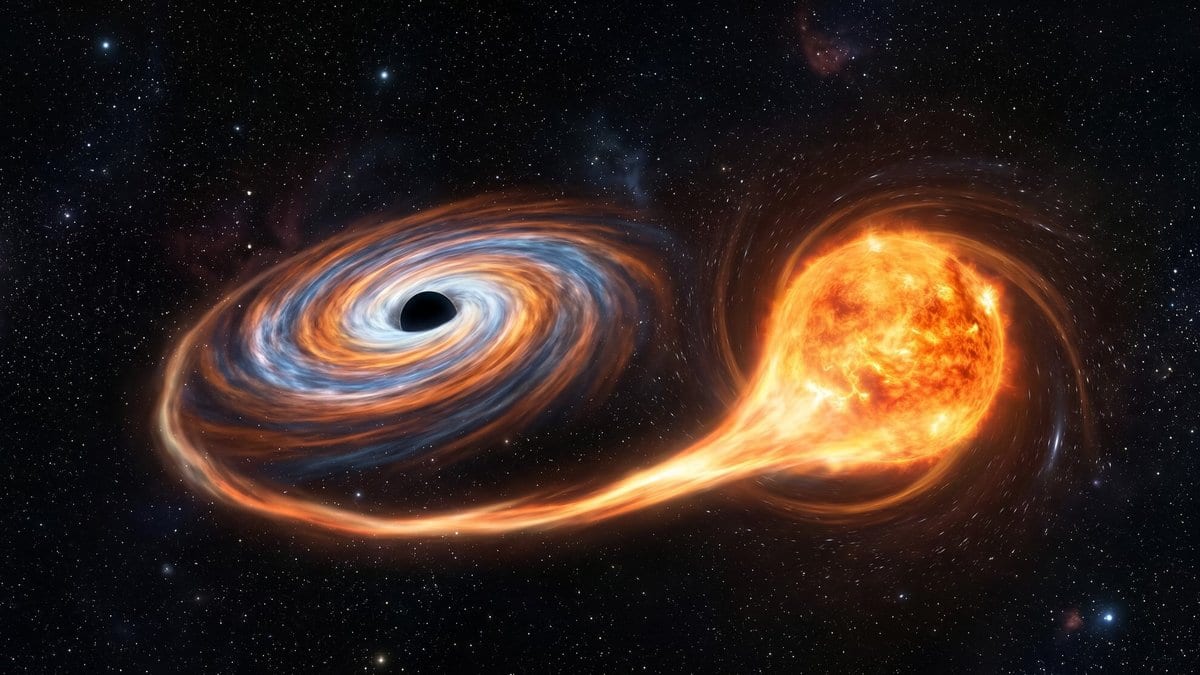
Something was off about the way this black hole faded. It sits in our own galaxy, pulling gas off a small companion star and heating the stolen material until it glows from X-rays to the infrared. Over the months after it flared up, the glow dimmed, the way these outbursts always do. The visible and infrared spectrum, though, did not simply cool as the source faded. It shifted to a hotter, almost featureless state.
That backward switch is the subject of a peer-reviewed paper published Oct. 22 in Nature Astronomy. M. Armas Padilla of the Instituto de Astrofísica de Canarias and colleagues took three optical and infrared spectra of the system, MAXI J0637-430, with the Very Large Telescope in Chile as its 2019–2020 outburst decayed. The first was taken in November 2019. Beside them they set X-ray measurements made at the same time by Swift, NICER and NuSTAR.
At the brightest point of the outburst, the spectrum was cool, with strong hydrogen and helium emission lines standing above the continuum: the fingerprint of relatively cool gas out in the disk's outer reaches. As the source faded, those lines drained away. What was left was hot, heavily irradiated and almost featureless. That is the measurement, and it holds whatever picture one takes of the disk.
What the switch means is a separate claim. In their interpretation, the inner disk had puffed up vertically near the outburst's peak into a wall thick enough to block the hard radiation produced close to the black hole from reaching the outer disk. Shaded that way, the outer gas stayed cool and gave off its hydrogen and helium lines. As the flow of gas onto the black hole slowed, the inner disk settled back toward a thin sheet and the shadow lifted. The high-energy light then reached the outer disk, heating and ionizing it until the lines washed out. The paper calls this "a scenario supported by contemporaneous X-ray spectra." The disk's vertical thickness was not directly imaged.
The brightness at which this happened is the number that carries the story, and it is the least certain part of the paper. The paper puts the outburst's peak at about a fifth of the Eddington limit, the point at which the outward pressure of radiation can counteract gravity, and says in the same breath that both the brightness at which the change sets in and the signs by which it can be recognized remain uncertain. So the figure describes the peak of this one outburst rather than a threshold the work measured. A fraction of the Eddington limit is also only as firm as the black hole's mass and its distance, and neither has been measured directly here.
A disk that swells vertically is not, by itself, a surprise. The "slim" disk models of the 1980s and the "puffy" disk simulations that came after them, both of which this paper cites, already predict that the inner flow can inflate when gas arrives at roughly this rate or faster. What has been thin on the ground is the observational half: at what brightness the change sets in and what a spectrograph sees when it does. These spectra are mostly an answer to the second of those.
MAXI J0637-430 was not a blank slate either. Another team had already used optical spectroscopy to map the irradiated disk of this same system during this same outburst, in a study the new paper cites as a pilot investigation. It also remains, strictly speaking, a black hole candidate. Its mass has not been determined dynamically by tracking the companion star's orbital motion, so the estimates on record come from models of its X-ray emission; one such analysis puts it between five and twelve times the mass of the Sun. A later reconstruction of the system landed near the bottom of that range. It also estimated an orbital period of about two hours, the tightest known for any black hole binary in our galaxy, roughly 28,000 light-years away.
If inner disks really do inflate at luminosities well below the Eddington limit, as the paper puts it, the consequences extend beyond this one binary. A thick inner wall changes both what an outside observer sees and what the outer disk receives. The authors list what that could affect: black hole spins inferred from disk emission, X-ray polarization measurements and the conditions in the outer disk and the winds that blow off it. On how widespread the geometry might be, they stop at a suggestion, writing that observations of similar systems suggest the phenomenon "may be common among black hole accretion disks." What is in hand is one binary, one decay, three spectra.
Everything the conclusion rests on is publicly available. The X-ray data sit in NASA's HEASARC archive, the Very Large Telescope spectra in the ESO archive under programme 0104.D-0251(A) and the spectrum from the SOAR telescope at NOIRLab in Chile; the data reduction and spectral fitting were done with publicly available software. Another group can retrieve the same spectra and test whether a shadow is the best way to interpret them.