Snake Embryos Coil Because Their Bodies Outgrow Their Guts

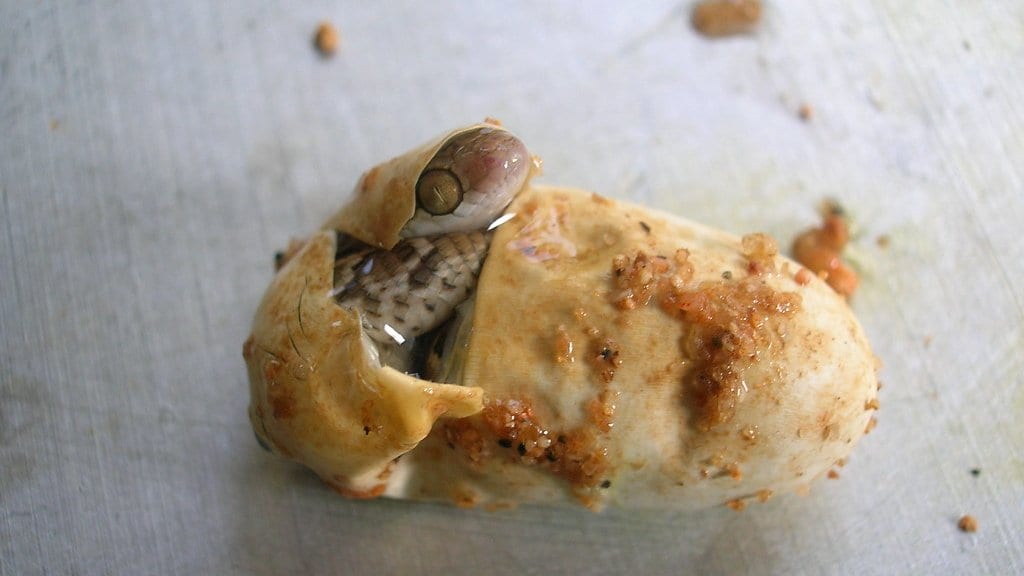
Crack a snake egg partway through incubation and you find an animal that does not fit the space it is in. The embryo is already a long ribbon of vertebrae and muscle, stowed inside the shell wound tightly around itself, the way a cable gets coiled to fit a drawer. Naturalists have been looking at that shape in specimen jars and journal plates for well over a century. Nobody had an account of what puts it there.
A paper published online Aug. 31 in Current Biology now offers one, and it turns on something plainer than genetics: the embryo runs out of room. Alexandra Weber, who started the work at Carleton University and is now a graduate student in zoology at the University of British Columbia, led the survey with Tetsuto Miyashita of the University of Ottawa and the Canadian Museum of Nature. With colleagues in California and Helsinki, they compared the direction of coiling in 39 species of snakes and other limbless reptiles. In early development, they report, the coil is nearly always right-handed.
The account they arrive at is mechanical, and Miyashita reaches for something most people have done with a backpack. "It's like when you adjust the length of a strap and the longer, buckling side of the loop twists," he said in the Canadian Museum of Nature's announcement of the work.
What gets adjusted, in the snake, is the relation between two things growing at different speeds. A vertebrate embryo builds its body in repeating segments (the blocks that become vertebrae and trunk muscle), and in snakes that process runs fast. Fast enough, the authors report, to outrun the lengthening of the gut. The gut and the body axis are physically separate at these stages, and the gut holds still as a pillar reaching from the stomach to the cloaca, the single opening at the tail end. The growing body has nowhere to go except around it, and that is what the spiral is: the vertebral column and its segments wound around a length of stalled gut.
That leaves the direction, and here the team's answer is the yolk. At this stage the one gross asymmetry in the egg is the food supply, which sits on the embryo's left side. The coil turns right, on this account, because the body grows away from the mass on its left. The authors state it carefully: the early rightward bias is "likely passively determined by the left-sided yolk mass." The evidence is a set of observations that line up with one another, not an experiment that pushed the yolk somewhere else to see what happened.
The right-handedness also does not last. It belongs to the early stages. Later, once the embryos have built enough muscle to shift themselves and the gut has caught up in length, the coil goes slack and the direction stops being consistent. "Some remain in right-handed coils, but some recoil to the left side," Weber said. The handedness, in other words, is a property of a window in development rather than of snakes.
The reason this matters beyond the charm of it is what it says about building an extreme body. Snakes carry the most elongate body plan in the vertebrate world, and the usual place to look for how such a body gets built is the genetics of the axis, the genes that set how many segments a vertebrate lays down and where. The coiling result sits at a different level. Snakes "apparently solve some of the many challenges to patterning their startlingly elongate bodies by coiling," the authors write: the spiral is one of the accommodations that lets a body far too long for its shell go on growing inside it.
The project itself came out of the COVID lockdown. Miyashita had been wondering about it for years. "I had inherited from my PhD advisor this fascination with asymmetries in animal forms," he said. "So every time I saw images of snake embryos in papers, I wondered whether they are right- or left-handed in their coiling."
Weber places the answer among the other spirals biology has not fully accounted for. "There is a touch of mystery to spirals and we are only beginning to understand how these shapes are produced in animals, such as our looping intestine, snail shells, and now these beautifully coiled snake embryos," she said.