The Maya Scientist We Can Finally Name, and the Formula That Revealed Him

For more than a century, the Maya arrived to us as a civilization without authors. Their astronomers charted Venus across generations and their scribes carved dynasties into stone, yet the people who actually did the mathematics stayed anonymous, a collective "they," never a "he" or "she" with a name. A small chamber at Xultun, in the northern Guatemalan lowlands, has now cracked that silence.
On the plastered east wall of a structure archaeologists label 10K-2, a nine-glyph inscription known to the researchers as Text 19 lays out a calculation. Franco D. Rossi of MIT, David Stuart of the University of Texas at Austin, and Heather Hurst of Skidmore College report in the journal Antiquity that the text does something the surrounding wall notes do not: it ends by claiming credit. After the numbers comes the glyph cheheen ("so says") and then a personal name, Sak Tahn Waax. Someone signed his arithmetic around 781 CE.
What he was working on was a problem of reconciliation. The Maya ran several clocks at once, and those clocks did not divide neatly into one another. The 260-day Tzolkin governed ritual life; the 365-day Haab tracked the solar year; Venus returned to the same point in the sky every 584 days, and Mars every 780 days. A Maya astronomer's craft lay in finding the moment when these independent cycles lined up again, the least common rhythm hidden beneath the noise.
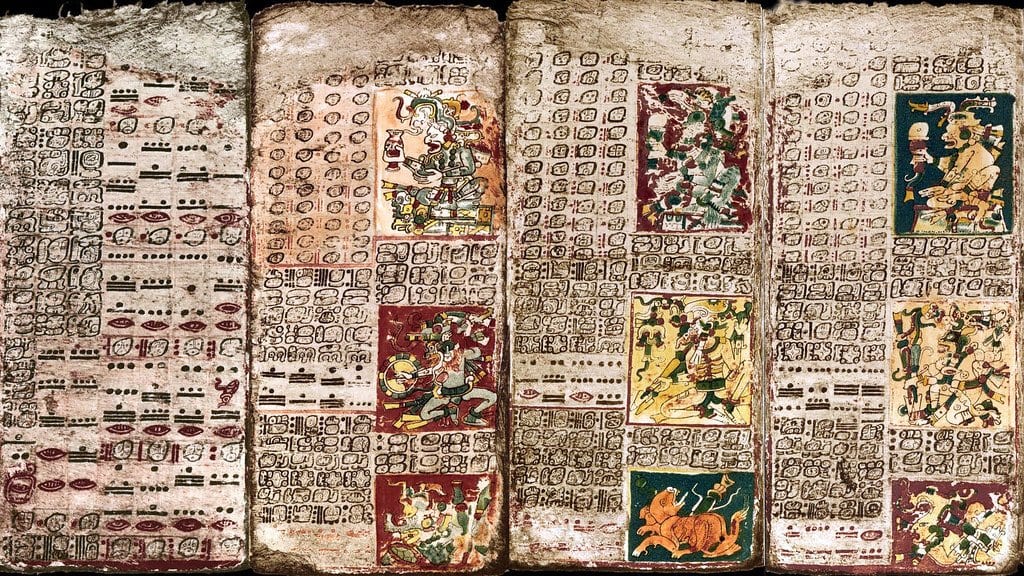
Text 19 finds one. Its five calendar dates, spaced by deliberate intervals, encode a 2,920-day cycle: exactly five Venus synodic periods (5 × 584), and, folded in through the Tzolkin and Haab counts, a scaffold that also carries the 780-day Mars period and the base units of the Maya count, the 20-day Uinal and the 360-day Tun. The result is a compact table showing how one scholar reconciled Venus, Mars, and the two calendars in a single unbroken sequence. Similar sky-tables survive elsewhere, most famously in the Dresden Codex, but nothing quite like this construction had been documented before.
The signature is what makes the find unusual. Rossi and his colleagues do not argue that Sak Tahn Waax was the first Maya scientist, or the first in the Americas. Earlier astronomers plainly existed; we simply cannot name them. What they describe is narrower and, in a way, more startling: "the only known example of a Classic-period Maya mathematician-astronomer identified by name and claiming direct credit for their intellectual work." In other words, this is the earliest instance we have of an individual in the ancient Maya world stepping out from behind the collective record to say, in effect, I did this math. The popular framing of an "earliest named scientist in the Americas" runs ahead of that scoped statement; the paper's own wording is the safer guide.
That distinction matters because it changes what the wall tells us. The murals of structure 10K-2, first documented more than a decade ago, had already suggested the room served working astronomers rather than kings, a kind of scholars' workspace, its plaster covered in numbers rather than propaganda. A named author turns that impression into evidence. It implies a culture in which intellectual work could be owned and attributed, where a calculation carried not just a result but a person behind it.
Reconstructing that person from the wall was painstaking. The relevant glyphs are faint, and the two that spell out the attribution, the "so says" marker and the name itself, sit apart from the tidy columns of dates, which is part of why the signature had gone unread. Epigraphers work by comparing sign forms across the corpus of Maya writing, and it was that comparative reading, rather than any single dramatic discovery, that resolved Sak Tahn Waax out of the microtexts.
Sources
- www.science.org
- AntiquityPeer-reviewed
- www.nature.com