A Black Hole's Energy Trick, Recreated on a Lab Bench

Nothing in the apparatus actually spins. That is the first surprise, and the one that makes the rest of the story hang together. Sitting on a bench at the City University of New York's Advanced Science Research Center is a ring-shaped network of electronic resonators: circuits, in other words, wired into a loop. Left alone, it does nothing dramatic. But when the team rapidly cycles the electrical properties of each element around the ring in a carefully timed sequence, a pattern begins to travel around the loop. To a radio wave passing through, that traveling pattern reads exactly like a surface whipping around at enormous speed. The wave cannot tell the difference between a genuine rotation and a well-choreographed illusion of one. And that illusion, it turns out, is enough to hand the wave extra energy on its way out.
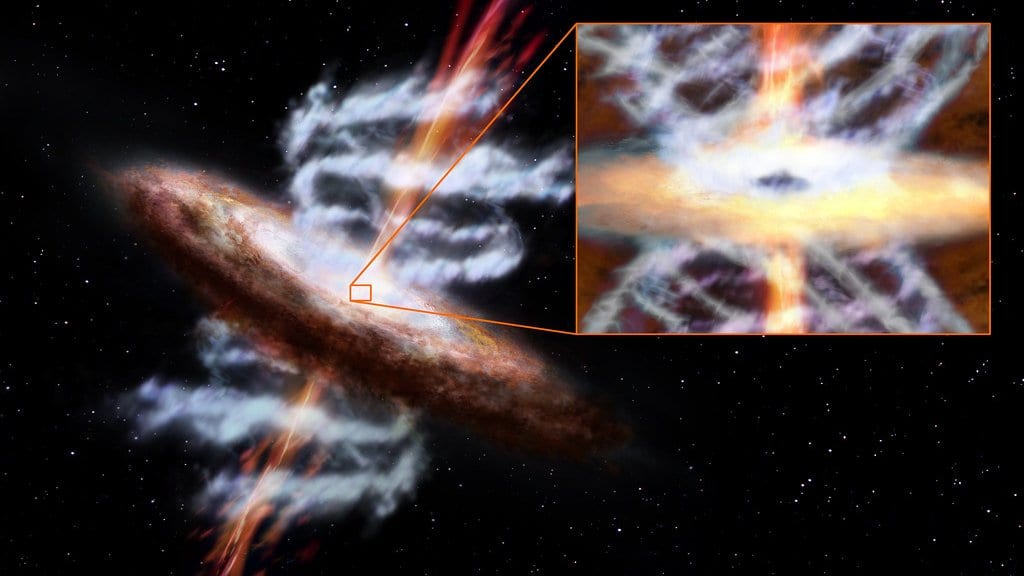
The effect the group set out to catch has a long theoretical shadow. In the 1960s, Roger Penrose worked out that a particle dropped into the swirling region just outside a rotating black hole could, in principle, escape carrying more energy than it fell in with, energy skimmed from the hole's spin. Yakov Zel'dovich soon extended the thought to waves: send a wave at an object rotating fast enough, he argued, and it should bounce back amplified, the object's rotation paying the difference. The phenomenon acquired a name, rotational superradiance, and then sat for decades as one of those predictions everyone believed but nobody could stage. You would need something spinning implausibly fast (in the relevant regime, faster than light itself), which no material object can do.
The CUNY team, led by principal investigator Andrea Alù with lead author Hadiseh Nasari and co-lead author Hady Moussa, found a way around the spinning part entirely. Their trick belongs to a fast-growing field called Floquet engineering, where a system's properties are varied rhythmically in time rather than held fixed. By modulating the ring in space and time together, they manufactured what the researchers call a synthetic, or effective, rotation: a rotation that exists only in how the wave perceives the structure, not in any physical motion of it. Crucially, that engineered rotation can be pushed past limits no real object could reach, including the effective superluminal regime the theory demands. The device stays put; the "faster than light" spin is a property of the modulation pattern the wave experiences, never of matter moving faster than light, which remains as forbidden as ever. Their results were published on 8 July in the journal Nature, in a paper titled "Observation of Floquet rotational super-radiance."
With the illusion of ultrafast rotation in place, the payoff followed. Waves whose own rotational character matched the synthetic spin of the ring came out amplified, drawing energy from the time-engineered modulation just as Zel'dovich's waves were supposed to draw it from a spinning body. "Our approach facilitates a new method of wave–matter interaction in which waves with selected rotational properties extract energy from synthetic time-engineered rotation," Alù said in a statement released by CUNY. Moussa put it more plainly: the experiment reproduces "the essential physics of the Penrose–Zel'dovich process"; the black hole's energy-skimming trick, staged in circuitry you could hold in your hand.
It helps to be clear about what has and has not happened here. No black hole was involved, and none was simulated in the sense of a computer model; this is a physical system that obeys the same underlying wave physics that governs superradiance around a spinning mass. That is why the result matters. A prediction that lived for half a century only on paper and in the extreme environs of collapsed stars now has a bench-top counterpart that behaves the way the theory said it should, a rare case of laboratory hardware reaching a phenomenon that was supposed to require a black hole to see. The work is peer-reviewed and appears in a top-tier journal, so this is a solidly established result rather than a preliminary claim, though it is a single study and the practical uses remain prospective.
Nasari framed those uses broadly, saying the work "has implications for advances in fundamental science and in communications, optics and photonics." A device that can selectively pump energy into waves carrying a particular twist could, in principle, become a new kind of amplifier, one that boosts certain signals while ignoring others, useful anywhere from wireless links to photonic circuitry. For now, that is a direction rather than a product.
What the team has really delivered is a proof: that a piece of physics thought to belong to the neighborhood of black holes can be coaxed onto a lab bench, one carefully timed electrical pulse at a time. No singularity required, just the patience to make a wave believe something is spinning when nothing is.
Sources
- phys.org
- NaturePeer-reviewed
- www.eurekalert.org