A Bacterial Ribosome That Builds a Protein Written Into Its Own RNA

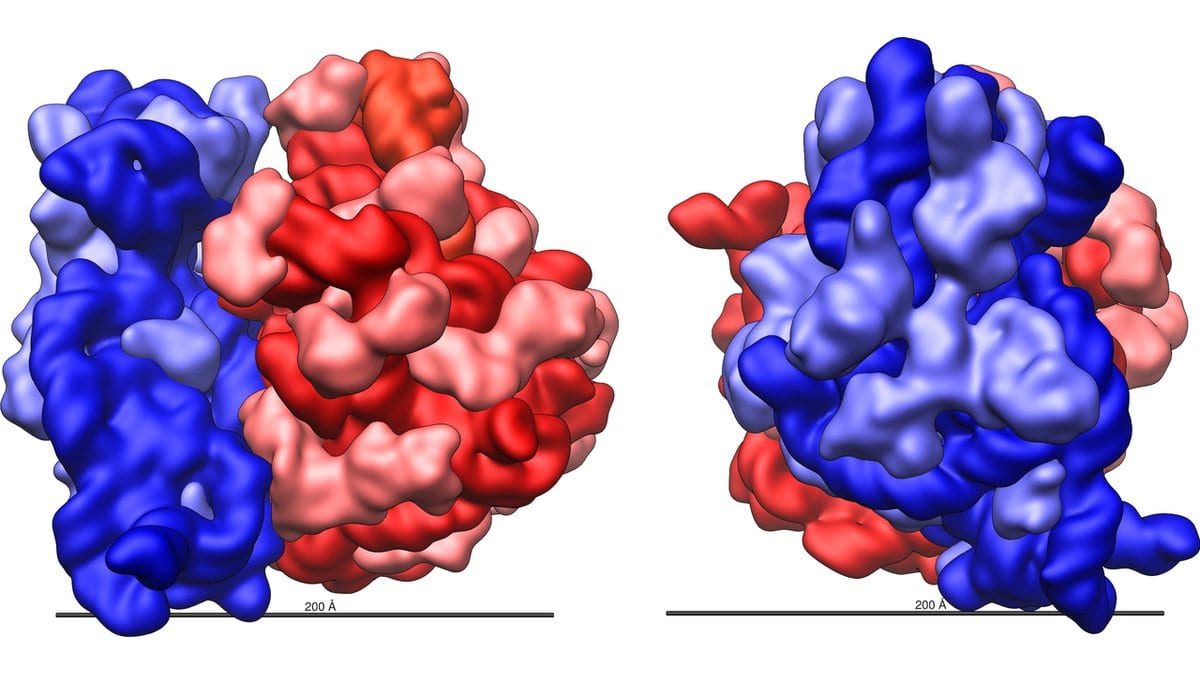
A ribosome spends most of its working life waiting. The machine that builds every protein in every living cell cannot start until a messenger RNA happens to drift into it and thread through the right groove. The encounter is a matter of chance, and a cell's ribosomes are indiscriminate about which message they take. That suits a bacterium needing thousands of different proteins. It frustrates anyone who wants a cell to make one protein very well. It also sits oddly beside something biologists have known for decades: a ribosome is itself built largely out of RNA, the same chemistry as the messages it reads.
Whether a ribosome can read the RNA it is made of has remained an open question. In a paper published in Nature on September 2, Kasra Alizadeh, Alexander Mankin and colleagues in the pharmaceutical sciences department at the University of Illinois at Chicago report that a bacterial one can. They took the RNA of the ribosome's small subunit, the strand known as 16S, and appended a protein-coding sequence to its end. The result is a single hybrid molecule that is part machine and part message, which they call a messenger-ribosomal RNA.
The hybrid assembled anyway. It folded into a working small subunit, and that subunit docked with the large one. The resulting ribosome, which the team named Ribo-M, built protein from the coding sequence riding on its own RNA. It did so inside living bacterial cells and also in a tube, with the translation machinery working outside any cell at all. Nor did it depend on one obliging sequence; more than one protein was made this way.
The delicate part is showing that a ribosome read the message attached to itself, rather than passing it to some other ribosome drifting nearby. The team's argument for that rests on two independent forms of sabotage. Mutations that cripple the small subunit stopped the protein from appearing, and so did antibiotics that block the same subunit's work. Both should be harmless if a neighboring, undamaged ribosome were doing the reading. The researchers conclude from those controls that the translation happens in place, on the particle that carries the message.
One more step produces the version that is genuinely a single object. A decade ago the same laboratory built Ribo-T, a ribosome whose two subunits are tethered into one continuous piece of RNA instead of coming apart after every round of work. Appending a coding sequence to that construct gives Ribo-TM, in which the instructions, the decoding of them and the chemistry that links amino acids together all sit on one molecule. Plain Ribo-M is not that: the large subunit's RNA remains a separate strand, so the one-molecule description belongs to the tethered version only.
None of this arrives out of nowhere, which is part of why it is credible. In 1987, Berg, Squires and Squires reported in the Journal of Bacteriology that a short open reading frame sitting inside a bacterial 16S gene is genuinely translated in living cells. The idea that ribosomal RNA can hide a readable message is nearly forty years old. Other groups have since fused message elements directly onto 16S RNA and found that the ribosomes still assemble and still function. What had not been shown is the piece between: a full protein-coding sequence read by the very ribosome built around it.
The older work also explains why the group frames the new result against a question about beginnings. Models of an early RNA world struggle to explain how the first protein synthesis could have been reliable when its components were scarce and poorly organized. A particle carrying its own instructions would not have had to find them. The authors put that forward as motivation and as a possible implication, and they keep it conditional. Showing that a modern, heavily engineered ribosome can work this way says the arrangement is chemically workable. It says nothing about whether anything of the kind happened on the early Earth.
The nearer-term interest is industrial. A ribosome committed to a single product could turn a cell into a dedicated factory for one protein while leaving the rest of its translation alone, which is a long-standing goal in biotechnology. The paper offers this as a platform rather than a method in hand: its own claim is mechanistic feasibility, and it does not argue that the approach can match the expression systems already in use.
This is one study from one laboratory. No independent group has reproduced the result. The means to try are on offer: the key plasmids and strains are listed as available through the Addgene repository or from the corresponding author, and the sequences of the constructs are published with the paper.