A Pulse Lasting Trillionths of a Second Finds a Superconductor's Real Limit

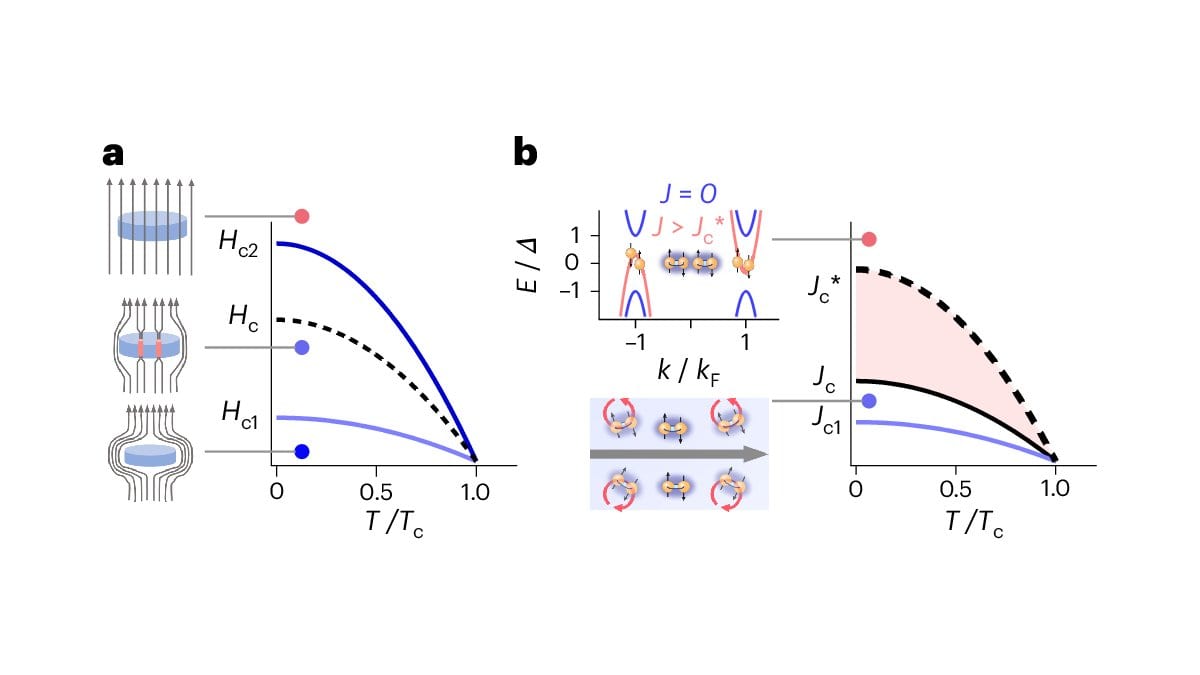
Ask how much current a superconductor can carry and the most honest answer is a number about its flaws. Push the current up and thin tubes of magnetic field, called vortices, tear loose from the defects that hold them in place, sweep across the material and heat it until the superconducting state collapses. That threshold is the critical current, and it is as much a property of a particular film's defects as of the metal itself. Underneath it sits a harder limit, the depairing current, where the paired electrons carrying the current come apart, and it has stayed mostly out of experimental reach.
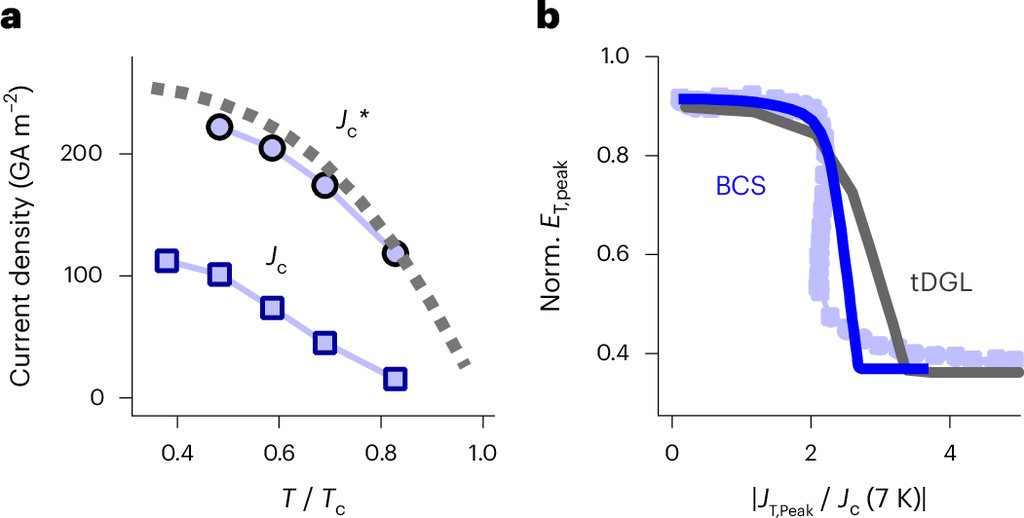
A team at the Max Planck Institute for the Structure and Dynamics of Matter in Hamburg reached it by not giving the vortices time to move. In a paper published on September 24, 2026, in Nature Physics, Eryin Wang, Andrea Cavalleri and colleagues report driving current pulses about two trillionths of a second long through films of two different superconductors. In niobium nitride the breakdown was abrupt, and it came at about 2.2 times the current that same film tolerated under steady current. In the copper oxide YBa2Cu3O7 there was no single breaking point at all.
The numbers belong to one sample at one temperature. Held at 7 kelvin, deep in its superconducting state, the niobium nitride film gave up superconductivity under a steady current at about 100 billion amperes per square meter. Under picosecond pulses it carried current cleanly through that value, and the pulse coming out the far side collapsed only near 220 billion. The ratio is not a constant either: closer to the temperature where superconductivity fails altogether, the steady-current value drops to nearly a tenth of the intrinsic one.
Why a very short pulse gets further
"Our strategy was to outrun the vortex dynamics," Wang says in the Max Planck Society's announcement of the work. Vortices move at tens of kilometers per second at most, which comes to tens of nanometers in a picosecond. The strip the current crosses is 10 micrometers wide, so during a pulse roughly two picoseconds long the vortices barely leave the edge where they enter. What the current does instead, in Wang's image oof it, is this: "One way to picture it is that the current 'twists' the phase of the coherent quantum state of the superconductor, rather like winding a spring." Twist it far enough and the pairs come apart.
The team rules out vortices on three counts. The samples were cooled in a shielded space with almost no magnetic field present, so none were sitting in the film to begin with. Even if a vortex were granted instant entry and no friction, it could not cross the strip in the time available. And the two materials differ from each other in the way their internal structure predicts, which a heating artifact would not do.
The copper oxide never snaps
YBa2Cu3O7, better known as YBCO, did something else. At 50 kelvin, well inside its superconducting state, the transmitted pulse began shrinking as soon as the current rose and kept shrinking, with no sharp drop and no point at which the supercurrent peaked. The authors read that as the signature of the energy gap, the price of breaking a pair. In niobium nitride that price is nearly the same in every direction. In YBCO it is large in some directions and falls to zero in others, so pairs moving the right way can be broken by a modest current, and the breakdown is piecemeal. Their conclusion is a limiting one: a material with a gap shaped like YBCO's has no well-defined intrinsic threshold to measure, and none was obtained for it here.
That contrast is the part the group thinks will travel. "Our results suggest that picosecond transport can provide access to microscopic properties of superconductors, including their gap symmetry, that are not directly available from conventional DC transport," says Andrea Cavalleri, who leads the research group. The shape of the gap is usually read with light or with a fine metal tip; here it shows up in how a current pulse comes out the far side of the film, which is a way into materials where the optical methods work poorly. The announcement adds that measurements on more superconductors will be needed to show how widely that holds.
A measurement, not a stronger wire
None of this is a superconductor made to carry more current in service. The high current exists only while the pulse does, in a film a few micrometers across on a laboratory bench, and the pulses themselves are launched by firing laser light at photoconductive switches, patches of silicon that briefly conduct. "To apply current to superconductors for only a few picoseconds, we used the ultrafast electrical-transport platform that we have been developing at our institute," says Guido Meier, a co-author. What the paper claims from the applications side stays conditional: reaching the depairing current could support superconducting electronics running closer to their intrinsic limits, and the pulses could become a way to make very short, strong magnetic field pulses. Wang, Meier and Cavalleri are named inventors on a European patent application covering the method.
What bounds the result is the sample. This is one laboratory and one film per pairing type: a niobium nitride layer grown at the Shanghai Institute of Microsystem and Information Technology, and a commercial YBCO film. It also depends on those films being single crystals. The authors note that in films made of many small grains, quantum phase slips at the boundaries dominate the response and would hide the effect. A calculation built from the film's own measured properties tracks how the intrinsic limit falls with temperature and reproduces the sharp drop. It does not reproduce the slow tail as the film returns to normal, which the authors take as a sign of something left out, probably the material's lattice vibrations. One smearing term in that calculation was tuned to fit rather than measured. The simulations came from ETH Zurich, and Cavalleri is at the Clarendon Laboratory in Oxford as well as in Hamburg. The paper is open access, and the data behind each figure are published with it.
Sources
- Nature PhysicsPeer-reviewed
- www.mpg.de