A Hydrogen Study Hedged Its Own Title. The Headlines Did Not

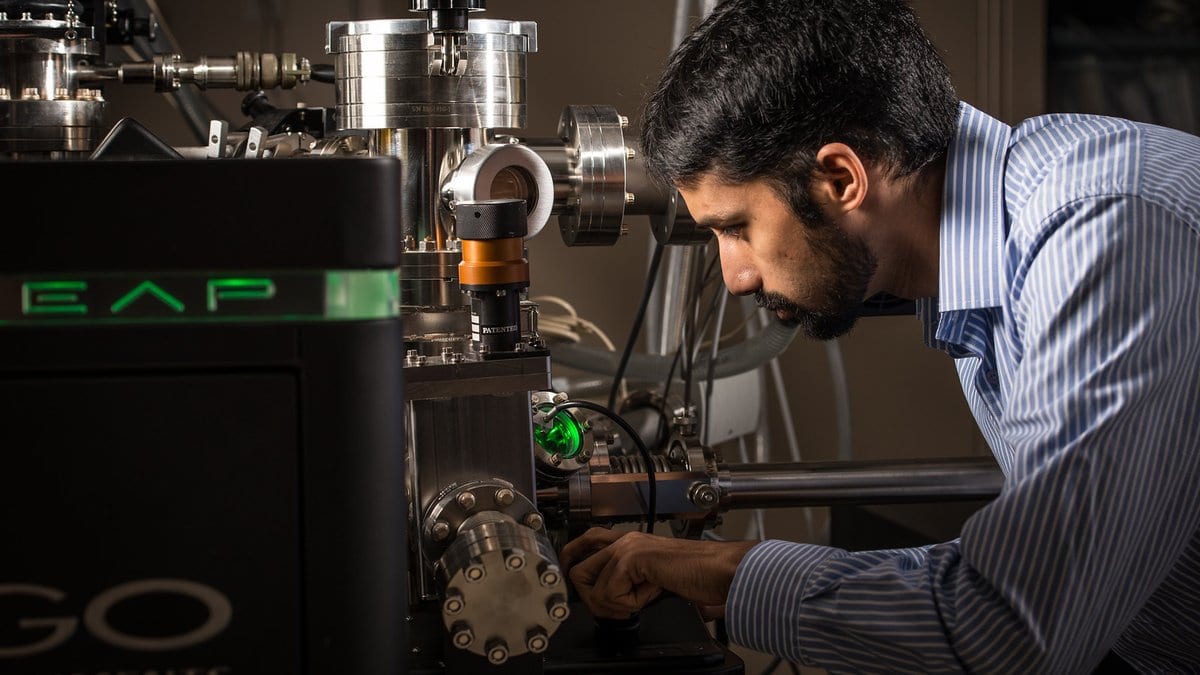
A hydrogen atom dissolved in metal is about the hardest thing in materials science to catch sight of. It is small enough to slip between the atoms of the lattice, too light for most microscopes to register, and mobile enough to leave the sample before anyone gets a measurement. So the recipe Chao Huang, Julie Cairney and 18 colleagues settled on reads like a relay handoff. Charge a needle of alloy with deuterium, spend about three seconds wiping off the electrolyte, then drop the needle into liquid nitrogen and keep it cold all the way into the instrument.
Atom probe tomography, which counts atoms one by one and records where each sat, can in principle find hydrogen. In practice the instrument is full of hydrogen already. That is why these needles were charged with deuterium, a heavier form of hydrogen that lands somewhere else on the mass spectrum. Huang, Cairney and colleagues report in Nature that in an equal-parts cobalt-chromium-nickel-iron-manganese alloy the deuterium reached 1.3 atomic percent, which they give equivalently as 473 parts per million by weight. It was spread through the metal at random, "consistent with what is expected for interstitial hydrogen in solid solution." Interstitial means sitting in the gaps of the crystal, not bound to anything.
Hydrogen sits in metal in three ways: bound into hydride compounds, caught at flaws such as dislocations and grain boundaries, or dissolved in the gaps. The hydrides and the trapped hydrogen are old news to this instrument. A 2010 paper in Scripta Materialia was titled "The first direct observation of hydrogen trapping sites in TiC precipitation-hardening steel through atom probe tomography," and a 2020 paper in Science mapped hydrogen trapped at dislocations, grain boundaries and particles inside the metal. The University of Sydney's release says as much: "The first two have been experimentally observed before but the third, while understood theoretically, has been extremely difficult to observe directly."
What the paper says and what the headlines claim
The paper's closing summary keeps a hedge in it: "The deuterium partitioning reflects interstitial occupancy, although minor contributions from vacancies, vacancy-hydrogen/deuterium complexes or elastic fields cannot be fully excluded." Its abstract claims that atom probe tomography can now "move beyond identifying hydrides and solute-decorated defects" to examine hydrogen in solid solution. No claim of priority appears anywhere in it.
The University of Sydney's release, out the same day, opens differently: "The world-first observation of hydrogen dissolving in these 'metal crystal lattices' offers fresh insights into why hydrogen can weaken metals and how more hydrogen-resistant materials might be developed." Further down, the release says the team "verified that hydrogen is present between metal atoms, known as an interstitial state, rather than only being trapped at defects." The paper's own verb, in the abstract and in the summary, is "consistent with."
The release's own figure caption is more careful than its opening line, describing the atom maps as "providing evidence consistent with interstitial hydrogen in solid solution." phys.org, which reprints the release's text, ran it under a headline that promoted the finding again, into direct observations of hydrogen itself in the gaps between metal atoms. Neither hid the isotope. The release says in its body that the team worked by "swapping it out for deuterium, a heavier form of hydrogen," and the reprint carries that sentence too. The distance to travel, then, is from a title to a headline, and from "consistent with" to "verified."
What they did to rule out the obvious alternative
That alternative is where most of the authors' effort went. Electrolytic charging can punch vacancies into a metal, meaning sites where an atom is simply missing, and hydrogen is glad to settle into those. A deuterium map that looks random could be a map of vacancies instead. So the team ran positron annihilation measurements, which are sensitive to exactly those empty sites, on charged specimens, on uncharged ones and on strained ones that ought to hold more vacancies. Every alloy specimen came in below the instrument's detection limit. Calculations from quantum mechanics put the energy needed to make a vacancy high enough that a large population is unlikely, and the team photographed the same particles in an electron microscope before and after charging without finding any new defects.
Having done all of that, they still wrote that minor contributions "cannot be fully excluded," and they wrote it twice; the earlier version of the sentence also names the instrument's own detection limits among the things it cannot rule out. Two numbers in the methods make the same point. Of 68 cryogenic runs attempted, eight produced usable datasets. The deuterium signal also arrives at a mass of 2 daltons, the same mass molecular hydrogen occupies. The authors write that the two "cannot be resolved directly," so that overlap was measured on uncharged reference specimens and carried as a systematic uncertainty rather than removed.
What an alloy designer gets out of this
The usable part of the result is not the random map but the uneven one. In a cobalt-chromium-nickel alloy aged to grow ordered particles of nickel, aluminum and titanium, deuterium gathers inside the particles, which is where the team's calculations said hydrogen would prefer to sit. In a 3D-printed Inconel 718 superalloy carrying two kinds of particle side by side, the deuterium concentrated in the nickel-aluminum-titanium ones and showed only a low concentration in the niobium-rich ones. The paper calls that low, not absent. Both experiments were repeated on another needle and gave the same answer.

Chemistry and crystal structure, in other words, decide where hydrogen goes inside an alloy, and both are things a metallurgist chooses. "By identifying not only where hydrogen accumulates, but also why it prefers particular atomic environments, we can gain a deeper understanding of its fundamental behaviours in metals," Cairney said in the release. Huang, who led the work, said the team is now after a different question: "Our next step is to understand how hydrogen inside metals affect the way metals deform and perform under stress." The paper is peer-reviewed and open access, and Nature names the reviewers who vetted it.
What the authors say they have built is a protocol: a way to line up predictions made on a computer with something an instrument can see. That is a smaller thing than seeing hydrogen, and it is the thing their title claims.
Sources
- NaturePeer-reviewed
- www.eurekalert.org
- Science