Helical Electronic Orbitals in the Mechanism of Directional Rotation in a Molecular Motor

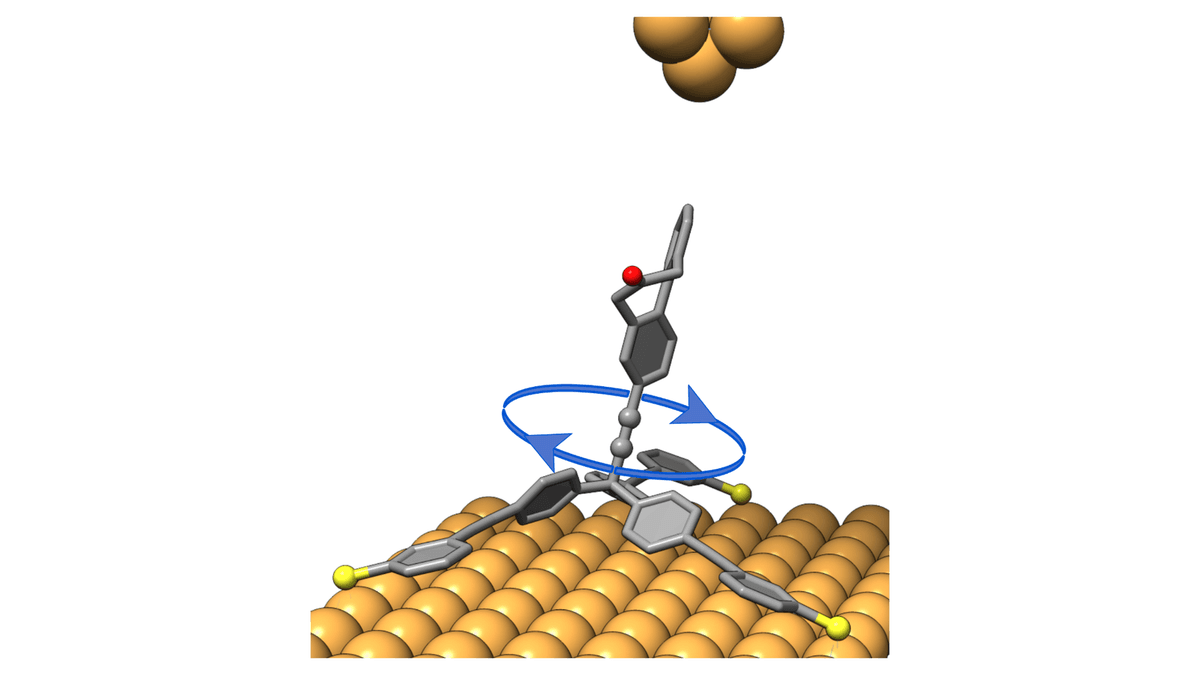
Imagine a molecule designed specifically to work as a motor. Its lower part is anchored to a gold surface, while the group of atoms at the top can turn about the axle connecting the two. Chemists call this moving part the rotor. In a conventional electric motor, the rotor is a separate rotating component; here, the whole assembly fits within a single molecule. The researchers needed to find a way to distinguish the rotor’s positions by measuring the electric current and to determine how its motion depends on the direction of that current.
An international team of physicists and chemists from Karlsruhe, Prague, Regensburg, San Sebastián, and Basel published the study in Nature Chemistry on Oct. 16, 2026. The work combined molecular synthesis, electrical measurements of molecular motion, and theoretical calculations. Julian Skolaut, Štěpán Marek, Nico Balzer, and María Camarasa-Gómez contributed equally to the study. An early version appeared as an open-access preprint in March 2025.
Why Is It So Hard to Make a Molecule Rotate in One Direction?
Chemists have been working on molecular machines for decades. Jean-Pierre Sauvage, James Fraser Stoddart, and Bernard Feringa received the 2016 Nobel Prize in Chemistry for creating such machines. Their research showed that individual parts of a molecule can be made to move in a controlled way. At such small scales, however, thermal fluctuations cause the moving parts of molecules to switch randomly between stable positions. For rotation to be directional, turns in one direction must outnumber turns in the other.
For that to happen, the motor needs an external supply of energy, and the two directions of motion must be inequivalent. At each transition, the rotor must overcome an energy barrier, an obstacle that arises because the molecule’s energy changes as the rotor moves. In some designs, spatial asymmetry helps an externally driven rotor turn more often in one direction than the other. A ratchet works on a similar principle: with a suitable drive, its teeth and pawl allow motion in one direction and impede it in the other. The authors of the new study considered a different mechanism: electrons passing through the molecule might exert a torque on its moving part.
In 2011, Heather Tierney and her colleagues in Charles Sykes’s group demonstrated a single-molecule electric motor. Electrons tunneling from the tip of a scanning tunneling microscope set a butyl methyl sulfide molecule rotating on a copper surface. Its rotation rate and preferred direction were related to the chirality of both the molecule and the microscope tip. In 2023, Richard Korytár and Ferdinand Evers showed theoretically that an electric current could produce a directional torque in a model of a chiral molecular rotor. These results raised a question: how are the current, the rotation of a molecule designed as a motor, and its electronic states related?
How the Researchers Built a Motor from a Single Molecule
For the new experiment, the team synthesized a molecule with three main parts. Its platform was anchored to the surface of a gold crystal by three legs. Above the platform was an axle made of two carbon atoms joined by a triple bond. The axle supported the rotor, the moving upper part of the molecule. The rotor is chiral: it can exist in two mirror-image forms that are related to each other like a right and a left hand. This spatial asymmetry affects the electronic states of the axle and, according to the calculations, is necessary for the rotation mechanism under study.
The rotor contains two linked benzene rings. A short carbon bridge holds them at an angle to one another, giving the upper part of the molecule a twist. Structures of this kind are called Geländer molecules. The German word Geländer means “railing.” The name evokes the way one part of the structure winds around another, like the banister of a spiral staircase. In solution at room temperature, the free rotor rapidly switches between its two mirror-image forms. At the low temperature of the experiment, these transitions were suppressed, and the rotor retained its chiral form.
The researchers used sulfur-containing groups to anchor the molecules to a smooth face of a gold crystal, designated Au(111). To keep the moving tops of neighboring molecules from interfering with the measurements, they mixed the molecular motors with identical platforms that had no rotors: three empty platforms for every motor. They heated the sample to about 100 °C. Heating removed the acetyl protecting groups from the molecules, allowing the sulfur-containing anchors to bind to the gold and helping the molecules stand upright. Together with the empty platforms, the motors formed ordered patches on the surface where individual rotors could be studied with less interference from their neighbors. After cooling the sample, the researchers selected one such molecule and brought the microscope tip close to it.
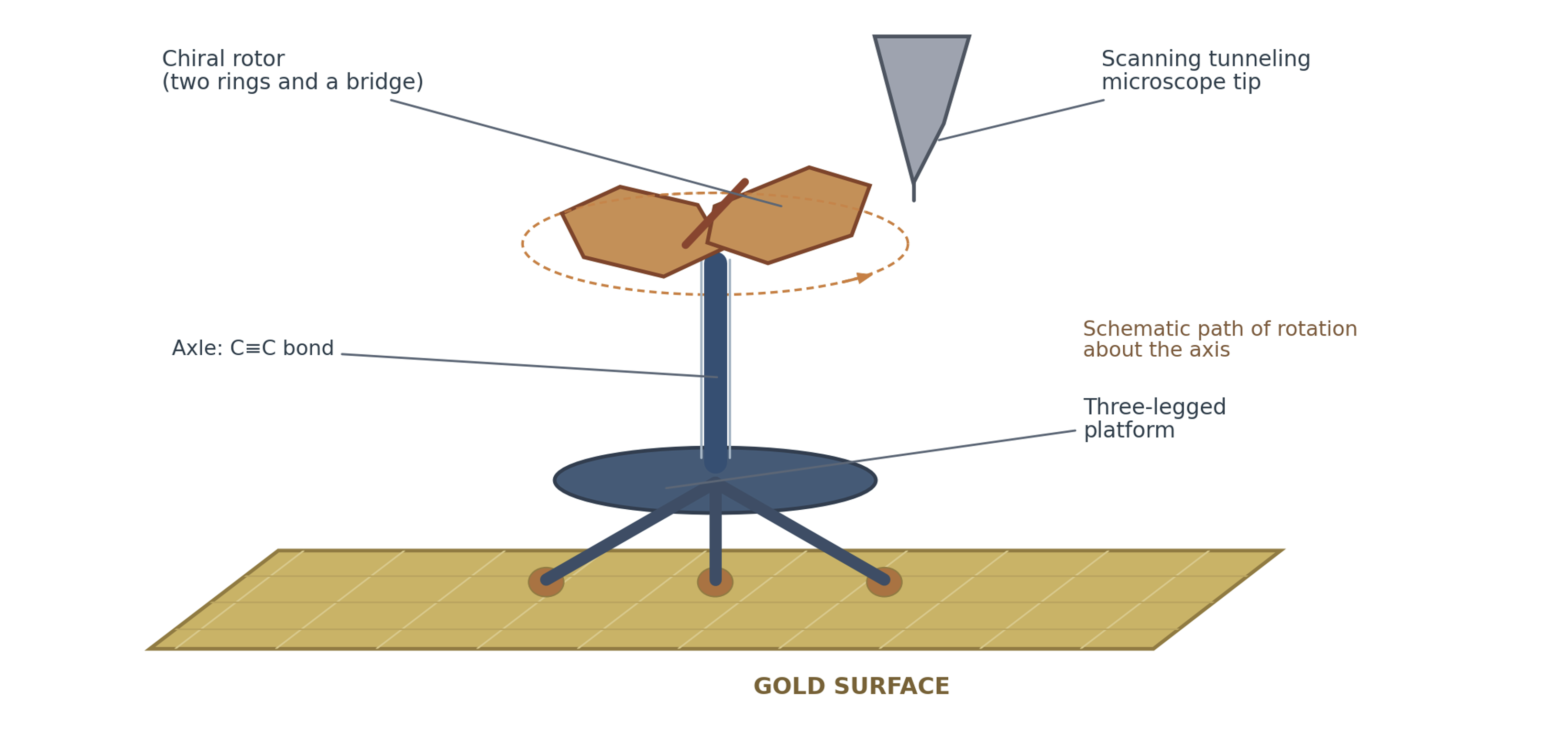
To track the rotor’s turns, the researchers used a scanning tunneling microscope. Its fine metal tip is placed above the molecule, leaving a very small vacuum gap. In classical physics, an electron cannot cross this gap if its energy is below the barrier height. In quantum mechanics, there is a small probability that it will tunnel through. This gives rise to a measurable tunneling current between the tip and the molecule. If the upper part of the molecule turns, the positions of its atoms relative to the tip change, and the measured current may change as well. The electrical signal can thus be used to track transitions between rotor positions.
The researchers took their measurements in ultrahigh vacuum at about 5 K (−268 °C). To record the turns, they held the tip stationary instead of scanning it across the surface, because moving the tip could itself make the rotor switch positions. They placed the tip slightly off the rotation axis so they could distinguish the rotor’s three orientations by their different tunneling current levels. The instrument continuously recorded how the current changed over time. From those changes, the researchers had to reconstruct the positions of the moving part of the molecule.
How Three Current Levels Revealed the Rotor’s Turns
The researchers distinguished three recurring levels in the tunneling current traces. The measured current would stay at one level for a while and then jump to one of the other two. The researchers labeled the levels A, B, and C and matched them to three stable orientations of the rotor relative to the stationary tip. These orientations reflect the threefold symmetry of the molecule’s platform: in moving from one orientation to the next, the rotor turns about 120 degrees, or a third of a revolution.
With only two distinguishable current levels, a return to the initial level does not reveal which way the rotor turned about its axis. A third level makes it possible to distinguish two opposite sequences of transitions. Even so, the traces showing how the tunneling current changed over time cannot, on their own, show which sequence corresponds to clockwise rotation as viewed from above.
The sequence A B C A corresponds to the rotor moving through the three positions in one direction, and A C B A to motion in the opposite direction. Both sequences appeared in the experimental traces: the rotor might linger in one position, make several turns in succession, and then turn back. The authors counted the transitions to see which sequence was more common and whether random transitions could explain the imbalance.
In all, the researchers analyzed 180 tunneling current traces. In 74 of them, one sequence predominated strongly enough that the statistical test gave p 0.001. Under the assumed model in which the direction is chosen at random, the observed imbalance would thus be very unlikely. The other 106 traces did not meet this stringent criterion, which does not mean directional motion was absent. These counts refer to individual current traces, not to the number of working molecular motors.
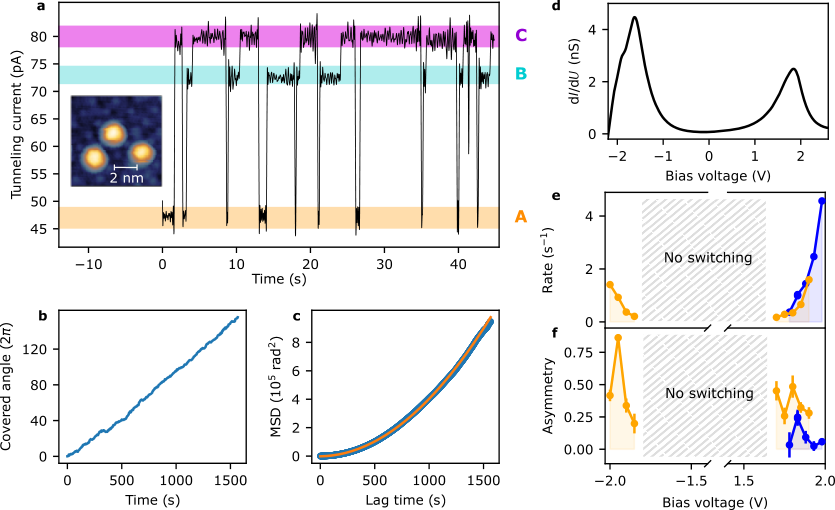
From the sequences of transitions, the authors estimated the rotor’s rotation rate at roughly 0.1–1 full revolution per second. The motion was intermittent: between rapid turns, the rotor would pause in one of its stable positions.
What Happened When the Current Was Reversed?
When the researchers reversed the voltage between the gold surface and the tip, the electrons passed through the molecule in the opposite direction. The measured current levels changed as well. For the same rotor orientation, for example, the current level could be high before the polarity reversal and lower afterward. The researchers first had to establish which signals at opposite polarities corresponded to the same molecular orientation. Only then could they compare the sequence of turns before and after the current was reversed.
In the supplementary information for the journal article, the researchers describe how they checked the correspondence between current levels at opposite polarities. In 87 of 99 polarity reversals, they could match signals from the same rotor positions (Supplementary Fig. 34). This allowed them to compare the sequences of turns for the two current directions. Across five sets of measurements on three molecules, the preferred sequence of turns remained the same after the polarity reversal (Supplementary Table 1). The fifth set, however, provided weaker evidence: the statistical confidence in the directional preference was 69.87% at positive polarity and 82.26% at negative polarity.
The rate at which the rotor switched between stable positions depended on the applied voltage. In the series of measurements examined, no switching was recorded between about −1.7 and +1.8 volts. Outside that range, transitions appeared and generally became more frequent as the magnitude of the voltage increased. One possible explanation involves conductance resonances: at certain voltages, electrons pass more readily through particular molecular states. The researchers observed such resonances near −1.8 and +1.9 volts. The directional preference peaked nearby: at about +1.8 and −1.95 volts in one series of measurements and at about +1.83 volts in another. According to the calculations, the current at these voltages flowed mainly through the nearest helical states of the carbon axle. At still higher voltage magnitudes, other states also contributed to transport, so the number of turns could increase even as the preference for one direction weakened.
To move between stable positions, the rotor has to overcome an energy barrier. The authors calculated this barrier for the complete molecule, including its three-legged platform: about 11.7 millielectronvolts, or 0.012 electronvolts. Yet appreciable switching began at voltage magnitudes of around 1.8 volts. The energy an electron can gain across that potential difference is about 150 times the barrier height, but that does not mean all of it is transferred to the rotor. The barrier height alone therefore cannot explain the observed threshold. Its proximity to the conductance resonances suggests that the electronic states of the molecular axle are likely to play a role.
Where Does the Twist in a Straight Bond Come From?
Two carbon atoms joined by a triple bond form the molecule’s axle. Although the atoms lie on a straight line, the electronic states near the axle can have a helical shape. In quantum chemistry, these states are described by orbitals, which characterize the distribution of electrons and their energies. In a symmetric triple bond, the two orbitals are degenerate (equal in energy) but have different orientations about the axis. The chiral rotor influences how these two orbitals mix. The authors’ quantum chemical calculations show that this gives rise to electronic states with a helical twist.
The helical shape describes the spatial pattern of the electronic wave function and its associated current. The carbon atoms themselves still lie on a straight axis, and electrons do not follow the drawn helix like beads sliding along a wire. Figure 3 shows the shape schematically to illustrate the properties of the calculated electronic states.
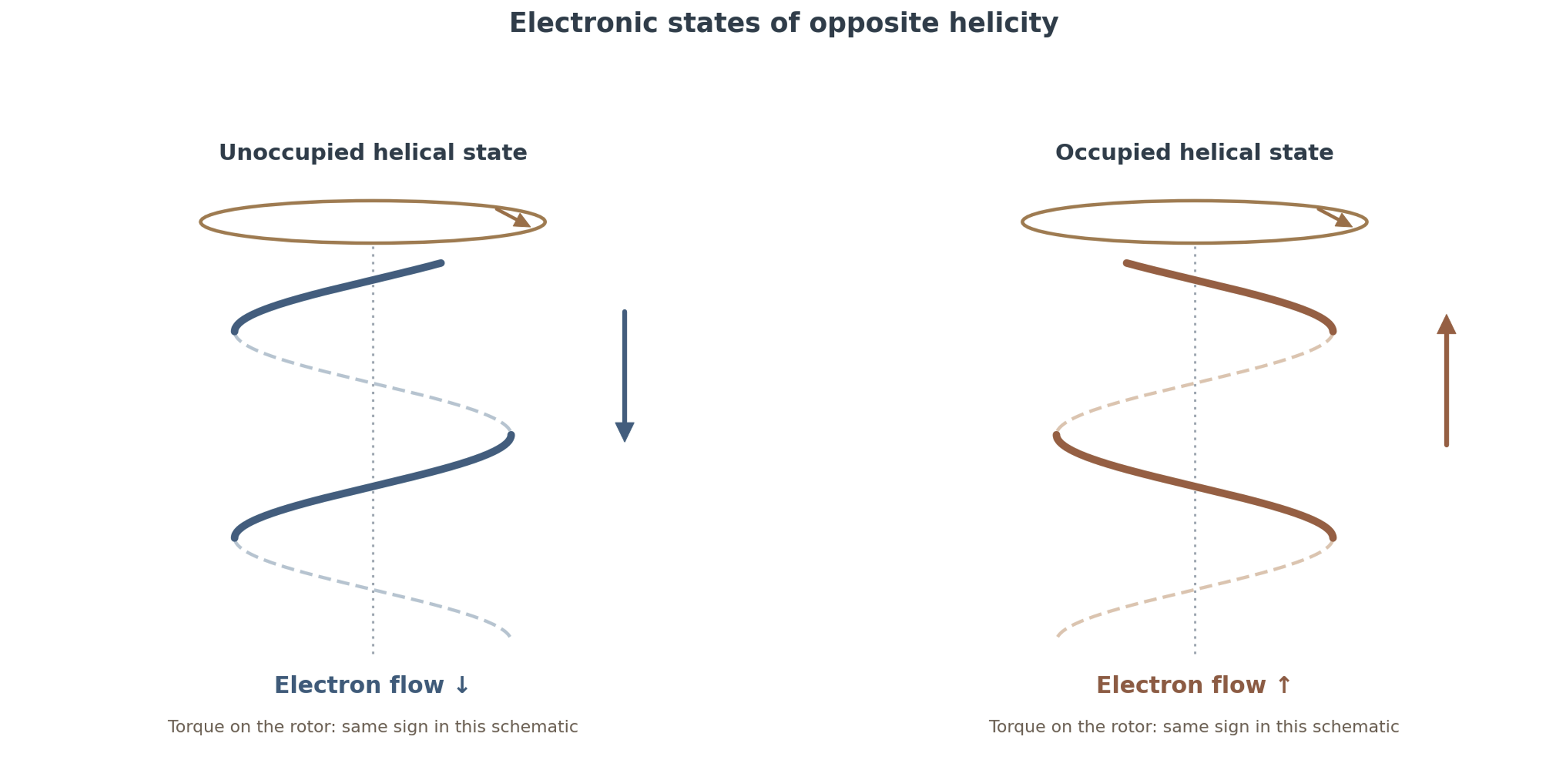
Angular momentum characterizes rotational motion. An electron has an intrinsic form of angular momentum called spin. Here, the researchers consider orbital angular momentum, which is associated with the motion of electrons through space. In the model, electrons gain orbital angular momentum as they enter a helical state of the axle from an electrode and lose it as they leave. This exchange of angular momentum can exert a torque on the rotor. The experiment did not measure the torque directly.
For their electron transport calculations, the authors used a simplified, symmetrized model of the molecule. They kept the chiral rotor and the carbon axle but omitted the three-legged platform. This allowed them to examine how the electric current and the transfer of orbital angular momentum depend on electron energy. They calculated the barrier between rotor positions separately, using the complete structure with the platform. In a separate theoretical study, Štěpán Marek and colleagues examined in detail how the helical structure of the orbitals relates to the direction of rotation. What the experiments recorded directly, however, was the change in current. They did not directly observe the spatial form of the electronic states.
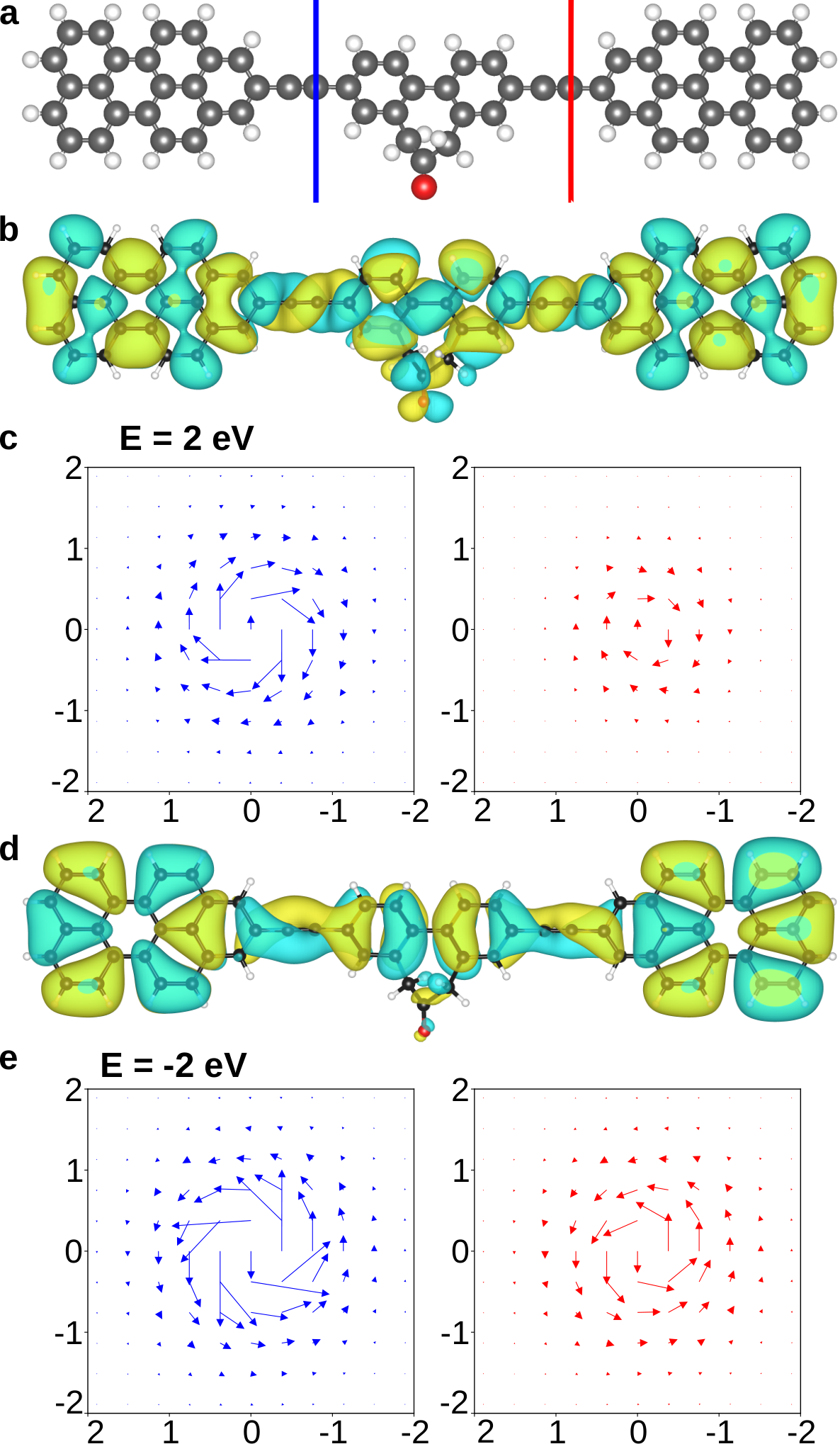
In their theoretical model of electron transport through the molecule, the authors distinguish between occupied and unoccupied molecular orbitals. These terms describe whether the orbitals are occupied by electrons before a voltage is applied. At positive sample bias, the nearest unoccupied helical states make the main contribution to transport; at negative sample bias, the nearest occupied helical states do. The two sets of states have opposite handedness. Reversing the polarity therefore reverses the electron flow and changes the states through which it flows. According to the authors’ calculations, the two changes together leave the sign of the torque on the rotor unchanged. This is consistent with the experimental observation that the preferred sequence of turns did not change. Unlike ratchet mechanisms that rely on transitions through excited states, this model attributes directionality to the transfer of orbital angular momentum. The authors also considered other explanations, including a direct effect of the electric field, and presented arguments against them.
What the Experiment Left Open
The experiments were conducted on individual molecules anchored to gold, in ultrahigh vacuum and at low temperature. The researchers inferred the turns from changes in tunneling current; they did not measure the mechanical work done by the motor against an external load. It is still unknown whether such rotors can work together or how they would behave under conditions different from those of the experiment.
In the measurements analyzed, the rotor’s preferred direction of rotation remained the same when the voltage polarity was reversed. According to the calculations, the transfer of orbital angular momentum through helical electronic states could explain this observation. A direct measurement of the resulting torque would help test the proposed mechanism and clarify the limits of its applicability.
Tests on molecules with different structures will help establish how widely this mechanism applies. Two other questions remain: does the rotor retain its chiral form at higher temperatures, and can it be made to turn without the tip of a scanning tunneling microscope? Such studies will help identify which features of the rotor’s shape and the electronic structure of its axle need to be taken into account when designing new molecular rotors.
Sources
- Skolaut J., Marek Š., Balzer N., Camarasa-Gómez M., et al. (2026). Unidirectional rotation in a molecular motor driven by angular-momentum transfer via helical orbitals. Nature Chemistry. DOI: 10.1038/s41557-026-02264-w.
- Skolaut J., Marek Š., Balzer N., Camarasa-Gómez M., et al. (2025). An electrical molecular motor driven by angular momentum transfer. Preprint, version 1, March 7, 2025. arXiv:2503.05351v1.
- Skolaut J., et al. (2026). Supplementary Information for “Unidirectional rotation in a molecular motor driven by angular-momentum transfer via helical orbitals.” Nature Chemistry. Supplementary Figs. 1–37, Table 1, methods, and results. Supplementary PDF.
- Skolaut J., Gerhard L., Wulfhekel W. (2026). Unidirectional rotation in a molecular motor driven by angular-momentum transfer via helical orbitals. Zenodo. [Dataset: raw STM measurements.] DOI: 10.5281/zenodo.21281784.
- Camarasa-Gómez M., Marek Š., Korytár R. (2026). Unidirectional rotation in a molecular motor driven by angular-momentum transfer via helical orbitals. Zenodo. [Dataset: molecular structures, orbitals, and the energy barrier.] DOI: 10.5281/zenodo.21281269.
- Korytár R., Evers F. (2023). Current-induced mechanical torque in chiral molecular rotors. Beilstein Journal of Nanotechnology 14, 711–721. DOI: 10.3762/bjnano.14.57.
- The Royal Swedish Academy of Sciences (2016). The Nobel Prize in Chemistry 2016. Official press release, October 5, 2016. Academy website.
- Tierney H. L., et al. (2011). Experimental demonstration of a single-molecule electric motor. Nature Nanotechnology 6, 625–629. DOI: 10.1038/nnano.2011.142.
- Marek Š., Wulfhekel W., Evers F., Korytár R. (2026). Helical orbitals in electrical unidirectional molecular motors. Physical Review Research 8, 013270. DOI: 10.1103/zx3k-hkph.
- Marek Š., Camarasa-Gómez M., Korytár R. (2026). Unidirectional rotation in a molecular motor driven by angular-momentum transfer via helical orbitals. Zenodo. [Dataset: orbital angular momentum calculations for the idealized model.] DOI: 10.5281/zenodo.20846643.
- Livoreil A., Dietrich-Buchecker C. O., Sauvage J.-P. (1994). Electrochemically Triggered Swinging of a [2]-Catenate. Journal of the American Chemical Society 116(20), 9399–9400. DOI: 10.1021/ja00099a095.
- Bissell R. A., Córdova E., Kaifer A. E., Stoddart J. F. (1994). A chemically and electrochemically switchable molecular shuttle. Nature 369, 133–137. DOI: 10.1038/369133a0.
- Koumura N., Zijlstra R. W. J., van Delden R. A., Harada N., Feringa B. L. (1999). Light-driven monodirectional molecular rotor. Nature 401, 152–155. DOI: 10.1038/43646.