Static Electricity: New Research Into the Mechanisms of Contact Electrification

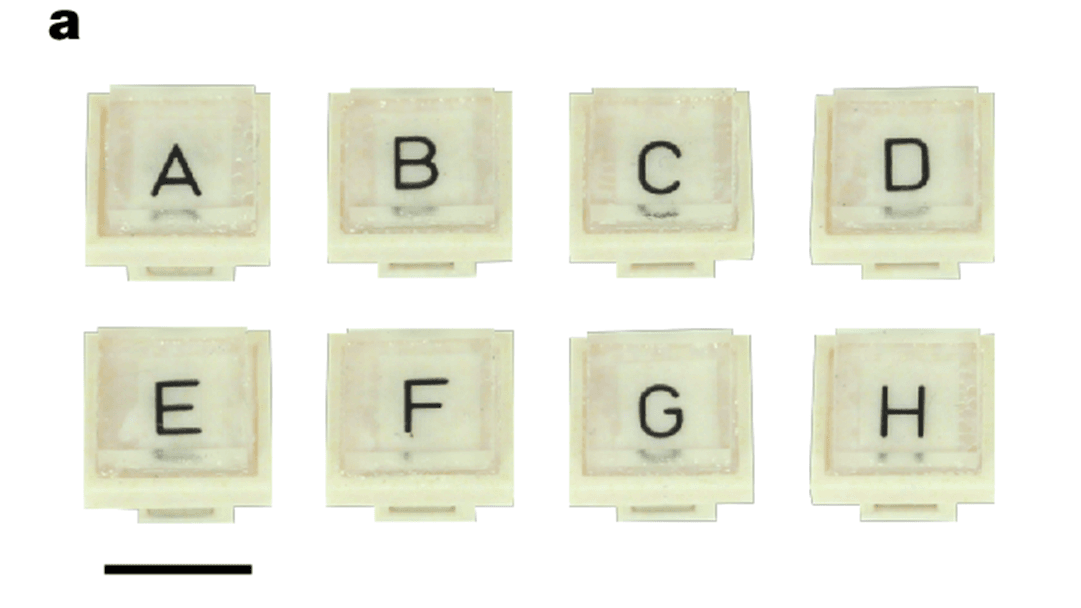
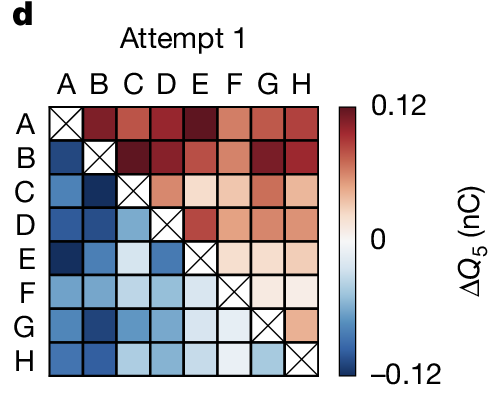
Which of two pieces of silicone will be positively charged when they are pulled apart? For Scott Waitukaitis’s group, this question took a particularly intriguing form. The physicists cut all eight samples from a single slab of transparent silicone. They first discharged the samples and then pressed them together in pairs. After separation, one sample invariably carried a positive charge and the other a negative charge. It was much harder to predict whether a particular sample would become positively or negatively charged. Over time, enough experiments had accumulated for a pattern to emerge. The sample that had previously made more contacts with others usually charged negatively relative to its partner.
In February 2025, Juan Carlos Sobarzo of Waitukaitis’s group and his colleagues published the results of these experiments in Nature. In 2026, Galien Grosjean and other researchers in Waitukaitis’s group investigated how a thin layer of material deposited from the air affects the charging of glass. In October of the same year, Andris Šutka, Linards Lapčinskis and their colleagues showed that an external electric field can be used to control the sign of the charge on a polymer surface.
From amber to the puzzle of identical surfaces
Amber rubbed with wool can attract lightweight objects. This has been known since antiquity. In 1600, the English physician William Gilbert described experiments with amber and other substances in his book De magnete (On the Magnet), and distinguished electrical attraction from magnetic attraction. Physicists later distinguished positive and negative electric charge and learned to use this distinction to explain both spark discharges and the attraction of lightweight objects to a charged surface.
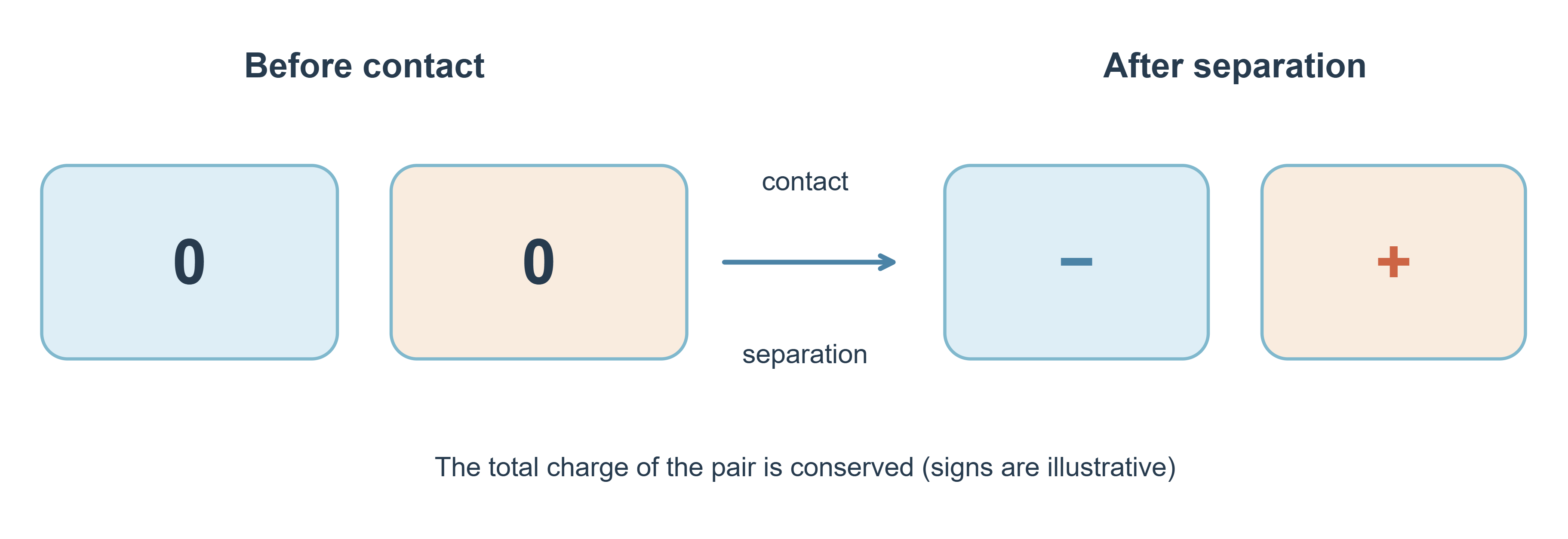
Static electricity refers to phenomena involving the accumulation and retention of electric charge on the surfaces of materials or inside them. One way to charge materials is to bring two of them into contact and then separate them. When charge is redistributed only between the two objects, one may become negatively charged and the other positively charged. The total charge of the two objects is conserved. Friction can enhance charging through repeated contacts, although even a single contact is sometimes enough.
For a familiar example of electrostatic polarization, consider a rubbed plastic comb drawing a scrap of paper toward it even though the paper is electrically neutral. The comb’s charge shifts the charges within the paper slightly, and the attraction on the part nearer the comb is stronger than the repulsion on the part farther away. Charge has an observable effect in this experiment, but the reason that contact leaves one insulator positively charged and the other negatively charged is still unexplained by this example alone.
Predicting the sign of the charge after two dielectrics touch remains difficult because the mechanisms by which charge passes between them have yet to be settled. Conduction electrons move comparatively freely through a metal. In glass or plastic, both of which are dielectrics, charge can instead remain close to the place where the two objects met. The question is what actually travels from one object to the other. Electrons are one possibility; ions and even charged molecular fragments are also under investigation. Jia Tian and colleagues discuss, in their review, the experimental methods physicists use to tell these possible mechanisms apart.
In 1757, the Swedish researcher Johan Carl Wilcke arranged glass, paper, sulfur and other substances in a series, now known as a triboelectric series, according to how they charged on contact. The positions of two substances in such a series could indicate which was more likely to become positively charged. For modern synthetic materials, the order depends on the experimental conditions. But what can chemical composition reveal if the experimenter has cut both samples from the same slab? Their composition gives no clue as to which one will become positively charged. The clue, then, had to lie in what had happened to the samples before measurement. This dependence on the samples’ history was precisely what Sobarzo and his colleagues investigated.
How previous contacts change the charge on silicone
For Juan Carlos Sobarzo, Felix Pertl, Daniel Balazs and their colleagues, the material of choice was polydimethylsiloxane, a soft silicone polymer. One pair of samples after another was pressed together under a controlled force, then separated so that the charge on each sample could be measured with an electrometer. Before starting the next series, the team discharged the samples to keep charge left over from the previous experiment out of the new measurements. What repeatedly distinguished the sample that charged more negatively was its longer history of contact: it had touched other samples more often than its partner had. This gave the researchers a way to construct a triboelectric series. They could prescribe how the samples would charge relative to one another by choosing the order in which contacts took place, although that prescribed order could break down when the test sequence changed.
Sobarzo and his colleagues also tested whether the silicone surface itself changes after repeated contacts. To do so, they compared the surface chemistry and topography of two groups of samples: pristine samples and samples that had been pressed together repeatedly. The methods used revealed no appreciable changes in surface chemistry. Atomic force microscopy, which uses a very sharp probe, showed that after repeated contacts the surface became slightly smoother at the smallest scales. Experiments with deliberately roughened samples also showed that surface topography affects charging.
How air changes the charging of identical glass samples
In March 2026, Galien Grosjean and colleagues from Waitukaitis’s group published a new paper in Nature. Their experiments used a sphere about half a millimeter in diameter and a flat plate, both made of high-purity fused silica. This material is an amorphous form of silicon dioxide: its atoms do not form the ordered crystal lattice characteristic of natural quartz.
An acoustic trap provided a way to measure charging after collisions without the sphere making extra contact with a sample holder. Its ultrasonic vibrations held the small sphere in the air above the plate. For each collision, the researchers switched off the trap briefly, let the sphere strike the plate and then caught it again. An alternating electric field of known strength was applied afterward, and the sphere’s resulting motion gave both the magnitude and the sign of its accumulated charge.
Initially, the fused-silica sphere and plate had the same preparation and were both stored in air, but the charge acquired by the sphere could be positive in one experiment and negative in another. The next step was to clean just one of them, either with plasma or by baking, while leaving the other without additional treatment. The cleaned sample then charged more negatively relative to the untreated one. If the plate was the sample cleaned, the sphere consequently acquired a more positive charge in collisions with it. Over the next several hours, repeated measurements showed the average charge acquired in those collisions gradually settling toward a new stable value.
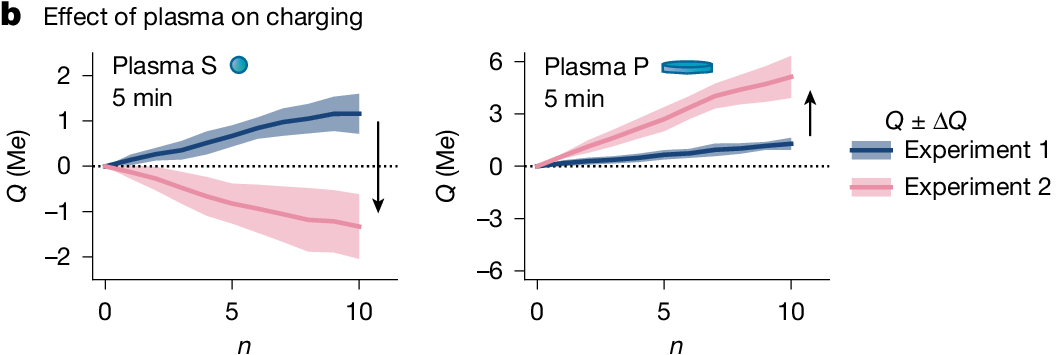
Glass that looks clean still slowly collects carbon-containing molecules from the laboratory air, the layer called adventitious carbon. Baking or plasma treatment removed a substantial part of that layer, after which the team could follow its return by measuring the composition of the outermost atomic layers and recording the characteristic vibrations of chemical bonds. At the same time, they tracked the average charge transferred to the sphere per collision with the plate. It changed markedly immediately after cleaning, then settled at a new stable level. This happened over roughly the same time as the surface layer grew back. In about ten hours, the charge moved halfway from its value immediately after cleaning to its new steady-state level. The time required varied between experimental runs. Even after prolonged exposure to air, however, the average charge didn’t always return to its pre-cleaning value.
The scientists also considered water adsorbed from the air onto glass as a possible explanation for the changes. The timing did not fit as well: the water layer returns much faster than the surface’s electrical behavior recovers. Moreover, some models based on adsorbed water predicted the opposite sign of charge to the one measured. Adventitious carbon better matched the observations for the oxides under study, and the same tests were also carried out with other oxides, including aluminum oxide. Reproducing such experiments requires a record of the cleaning method and of the interval between cleaning and measurement. During that interval the surface chemistry can change, even though the plate still looks the same.
How an electric field changes the charge on polymers
Experiments began with two identical polystyrene films, which were pressed together and separated repeatedly while a voltage between −3 and +3 kilovolts was applied to a metal electrode behind one film. A protective plastic layer separated this electrode from the test polymer, preventing charge from passing directly from the metal into the sample. After the contacts, the voltage was switched off and the film was moved toward a separate measurement electrode and away again, without touching it. An electrometer recorded the current induced in that electrode’s circuit by the movement, providing a measure of the film’s charge. Tests with other polymers explored how broadly the effect applied. Andris Šutka, Linards Lapčinskis and their colleagues at Riga Technical University, RMIT University and the University of Melbourne described these experiments in Nature Communications on Oct. 15, 2026.
The authors attributed the initial part of the signal mainly to polarization of the material. Under an external field, bound charges within the dielectric shift slightly. As this contribution weakened, the measured signal passed through zero and changed sign. The researchers associated the slowly decaying signal with charge accumulated during contact between the polymer films. They were able to control the magnitude of this charge by varying the strength of the external field, and its sign by changing the field’s direction.
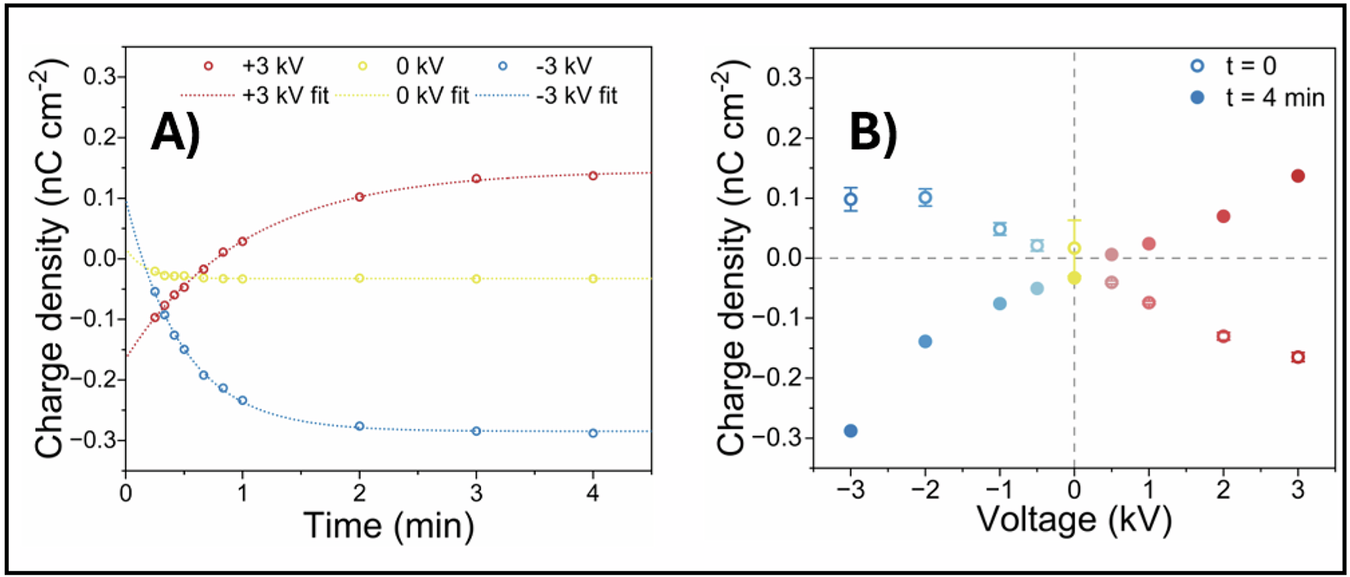
The authors kept the films slightly apart, with a small air gap between them, to check whether contact was necessary for charge to persist. Even with that separation, the field produced a measurable response, which decayed rapidly when the voltage was switched off. The persistent charge and the sign reversal seen after contact were both absent. In another control, ethanol was used to rinse the polystyrene, and the residual charge fell sharply. This suggests a role for charged species at the surface, but the ethanol test alone cannot identify them. These controls let the researchers distinguish charge retained after contact between the films from transient polarization.
Where might a field able to affect charge transfer arise during ordinary contact? The protrusions, or asperities, on rough surfaces deform when the surfaces meet, and the strain is not the same throughout the contact region. These spatial differences in strain are called strain gradients. They can polarize a dielectric even when its structure has a center of symmetry. The effect is known as flexoelectricity, and how large it is depends on the material as well as on how it deforms. To examine this possibility, the authors used COMSOL to simulate a polytetrafluoroethylene (Teflon) asperity pressed against a flat substrate. Their two-dimensional calculation followed the deformation together with the polarization and electric field it produced. With a radius of curvature of 250 nanometers, the average field calculated near the asperity was approximately 1.9 volts per meter; for a radius of 50 nanometers, the corresponding value was 4.3 volts per meter. These fields are comparable to the approximately 2 volts per meter calculated for polystyrene with 3 kilovolts applied externally. The model thus offers an explanation for how rough surfaces in contact could produce a field that affects charge transfer. The sign of the charge left on the polymer films, measured after the voltage was switched off, depended on which way the external field had pointed during their repeated contacts. Temporary polarization of the material is therefore insufficient, on its own, to account for this result.
What the three studies have changed
The silicone results depended on the number and order of previous contacts. With glass, the relevant conditions were the cleaning method, the time that had passed since cleaning and how the samples were stored. In the polymer-film work, the electric field during contact was crucial.
These studies by Sobarzo, Grosjean and Šutka show that contact electrification depends both on the material and on the circumstances of the experiment. A record of those circumstances has to accompany the material name and the description of the measurements; otherwise, results from different laboratories can’t be meaningfully compared. So the different results obtained with identical materials reflect each sample’s contact history, surface condition and exposure to an electric field during contact, rather than an inherently unpredictable charging process. Taking these conditions into account can explain the differences between laboratories. The identity of the particles carrying charge between the surfaces, and how the contact conditions affect their motion, remain open questions. Resolving them would connect the measured sign of the charge to processes at the interface between materials and make that sign something that can be predicted rather than guessed.
Sources
- Sobarzo J. C., Pertl F., Balazs D. M. et al. Spontaneous ordering of identical materials into a triboelectric series. Nature. 2025. Vol. 638, No. 8051, pp. 664–669.
- Grosjean G., Ostermann M., Sauer M. et al. Adventitious carbon breaks symmetry in oxide contact electrification. Nature. 2026. Vol. 651, No. 8106, pp. 626–631.
- Šutka A., Lapčinskis L., Linarts A. et al. Electric fields control static charge during contact-friction-separation. Nature Communications. 2026. Vol. 17. Article 9971.
- Gilbert W. De magnete, magneticisque corporibus, et de magno magnete tellure; physiologia nova, plurimis et argumentis et experimentis demonstrata. Londini: Petrus Short, 1600. Book II. Historical primary source; digital copy of the Smithsonian Libraries volume in the Internet Archive.
- Tian J., He Y., Li F., Peng W., He Y. A comprehensive review on the mechanism of contact electrification. Journal of Materials Chemistry A. 2025. Vol. 13, No. 4, pp. 2505–2536. Review; first published online on December 6, 2024.
- Herr W. Wilcke (Wilke, Vilcke), Johan(n) Carl (Johannes Carolus). Neue Deutsche Biographie. 2024. Vol. 28, pp. 122–123. Historical and biographical article; online version in Deutsche Biographie.