Jupiter's Aurora Favors the North in One Place and the South in Another
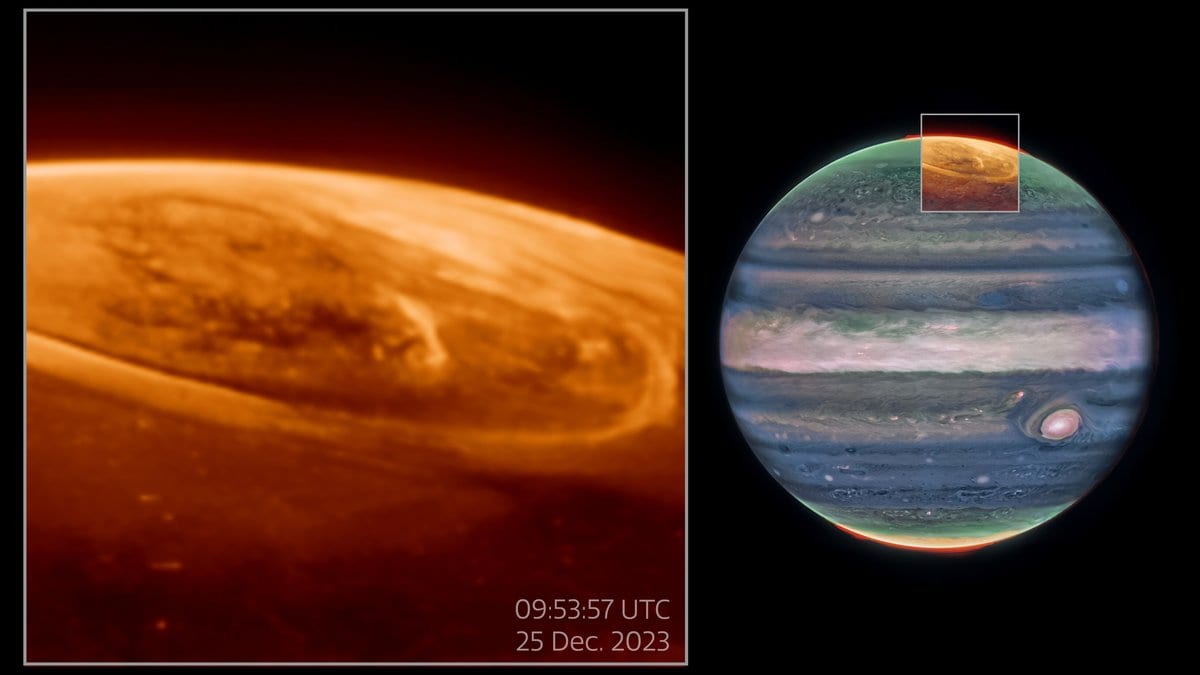
A survey of measurements from NASA's Juno spacecraft across 64 close passes of Jupiter, the third through the 66th, finds that the planet's northern and southern auroras do not receive the same amount of electron energy, and that which hemisphere receives more reverses between the aurora's two main regions.
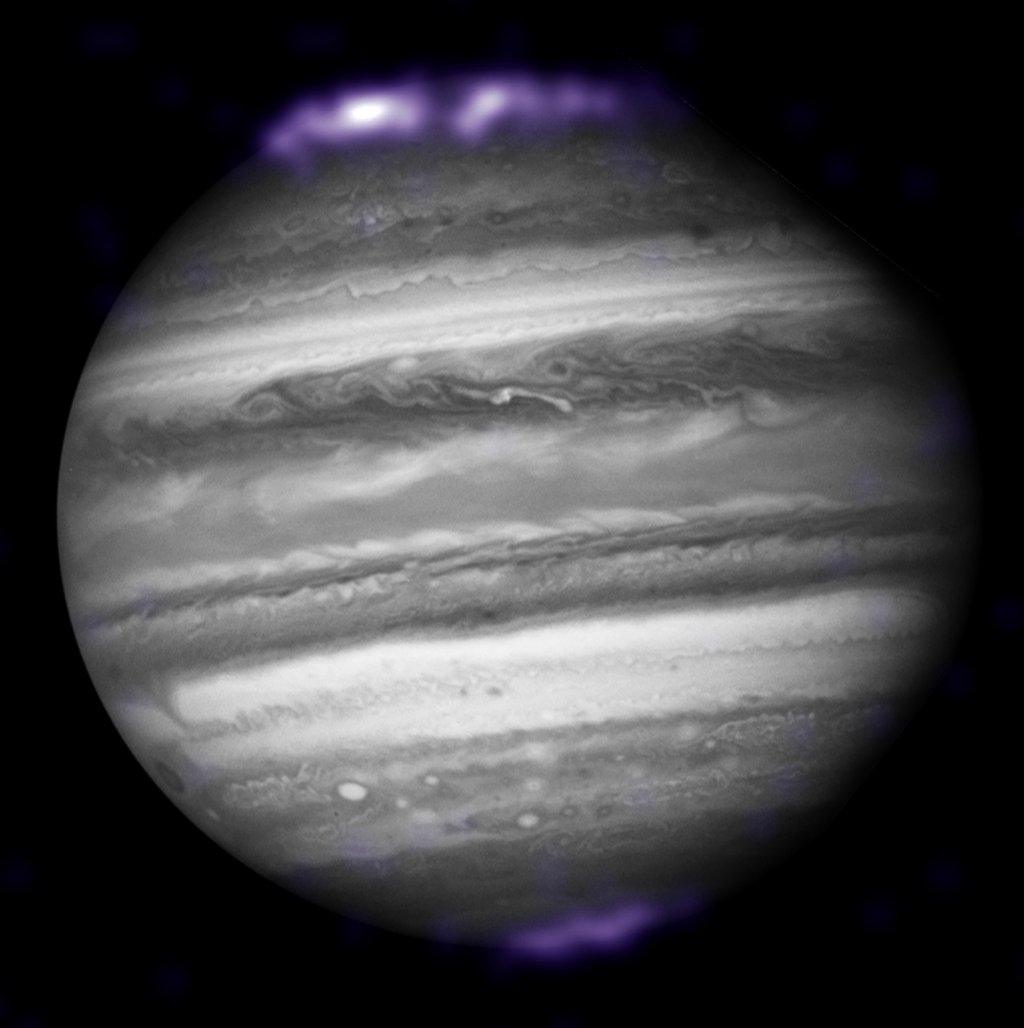
Bilal Benmahi and colleagues set out the result in a preprint posted Nov. 16, 2026, that has not been peer reviewed. The team writes that models of Jupiter's upper atmosphere should not use the same electron input in the north and the south, and that models of how the planet's magnetic field feeds the aurora have generally treated the two hemispheres as equivalent.
Jupiter's aurora splits into a bright ring, the main emission, and the region it encloses above the magnetic pole, the polar emission. The team reports that in the polar emission the median energy delivered by electrons falling into the atmosphere was 2.5 times as high in the north as in the south, or two and a half times as much energy arriving over the northern polar cap. In the main ring the imbalance runs the other way, at a north-to-south ratio of 0.65, with the south taking about half again as much as the north.
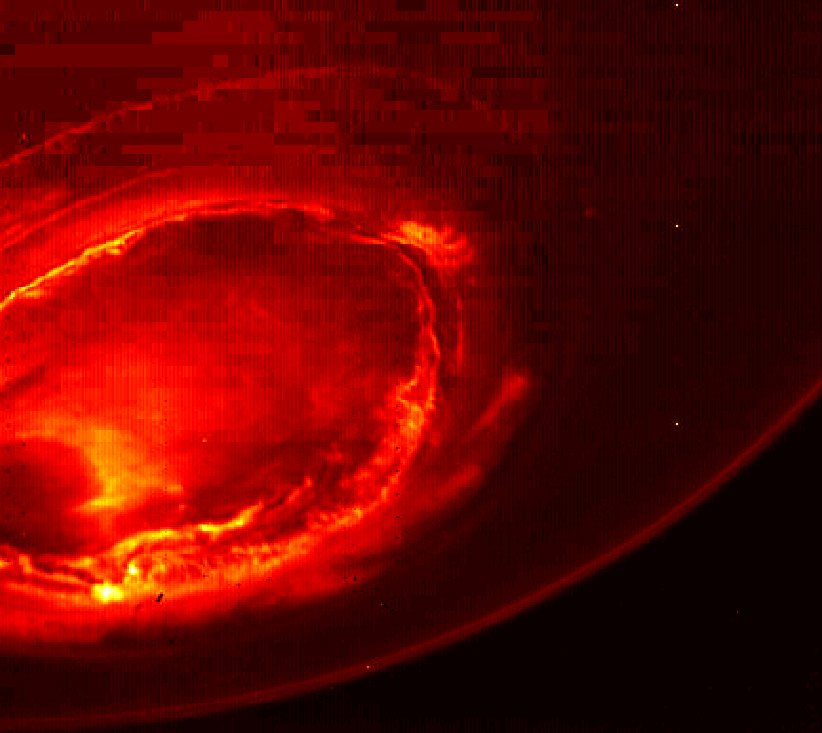
The mean energy of the individual electrons, by contrast, peaked at nearly the same value in both hemispheres in every region, between roughly 150,000 and 280,000 electron volts. Benmahi and colleagues read that as evidence that the difference lies in the number of electrons arriving rather than in how strongly they are accelerated: a hemisphere accelerating electrons harder would show higher electron energies, and neither does. They also find that electrons in the polar region carry more energy away from Jupiter than toward it in both hemispheres, which they read as a sign that the imbalance is set before the electrons are accelerated.
The figures are medians drawn from Juno's Jupiter Energetic particle Detector Instrument, or JEDI, which counts electrons above about 30,000 electron volts. Because of Juno's orbit, the northern and southern measurements were not taken at the same time. The authors report that which hemisphere dominated did not change when the ratios were recomputed from smaller subsets of passes. The JEDI measurements are public through NASA's Planetary Data System, and the averaged fluxes behind the paper's figures are posted on Zenodo.
Sources
- arXivPreprint